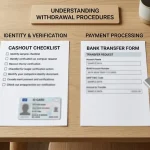
Payment networks set delivery windows, but casino approval and first-withdrawal identity checks can add a separate stage.

A withdrawal has a route before it has a delivery time. The method determines which payment network carries the funds and what kind of processing window applies. Selecting an option labelled “instant” does not, by itself, establish when money will arrive: the label may describe only one part of the transfer.
A specialist review of payment options for Australian-facing real-money platforms describes debit cards, PayPal and Skrill e-wallets, bank transfers and, at some operators, cryptocurrency. That is a description of reported availability, not a stable menu across providers. Credit cards are not an available route for online gambling payments in Australia: operators must not accept them. The broader legal position also matters: Australian law prohibits operators from providing real-money online casino games to people physically located in the country. Payment comparisons should not be mistaken for confirmation that a service is lawful or available to Australians.
E-wallets and bank transfers are not interchangeable simply because both can receive a withdrawal. A specialist review describes e-wallet transactions as potentially completing within hours rather than days. Another gives a typical processing window of within a day for e-wallet withdrawals. These are reported timings, not a promise for any particular transaction; provider procedures and the operator’s handling can change the result.
A “no ID verification” claim should not be taken as a promise that a casino will never request documents. Use this list as a starting point, and check each operator’s current withdrawal terms before depositing.
Bizzo Casino
Bizzo Casino is listed with a Curacao Gaming Control Board license under TechSolutions Group N.V. The supplied information does not specify its identity-check or withdrawal procedures.
Kingmaker
Kingmaker lists crypto payouts at about 90 minutes and fiat payouts at 1–5 days, with a minimum deposit of A$30. The supplied information does not state whether identity checks may be required.
Vegaz Casino
Vegaz Casino lists Curacao OGL/2024/1335/0780 and a minimum deposit of EUR 20. No withdrawal timing or verification details are provided.
JeetCity Casino
JeetCity Casino is listed with a Curacao eGaming license under Dama N.V. The supplied information does not describe its withdrawal or identity-verification process.
Thor Casino
Thor Casino lists a Curacao license with Antillephone N.V. (Versus Odds B.V.) and a minimum deposit of EUR 20. No payout or verification details are provided.
LevelUp Casino
LevelUp Casino lists Curacao eGaming OGL/2023/174/0082 under Dama N.V., with a minimum deposit of A$15. Its withdrawal speed and identity-check requirements are not specified.
LuckyVibe
LuckyVibe is listed with Curacao Gaming Control Board OGL/2023/176/0095 under Hollycorn N.V. The supplied information does not detail its withdrawal or verification policies.
JustCasino
JustCasino is listed with a Curacao Gaming Control Board license. No further details about payouts or identity verification are provided.
Ricky Casino
Ricky Casino lists crypto payouts in under an hour and PayID payouts in 1–3 business days. Its minimum deposit is A$20, or A$30 to qualify for the bonus; identity-check details are not specified.
Wild Tokyo
Wild Tokyo lists a Curacao license, crypto payouts in 30–60 minutes, fiat payouts in 1–5 days, and a minimum deposit of A$10. The supplied information does not state its identity-verification requirements.
Bank transfers have a different profile. A specialist review reports that a traditional transfer can take as long as five business days to complete. A separate review describes bank transfers as taking several days. The calendar matters: a business-day estimate does not mean the same thing as elapsed time across a weekend or public holiday. The method can therefore make a visible difference even when the withdrawal amount and request are unchanged.
For card payments, the distinction between debit and credit is material in Australia. Debit cards appear in descriptions of available payment routes, but credit cards must not be accepted for online gambling services. It is not sound to treat the two as a single card option or infer that a withdrawal can return through either one. The route available for receiving funds depends on the operator’s stated payment arrangements.
Some specialist reviews also report instant banking services through providers such as POLi at some real-money platforms. That is a reported feature, not a guarantee that every casino offers it or that a withdrawal reaches a bank account instantly. “Instant banking” can describe a payment connection or transfer function; it should not be read as a full end-to-end withdrawal time.
The payment logo shown on a cashier page answers only part of the practical question. It indicates a route the operator says it supports, but not necessarily whether that route can be used for both deposits and withdrawals, what conditions apply, or how quickly a particular payout will be completed. Prepaid cards and vouchers such as Neosurf, for instance, are described in a specialist review as generally suitable for deposits rather than withdrawals. A deposit method may therefore leave the account without being a usable cashout method.
The operator’s own payment terms are the relevant place to establish which routes are supported and what limits, fees and processing times apply. Those details can be method-specific. A bank transfer may have a different minimum or maximum from an e-wallet transfer; a fee may also change the amount ultimately received. Withdrawal amounts can be subject to operator policy, and published conditions matter more than a broad claim that a platform has fast payments.
Payment speed is affected by several elements, not merely the name of the method. A specialist review identifies multiple factors in the timing of online-casino payments. In practical terms, that makes a single headline estimate a poor basis for comparing routes unless it is clear what part of the transaction it measures. “Processed” might refer to the operator handling a request, while “received” refers to the funds appearing at the destination. Those are not equivalent endpoints.
Reported processing windows can range from within hours to within a day.
Traditional transfers can take several days, with some reports indicating up to five business days.
Listed as an available payment route for withdrawals in Australian-facing platforms.
Services like POLi may be offered, but this describes the connection rather than a guarantee of instant end-to-end delivery.
A useful comparison begins with the withdrawal destination that the payment method actually supports. E-wallets may have a shorter reported delivery window than traditional bank transfers, while bank transfers can extend across several business days. Debit cards and instant banking services may appear among the options, but their presence does not establish the timing for a specific withdrawal. Cryptocurrency is also reported as an option at some operators, though its transaction characteristics are a separate question from the overall casino payout process.
The sensible unit of comparison is therefore the complete method description: whether it accepts withdrawals, the operator’s processing window, the payment provider’s delivery time, any fee, and the applicable withdrawal limits. A method can be quick at one stage and still produce a longer overall wait. A button marked “withdraw” starts a request; it does not control every payment network or make every route equivalent.
No payment method turns the phrase “no verification” into a timing measure. The payment route indicates how funds might travel, not whether a real-money casino service is lawful in Australia or whether a particular transaction will be completed on a particular schedule. In this market, the legal restriction on operators providing online casino games remains the first condition; method comparisons describe payment mechanics, not an endorsement of the service.
A “no verification” label describes a claim made by an operator; it does not establish that identity checks will never be required. In particular, it cannot be treated as a promise that funds will be released without confirming who owns the account. A specialist review reports that first withdrawals can prompt identity requests, and an operator’s own terms may reserve the right to ask for documents when a payout is requested.
That distinction matters because account access and access to funds are separate stages. Registration may involve little visible scrutiny, while a later request to withdraw can lead to a check of the account holder’s identity. If documents are requested, the withdrawal can remain unresolved until the operator has reviewed them. The “no verification” wording does not remove that condition; at most, it describes what happened before the check arose.
For a person assessing an advertised no-ID claim, the relevant question is therefore not simply whether an account can be opened without documents. It is whether the operator’s written rules explain when identity evidence can be required and what happens to a pending withdrawal while the review is incomplete. A broad headline is weaker evidence than the terms governing the point at which funds become accessible.
Identity checks can also involve more than supplying a name. The operator may request documentation to establish that the person named on the account is the person seeking the funds. The exact requirements depend on the operator’s procedures, so a generic “no KYC” statement cannot be read as a complete description of the withdrawal process. If the terms retain a right to verify identity, that right remains relevant even when no documents were requested during registration.
Legal Restriction
Under the Interactive Gambling Act 2001, it is unlawful for operators to provide real-money online casino games to people physically located in Australia.
Completing verification early can significantly speed up later withdrawals by removing a potential document request from the point when funds are being claimed. That does not guarantee an immediate release or eliminate every possible review. It changes the sequence: identity evidence is considered before a withdrawal request rather than becoming an outstanding condition after one has been submitted. A claim of no verification is therefore not equivalent to a claim of unrestricted access to winnings.
There is a separate legal issue for people physically in Australia. Under the Interactive Gambling Act 2001, operators must not provide real-money online casino games, including slots and table games, to customers in Australia. Foreign branding or a “no verification” claim does not change that legal position, and offshore casino services are actively blocked and enforced against. The term “no verification casino Australia” should not be mistaken for a description of a lawful local casino service.
This is why the wording needs to be read as an operator’s marketing claim, not as proof of a safe or reliable cashout arrangement. Where an offshore service accepts a withdrawal request, its own identity rules may still apply, but that does not make the service legal to provide in Australia. Nor does a lack of an initial document request establish that the account has passed all checks. Those are different propositions, and neither should be inferred from a short label.
A useful comparison is between “no document requested at registration” and “no identity check under any circumstances.” The first describes an event that may have occurred; the second is a much broader promise. If the withdrawal terms allow the operator to request proof of identity, the broader promise is not supported by the terms. A first withdrawal is a point at which the gap can become visible: funds may be requested, then held pending an identity review.
Accordingly, “no ID verification withdrawal” should not be read as a guarantee that a withdrawal can be completed without identity checks. In Australia, the legality of the underlying online casino service is the prior issue; an operator’s marketing language cannot alter it. The practical distinction remains straightforward: an account may appear accessible without documents, but a claim to funds can still bring an identity check into play.
A bonus is not simply extra cash added to a balance. Its wagering condition determines which funds must be played through before a withdrawal can be made. The key distinction is whether the requirement applies to the bonus alone or to the deposit and bonus together. Those rules can produce substantially different amounts of qualifying play, even when the advertised bonus looks identical.
A specialist review describes both approaches and regards a bonus-only requirement as preferable. The reason is arithmetic: when wagering applies only to bonus funds, the deposited amount is outside that calculation. When the deposit is included, more of the balance is subject to the condition. The headline value of the offer cannot settle which arrangement applies; the wording of the terms does.
The relevant question is not merely whether a bonus has wagering attached. It is what the operator counts as the wagering base. A bonus-only rule uses the bonus portion for that purpose. A combined rule includes both the deposit and the bonus. The difference determines the scale of the obligation, so comparing offers by their displayed bonus value alone leaves out the part that can control withdrawal eligibility.
This distinction also matters when a promotion is described as a no-deposit bonus or as free spins. Such labels describe how an offer is presented, not necessarily how its funds are treated when a withdrawal is requested. The terms still need to establish whether winnings are subject to wagering and what balance the requirement covers. Without that scope, the promotion’s value cannot be assessed as withdrawable money.
A useful way to read the condition is to separate three figures conceptually: the player’s own deposit, any bonus credited, and the balance subject to wagering. The terms decide whether the third figure corresponds to the bonus alone or to the combined funds. No assumption should be made that a deposit remains immediately withdrawable simply because it originated as the player’s money. If the rule includes the deposit, that amount is part of the calculation.
Consider two offers with the same bonus credit. Under one, only the credited bonus is counted toward the wagering condition. Under the other, the deposit is added to that base. The second condition covers a broader balance, so meeting it requires more qualifying activity. The comparison does not depend on promotional language; it follows directly from the definition of the wagering base.
That is why “bonus available” and “funds available to withdraw” are separate statements. A credited amount may appear in the account while still being restricted by the offer’s conditions. A balance can therefore be visible without being eligible for withdrawal. The practical calculation begins with the terms governing the funds, not the promotional label displayed beside them.
The same logic applies when an offer is advertised as having easy terms. “Easy” is not a calculation. The terms need to specify which funds are covered and when the restriction ends. If the scope is expressed ambiguously, the economic value of the bonus is also unclear: the player cannot tell from the headline whether the deposit is included in the obligation.
A no-deposit promotion may sound as though it has no cost because no initial deposit is required. That does not establish that any resulting balance can be withdrawn without conditions. The wagering rule, if attached, still determines what must happen before a withdrawal becomes available. In a free-spins offer, the same distinction applies to winnings: the format of the promotion does not itself answer whether those winnings are subject to a wagering condition.
Email or SMS verification language also does not explain the bonus calculation. Those are separate matters from the scope of wagering. A promotion’s withdrawal value cannot be inferred from the absence of a deposit, the delivery of free spins, or the method used to register an account. The operative terms remain the terms that define which funds are included.
A bonus-only wagering requirement is more favourable than a combined deposit-and-bonus rule because it excludes the player's own deposited funds from the qualifying play calculation.
For Australian readers, there is a more basic boundary: the Interactive Gambling Act 2001 prohibits operators from providing real-money online casino games, including slots and table games, to people located in Australia. A discussion of bonus arithmetic is not an endorsement or recommendation to use such a service. The calculation simply explains why promotional credit should not be treated as cash on the strength of its label.
Before placing any value on an offer, the decisive line is the one that identifies the wagering base. Bonus-only treatment is the more favourable structure because it excludes the deposit from that base. A combined deposit-and-bonus rule is broader and therefore changes the amount of activity required before funds can qualify for withdrawal. Without that distinction, a bonus headline is packaging; the actual condition is the calculation.
Cryptocurrency can make the transfer stage appear almost immediate, but that describes the movement of funds, not the time taken to approve a withdrawal. Specialist reviews have described crypto transactions as capable of near-instant movement. That is a statement about the payment method’s potential, not a timetable for a casino account.
A withdrawal has a sequence: the operator reviews the request, releases the funds, and the payment network then handles the transfer. Crypto can affect the final stage. It cannot make the earlier decision disappear. A Bitcoin payment may therefore move quickly after release while the withdrawal itself remains pending.
That distinction is material to searches for a crypto casino with no identity checks. The payment method does not establish that an operator will omit checks, and a “no verification” label is not evidence that a withdrawal will be approved immediately. Australian law makes the provision of real-money online casino games to people in Australia unlawful for operators. The timing discussion does not make such services lawful or recommend using them.
A blockchain transaction and an operator’s withdrawal decision are separate events. The first concerns transmission of the cryptocurrency; the second concerns whether the operator authorises funds to leave an account. A claim about fast crypto transactions addresses only the former.
Consequently, “instant” can be an incomplete description. Even if a crypto transfer can be near-instant, a pending request has not yet reached the transfer stage. The operator may still need to review it, and casinos must verify a player’s identity before processing withdrawals. Choosing Bitcoin rather than a bank method does not remove that condition.
This is why a bitcoin casino advertised as requiring no verification cannot be assessed by the payment method alone. The relevant terms are those governing approval, identity checks and release of funds. If the withdrawal has not been authorised, the speed of the network has no practical effect on when the player receives anything.
Attention Cryptocurrency speed refers only to the transfer stage after the operator has approved the withdrawal; it does not eliminate the casino's internal review or identity checks.
A statement that cryptocurrency can move quickly supports a limited conclusion: the transfer mechanism may be fast once funds are sent. It does not establish how long a particular operator will take to review a request, whether a request will be approved, or whether a specific service will waive identity checks. Those are separate matters, and combining them into a single promise of instant cashout confuses the payment rail with the operator’s process.
The distinction also applies to searches for pokies with no verification or a casino with no identity checks. Changing the game or selecting a crypto option does not alter the point at which an operator must verify identity before processing a withdrawal. Nor does a “no verification” description convert a transfer capability into a guarantee that funds will be released without review.
In practical terms, crypto speed begins only after approval. Before that point, the amount available to withdraw remains subject to the operator’s decision and required checks; after release, the payment network handles the transaction. A fast second stage cannot compensate for an unresolved first one.
An “instant withdrawal” claim can describe only part of a payment. The first clock is the operator’s time to review and release a request. The second is the payment method’s time to deliver released funds. Until both stages are complete, the balance is not available in the receiving account. A fast transfer network cannot shorten a review that has not finished.
This distinction matters when wording such as “instant pokies” or “no-verification slots” is attached to a payout promise. Those labels do not establish that a withdrawal request becomes cash immediately. Nor does a quick deposit establish a quick withdrawal: the route used to put money in may not be the route used to return it, and the operator’s approval stage remains separate from either transaction.
Operator processing covers the period between submitting a withdrawal request and its release. A request may wait for internal handling before any transfer begins. Once released, the payment provider and receiving bank control the delivery stage. The two clocks can therefore produce a longer total wait than a headline that refers only to the transfer.
E-wallet figures illustrate why the stages should not be merged. A specialist review reports e-wallet withdrawals being processed within 24 hours; a separate specialist review describes e-wallet transactions as completing within hours rather than days. These are reported timings, not a fixed service standard. The exact point being measured also matters: “processed” may refer to the operator’s action, while “completed” may describe funds arriving in the wallet.
Bank transfers provide a different contrast. A specialist review reports traditional transfers taking as long as five business days to complete. More generally, bank transfers and card payments may take several days, while e-wallet withdrawals are typically processed within 24 hours. That comparison does not mean every e-wallet payout arrives within that period or every bank transfer takes the longest reported time. It identifies the method as one influence on delivery, not a guarantee.
E-wallet withdrawals are typically reported as being processed within 24 hours or completing within hours. In contrast, traditional bank transfers may take several days or up to five business days to complete.
For a claim to be useful, its starting point needs to be clear. If the clock starts only after approval, “instant” may describe the transfer phase but say nothing about how long the request waits in an operator’s queue. If a request is still under review, the payment network has nothing to transfer. A displayed estimate that omits this distinction leaves the most important part of the total time uncounted.
The same arithmetic applies to a no-deposit offer or a no-verification label: neither phrase, by itself, determines when funds can be withdrawn. The payment timeline depends on both release and delivery, and a method’s advertised speed cannot settle the first stage.
In Australia, real-money online casino games are prohibited interactive gambling services when provided to people in the country. That legal context makes promotional claims about casino payouts especially poor grounds for treating access or timing as assured. As a matter of payment analysis, the reliable distinction is still the same: operator processing first, payment delivery second. “Instant” is not a meaningful total-time promise unless it covers both clocks—and casino claims should not imply that a withdrawal request is immediately cash in hand.
A payment option and a phone-verification policy answer different questions. A bank transfer or an instant banking service describes how money may enter an account; it does not establish that a service will never ask for a phone number to be confirmed. Nor does accepting a deposit demonstrate that identity checks have been completed.
That distinction matters in Australia because real-money online casino games, including pokies, are prohibited services when offered to people physically in the country. The Interactive Gambling Act 2001 makes it unlawful for operators to provide those games to people in Australia. A website’s claim that it offers real-money play or “no phone verification” does not change the legal status of the service or make the claim proof of a particular check policy.
A specialist review has reported that some services described as Australian real-money casinos offer instant banking through providers such as POLi. That is a report about a payment feature, not evidence that a phone check is absent, that identity checks are waived, or that the service is lawful to provide in Australia. Payment access and verification remain separate terms.
Phone confirmation may be presented as a security or account-contact step, while identity verification establishes who controls the account. A phone number alone does not establish identity. Conversely, completing a phone check would not establish that all other verification requirements have been met. Casinos must verify player identity through KYC procedures before processing withdrawals, so a claim of no phone checks cannot sensibly be read as a promise of no verification at all.
The practical distinction is between a stated policy and an assumption drawn from a payment logo. Terms should specify whether a phone number is required for account setup, whether it can be requested later, and what documents are needed before a withdrawal is processed. If those conditions are unclear, the payment method cannot fill the gap. A deposit route is not a verification exemption.
Phone confirmation is often a security or contact step and is distinct from full identity verification (KYC) required for processing withdrawals.
In short, “real money” and “no phone verification” are not interchangeable descriptions. In Australia, the first also needs to be considered against the prohibition on providing online casino games locally; the second is only a claim about one possible account check, not a guarantee that identity checks will not apply.
A live dealer screen does not create an exception to identity checks. The relevant distinction is not between live tables and other casino games; it is between access to a game interface and the conditions for releasing money. A service presented as requiring no verification may still request identity documents when a withdrawal is made.
A specialist review reports that first withdrawals can prompt identity verification. That is consistent with the requirement that casinos verify a player’s identity before processing withdrawals. A claim that no verification is needed at registration or during play therefore does not establish that funds can be withdrawn without checks. The withdrawal stage is where the claim has to be tested.
For live casino play, the same point applies whether the game uses a human dealer, a streamed table or a digital interface. The format does not change the operator’s identity-check obligations. If documents are requested only after a balance has been accumulated, the practical result is that access to play and access to winnings are separate matters.
There is also a legal issue specific to Australia: the Interactive Gambling Act 2001 prohibits operators from providing real-money online casino games, including table games, to people physically located in Australia. A live casino offer does not alter that position. An interface that appears accessible is not evidence that the service is lawful or that a withdrawal will be available.
The useful reading of “no verification” is consequently narrow: it may describe the initial account process, but it is not a reliable statement about the identity checks required before a payout. For live casino services, neither the live format nor the absence of an early document request removes that condition.
PayID is Australia’s bank-to-bank payment system, operating through the New Payments Platform (NPP). Its real-time infrastructure can move money between participating bank accounts quickly. That describes the transfer network, not the time taken for a casino withdrawal to be approved.
A specialist review reports that a PayID transfer can arrive instantly once an operator releases the funds. The distinction is material: a pending withdrawal has not entered the bank-to-bank payment stage. Internal handling, account checks or other operator procedures can therefore leave the request waiting even when the payment rail itself is capable of real-time transfers. “Instant” applies to the transfer after release, not automatically to the full period from request to receipt.
PayID details also need to match the account information associated with the casino profile. A mismatch can prompt additional scrutiny rather than shorten the process. Any stated processing window, fees and withdrawal limits remain subject to the operator’s terms; the payment network does not set those casino conditions.
PayID Withdrawal Process
Request Submission
The player submits a withdrawal request to the casino.
Operator Approval
The casino reviews the account, performs necessary checks, and releases the funds.
Network Transfer
Funds move via the New Payments Platform (NPP) to the bank account, often arriving instantly after release.
There is a separate legal point for Australian readers. Under the Interactive Gambling Act 2001, providing real-money online casino games to people in Australia is illegal. The existence of PayID as a domestic payment service does not make such casino services lawful or establish that an Australian-facing casino is authorised.
So PayID’s speed is a property of the bank transfer phase. It cannot, by itself, confirm that a withdrawal will be approved promptly—or that the underlying service may lawfully offer real-money casino play in Australia.
A slot page advertised as requiring no identity documents may describe account opening or play before a cashout request. It does not establish that winnings can be withdrawn without checks. Identity verification remains part of the withdrawal process, so a “no verification” label is not a reliable measure of how quickly funds can be released.
Where an operator permits identity checks to be completed before a withdrawal is requested, doing so can significantly shorten later delays. The practical distinction is timing: the check is handled before the cashout rather than becoming an unresolved step after it. Early completion does not remove the check or guarantee that no further review will be required.
That distinction matters particularly for slots, where a session can produce a balance that appears ready to withdraw while the account is not yet cleared for payment. A displayed balance and an approved cashout are separate states. Until the required identity process is complete, the balance should not be treated as accessible funds.
There is also a legal limit to the premise in Australia. The Interactive Gambling Act 2001 prohibits operators from providing real-money online slots to people physically located in the country. Offshore casino services are actively blocked and enforced against; an advertising claim about playing slots without verification does not change that position. Any apparent withdrawal procedure described by such an operator is not evidence that the service is lawful in Australia.
For timing, the useful point is narrow: completing identity checks early can reduce a later administrative hold, but it cannot turn a prohibited real-money slot service into an available or lawful one.
Payment labels used in US-focused casino material do not establish what is available or lawful in Australia. An offshore operator may describe cryptocurrency, cards, e-wallets or bank transfers as deposit methods, but that description is not evidence that the service can legally be provided to people in Australia.
The Interactive Gambling Act 2001 prohibits operators from providing real-money online casino games, including slots and table games, to people physically located in Australia. Credit cards must not be accepted for online gambling services. A reference to a card payment therefore needs to be read carefully: debit cards and credit cards are not interchangeable terms, and a US payment page may describe rules that do not apply here.
Some specialist reviews report that certain offshore casino operators list cryptocurrency among their payment options. A specialist review also describes crypto transactions as potentially near-instant. That concerns the transfer mechanism, not the legality of the gambling service or an assurance that funds will be released without checks. Australian players may also encounter references to PayPal, Skrill and bank transfers in payment descriptions, but availability varies by operator and does not change the legal position.
“No verification” is another operator claim, not a substitute for Australian law or a reliable statement that identity checks will never occur. Payment method, identity review and permission to provide the underlying service are separate issues. Combining “US,” “Bitcoin” and “credit card” in one offer does not make its terms portable to Australia; the credit-card element is specifically incompatible with the applicable restriction.
E-wallet withdrawals are often completed within hours and are typically processed within 24 hours; traditional bank transfers can take up to five business days. PayID transfers can be near-instant once the casino releases the funds, but internal reviews and first-time identity checks can add delays.
Reported options include debit cards, PayPal and Skrill, bank transfers and, at some operators, cryptocurrency; POLi or other instant banking services may also be available. Options vary by operator, and prepaid vouchers such as Neosurf are generally for deposits rather than withdrawals. Credit cards must not be accepted for online gambling payments in Australia.
Compare whether each payment method supports withdrawals, its processing and delivery times, fees, and per-transaction and weekly or monthly limits. Check the operator’s payment terms and look for clearly published limits; fast-payment claims do not guarantee an immediate payout. Australian law prohibits operators from providing real-money online casino games to people in Australia.