Deposit speed, withdrawal routes, verification, fees and currency conversion can differ, so a familiar payment label does not tell the whole story.

“Payment method” can describe several different routes for moving money: a bank transfer, an e-wallet, a prepaid voucher or, in some contexts, cryptocurrency. These categories are not equivalent. They differ in how funds enter an account, whether they can later be returned through the same route, and what conditions apply to the transaction. A label in a payment menu is therefore not enough to establish what the method can do.
A specialist review of Australian casino payment options groups bank transfers, e-wallets, prepaid cards and cryptocurrency among the categories discussed for players. That is a description of payment types, not confirmation that any particular operator offers them or that they are lawful for real-money casino use in Australia. Under the Interactive Gambling Act 2001, providing online casino games such as slots, poker and table games to people in Australia is illegal for operators. Payment terminology does not change that legal position.
Bank transfers move funds through banking channels. E-wallets hold or route money through a separate payment account. Prepaid vouchers are funded in advance, so the amount available is limited to what has been loaded. Cryptocurrency uses digital assets and blockchain networks; it is not a bank transfer or a conventional wallet, even if an app provides access to it.
Payment options can affect how easily you fund an account and access your winnings. This list highlights the payment-related details available for each casino, while noting where those details are limited.
Bizzo Casino
Bizzo Casino is listed with a Curacao Gaming Control Board licence held by TechSolutions Group N.V. No payment methods or transaction timings are specified here.
Kingmaker
Kingmaker lists crypto payouts at around 90 minutes and fiat payouts in 1–5 days. Its minimum deposit is A$30.
Vegaz Casino
Vegaz Casino lists a Curacao OGL licence, number 2024/1335/0780, and a minimum deposit of EUR 20. Payment methods and payout timings are not specified.
JeetCity Casino
JeetCity Casino lists a Curacao eGaming licence held by Dama N.V. No payment-specific details are provided.
Thor Casino
Thor Casino lists a Curacao licence through Antillephone N.V. (Versus Odds B.V.) and a minimum deposit of EUR 20. The available details do not specify payment methods or payout speed.
LevelUp Casino
LevelUp Casino lists a Curacao eGaming OGL licence, number 2023/174/0082, held by Dama N.V. Its minimum deposit is A$15.
LuckyVibe
LuckyVibe lists a Curacao Gaming Control Board OGL licence, number 2023/176/0095, held by Hollycorn N.V. No payment methods or transaction timings are specified.
JustCasino
JustCasino lists a Curacao Gaming Control Board licence. The available information does not include payment-specific details.
Ricky Casino
Ricky Casino lists crypto payouts in under an hour and PayID payouts in 1–3 business days. The minimum deposit is A$20, or A$30 to qualify for the bonus.
Wild Tokyo
Wild Tokyo lists crypto payouts in 30–60 minutes and fiat payouts in 1–5 days. Its minimum deposit is A$10, and it lists a Curacao licence.
Those descriptions identify the mechanism, not a complete transaction route. A bank transfer or e-wallet may be shown as a way to pay in, while the method for receiving funds may be different. A prepaid voucher illustrates the distinction particularly clearly: its stored value can be used for payment, but voucher deposits may not be returnable to the voucher. Cryptocurrency also requires careful separation by transaction direction; it must not be treated as an online gambling deposit option in Australia.
Payment categories can also be confused with payment brands or services. A bank transfer is a category; a named service may provide one particular way to initiate it. An e-wallet is a category; a specific wallet is a provider. The distinction matters because a provider’s name alone says little about whether a transaction is available for a particular purpose.
A deposit option answers one question: how funds can be sent into an account. A withdrawal route answers another: how funds can be returned. The two need not match. Casino payment methods may differ by transaction direction, according to a specialist review, so the presence of a deposit button should not be read as evidence that the same method can receive a payout.
This difference changes the practical value of a payment solution. A method that accepts a deposit but cannot receive a withdrawal is only one part of the money route. The remaining route may involve another provider, another account, or conditions set by the operator. Those details affect where funds can go; the category name does not settle them.
Prepaid methods make the point without much interpretation. Loading a voucher sets a ceiling on the amount available from that voucher, while the funds cannot necessarily be returned to it. An alternative cashout route would then be required. The initial payment may look simple; the full path is not complete until the receiving method is identified.
The sound comparison is therefore not a ranking of labels such as “fast” or “easy”. It is a check of function: what the method can do, which direction it supports, and whether the resulting route fits the relevant terms. In Australia, that comparison remains subordinate to the legal status of the service itself. Payment mechanics cannot make prohibited real-money online casino services lawful.
A payment option shown for adding funds does not, by itself, establish how funds can be returned. Casino payment terms have two directions: money moving into an account and money leaving it. The operator may list different methods for each, so a deposit screen is not a complete description of the transaction route.
That distinction affects the final value of an offer or balance. A payment method can appear suitable at the point of deposit, yet fail to provide the withdrawal route expected later. In that case, the account holder must follow another available route, if one is offered, and assess its conditions separately. The label “accepted” is therefore incomplete unless it says whether the method applies to deposits, withdrawals or both.
PayID illustrates the point. A specialist review reports that its availability for deposits depends on the operator and that withdrawal support needs separate confirmation. That is a statement about the operator-specific terms described in that review, not a rule that can be applied to every service. The useful distinction is narrower: a PayID option at checkout confirms only the function explicitly assigned to it there. It should not be treated as evidence of a matching cashout facility.
A sound casino payment risk management check starts with the withdrawal route, not with the deposit button. Before any payment is made, the terms need to identify the methods available for receiving funds and whether the chosen deposit method is among them. If the route is unclear, the expected return cannot be calculated reliably. The deposit amount is known; the eventual route and its conditions are not.
This matters particularly when a promotion is attached to a deposit. A no-deposit offer can still carry wagering, verification and withdrawal conditions, so the displayed balance is not necessarily an amount ready to withdraw. The same accounting principle applies to a paid deposit: funds credited to an account and funds payable out are different stages, with separate terms. Treating them as one transaction obscures the conditions that determine what can actually be received.
A useful comparison of online casino payment methods therefore records each direction independently. For every listed option, the relevant questions are whether it accepts deposits, whether it supports withdrawals, and whether the operator states any additional conditions for either direction. A payment method should not be marked “available” without specifying its role. This is a basic ledger distinction, not a judgement about the technology.
The same approach prevents a common category error in online casino payments: assuming that the method used to fund an account must also be used to cash out. The terms may specify a different route, or may not confirm a withdrawal role for the deposit option at all. In either case, the payment path needs to be understood before money enters the account. Otherwise, the apparent convenience of the initial transaction says little about the later one.
Australia’s legal position is separate from the mechanics of a payment screen. The Interactive Gambling Act 2001 prohibits operators from providing real-money online casino-style services, including pokies and table games, to people in Australia. Payment availability does not alter that position or make an offshore casino service lawful for Australian customers. The practical distinction remains: deposit support and withdrawal support are separate terms, and neither should be inferred from the other.
PayID is an Australian bank-payment identifier, not a separate bank account. It links a mobile number, email address or Australian Business Number (ABN) to an existing account through the New Payments Platform. Every major Australian bank supports PayID, but that does not mean it appears as an option at every payment point. Bank support and a particular operator’s acceptance are separate conditions.
PayID links a mobile number, email address, or Australian Business Number (ABN) to an existing account through the New Payments Platform, rather than serving as a separate bank account.
For an Australian payment, the distinction matters: PayID can identify the bank account to which a transfer is directed, while the operator determines whether it offers that route and how it presents the transaction. A PayID listing should therefore be read as an operator-specific payment option, not as evidence that all services accept it. A specialist review describes PayID as the primary Australian-dollar deposit method at most offshore operators, but that is a time-sensitive assessment, not a guarantee of current availability. The payment screen and the operator’s terms determine what is offered for a particular transaction.
The legal setting is also separate from the payment infrastructure. Under the Interactive Gambling Act 2001, operators cannot lawfully provide real-money online casino games, including pokies, to people in Australia. A bank-supported payment route does not alter that position or make an operator’s service compliant with Australian law. Payment availability describes a technical or commercial option; it is not a legal endorsement.
PayID replaces the need to enter traditional account details for a transfer with an identifier already linked to a bank account. The identifier may be a mobile number, email address or ABN. The underlying connection remains to an Australian bank account through the New Payments Platform; PayID is not a wallet holding a separate balance.
That structure explains why PayID can be familiar within Australian banking while still being absent from a specific payment page. The participating bank can support the system, yet an operator may not offer it, may display it only in certain circumstances, or may change its listed methods. The payment route is determined by both sides of the transaction, not by national bank coverage alone.
A bank transfer label should not be treated as interchangeable with PayID. The relevant details are the named method, the instructions shown at checkout and the terms attached to that route. If the payment page names another transfer service, the fact that PayID is supported by Australian banks does not establish that the other service uses the same process.
BPAY has a different practical role in the descriptions available from payment specialists. Those sources place its processing at one to two business days, making it unsuitable where funds are needed for real-time gameplay. They describe it as a possible fallback when PayID is not offered. Both points concern reported operator arrangements, so the specific payment instructions remain decisive.
The timing also makes the distinction between a listed method and a usable method concrete. A route that takes one to two business days may be available without being suitable for an immediate transaction. BPAY can therefore function as a backup in the cases described by specialist sources, rather than as a like-for-like replacement for PayID.
For Australian payment options, the comparison is narrow but useful: PayID connects an identifier to a local bank account through the New Payments Platform, while BPAY is described as a slower alternative. Neither the bank’s support nor a method’s appearance on a payment page settles the legality of the underlying gambling service.
A payment gateway is the technical hand-off between a payment instruction and the systems that process it. It can carry transaction details, communicate with a payment provider and return a response to the site handling the payment. The broader payment system may include several parties and checks; “gateway” is often used for one part of that arrangement, not the whole chain.
A technical hand-off that carries transaction details, communicates with a payment provider, and returns a response to the site handling the payment.
That distinction matters because a gateway is not a promise of approval. A transaction can be declined, interrupted or left pending even when the payment option appears on a screen. The gateway can relay a response, but it does not control every decision made by the bank, payment provider or operator. Nor does a successful payment authorisation establish that an operator is lawful or that any balance is protected.
A payment flow can therefore be understood as a sequence of separate decisions. The payment interface collects the instruction; the gateway or related system passes it along; the relevant provider responds; and the operator may apply its own account or verification checks. A delay or failure at any point can prevent the transaction from reaching its intended state. An on-screen confirmation should not be treated as a final record if the account history or payment provider shows a different result.
The terms “casino payment system” and “online casino payment gateway” can describe different layers, even when a site uses them interchangeably. The gateway concerns the handling and routing of a transaction. A payment system is the wider arrangement that may include the payment method, its provider and the parties involved in processing. Neither term, by itself, says which methods are available, whether a transaction will be approved, or whether funds can later be returned through the same route.
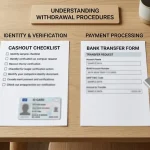
Transaction processing and identity verification are related, but they are not identical. A payment can be technically transmitted while an operator still requires documents to establish account identity, address or ownership of the payment method. Conversely, supplying documents does not guarantee that a later payment instruction will be accepted. Each step answers a different question.
A specialist review reports that an operator may ask for government-issued identification, a document confirming the account holder’s address dated within the previous three months, and evidence connecting the account holder to the payment method. The precise request is operator-dependent; the review’s description should not be read as a fixed checklist applying everywhere.
Those requests can affect how a transaction proceeds. If an operator asks for evidence and the account remains under review, a payment may not reach its final state until the check is addressed. The gateway does not replace this review: it handles transaction communications, while the operator’s account checks concern the person or payment details associated with the account. The presence of a gateway therefore says little about the length or outcome of a verification review.
Documents also have different purposes. Identification supports a name check; address evidence links that identity to a residential address; and payment evidence relates the account holder to the method used. A request for one does not automatically satisfy the others. The document details and submission route should be assessed as part of the operator’s stated process, rather than inferred from a payment logo or a successful transaction screen.
A payment page is an interface, not an independent certification. It may display a method, a provider name or a brand mark, but that display alone does not establish that the option will work for a particular transaction. It also does not demonstrate that a payment provider has approved the transaction, that the operator has completed its checks, or that the route is appropriate under Australian law.
Attention: The appearance of a payment brand or logo on a screen does not guarantee that the option is available for gambling transactions in Australia or that it will be approved.
Searches and screens may mention familiar labels such as Apple Pay, Google Pay or Klarna. Their appearance in a general discussion of payment technology does not establish that any of them is available for a particular gambling transaction in Australia. Availability and eligibility cannot be inferred from familiarity with a brand. In particular, a wallet’s ability to make payments in other settings does not establish that it supports gambling transactions.
The same caution applies to a gateway’s name or technical description. “Integrated,” “secure” or “automated” can describe aspects of a system, but none of those terms guarantees acceptance, completion or a particular outcome. A gateway can help move transaction information between parties; it cannot erase an operator’s terms or substitute for checks imposed by the operator or payment provider. Technical infrastructure is a mechanism, not a verdict.
This distinction has a legal dimension in Australia. The Interactive Gambling Act 2001 makes it illegal for operators to provide real-money online casino games, including slots, poker and table games, to people physically located in Australia. A payment gateway does not alter that rule. A functioning payment route, a familiar payment brand or a completed transaction cannot make the provision of a prohibited service lawful.
For that reason, technical descriptions of payment handling should not be read as an endorsement or an invitation to use an offshore casino. The existence of a payment system does not establish that an operator may lawfully offer real-money online casino services to people in Australia. Payment infrastructure and legal permission are separate matters, and the former cannot supply the latter.
The practical reading is narrow: a gateway can transmit and report payment information; an operator may separately request identity, address and payment-method evidence; and neither step guarantees the other. A payment page is not proof of approval, and verification is not proof of a lawful service. Those distinctions keep the technical role of a gateway separate from the operator’s checks and from the legal status of the service itself.
A payment portal is the transaction screen where an operator presents the payment routes it supports and the terms attached to each one. The options shown are not a universal catalogue: availability and conditions depend on the operator and the transaction. A method appearing on a screen does not, by itself, establish that it can be used for every transaction or that the service is lawful in Australia.
That distinction matters in this market. Under the Interactive Gambling Act 2001, providing real-money online casino games to people in Australia is illegal. A payment portal should therefore be understood as a description of how a transaction interface works, not as an invitation to use an offshore casino.
The portal is also where a payment can look simpler than its eventual route. A method may accept funds without providing a way to return them. For a prepaid voucher, the amount loaded sets the spending ceiling: once that stored value is used, further spending requires another source of funds. That makes the voucher’s cap a genuine control on expenditure, not merely a display feature.
The trade-off appears at cashout. Voucher deposits generally cannot be sent back to the same voucher, so a separate method is needed to receive a withdrawal. The original payment route and the route for funds leaving the account are therefore not necessarily the same. If the available cashout path is unsuitable, the voucher’s spending cap does not solve that problem; it only limits the amount loaded in the first place.
Legal Restriction
Under the Interactive Gambling Act 2001, providing real-money online casino games to people in Australia is illegal.
This is the practical cost of limited flexibility. The amount placed on a voucher is bounded, but money credited after a transaction may need another route to leave. The portal’s payment labels matter less than the conditions behind them: whether the voucher is accepted, whether it can receive funds back, and what alternative route is available. Those details determine whether a payment method is workable from start to finish.
Promotional balances can create a similar gap between what is displayed and what can be withdrawn. A no-deposit promotion may still carry wagering, verification and withdrawal conditions. “No deposit” describes the initial funding requirement; it does not establish that credited funds are immediately payable or free of conditions. The relevant calculation is the amount that can actually be withdrawn after the stated terms are met, not the promotional balance shown on screen.
A portal is useful only insofar as it makes those conditions visible. A list of payment logos is not a complete account of the transaction. For vouchers in particular, the loaded amount limits spending, while the separate cashout route determines how any resulting balance could be received. The two sides of that arrangement have different jobs, and treating them as interchangeable leaves the final route unresolved.
The displayed balance is not necessarily the amount that reaches a bank account. A deduction can arise from the payment provider, the casino’s transaction terms or currency conversion, and those costs should be compared separately. A low stated fee in one part of the route does not establish that the full transaction is inexpensive.
A specialist review describes Skrill withdrawals to a bank as carrying a transaction fee of 1–3% at some casinos. The percentage matters because it changes with the amount transferred: the deduction is calculated against the withdrawal rather than being a fixed charge. The review’s figure is not a universal tariff, so the applicable casino terms determine the actual amount. The withdrawal amount shown before confirmation should be checked against the amount expected to arrive after the fee.
Bank transfers can have a different cost structure. A specialist review reports flat casino fees of $5–$15 for transfers. A fixed charge takes the same dollar amount from a small or large transfer, so its relative weight differs with the withdrawal size. The cost comparison is therefore not simply “percentage versus flat fee”: it depends on the amount being moved and whether another charge is applied along the route. The stated bank-transfer fee should be read as a casino charge, not assumed to cover every possible bank-side cost.
Funding an e-wallet can also carry a separate charge. A specialist review lists Neteller’s credit-card funding fee as 1.45%. That is a funding cost attached to the wallet transaction, not a casino payout fee. It should not be mistaken for permission to use a credit card to fund online gambling; Australian market restrictions prohibit credit-card payments for online gambling services. The relevant calculation is whether the wallet’s permitted funding route has a charge before any later casino transaction.
Withdrawals to a bank may carry a transaction fee of 1–3% at some casinos.
Some casinos may apply flat fees ranging from $5 to $15 for transfers.
Funding the wallet via credit card may incur a 1.45% fee.
Currency conversion can reduce the amount independently of a provider fee. A specialist review puts AUD-to-EUR conversion costs at 2–4%. Where a balance is converted from Australian dollars into euros, the converted amount is lower than the value before the conversion cost. If a withdrawal then incurs a separate transaction fee, both deductions affect the final receipt. They should not be treated as interchangeable: one arises from converting currencies, the other from processing the transaction.
A useful comparison records the amount sent, the currency in which it is held, each stated provider or casino fee, and the amount expected after deductions. This keeps the accounting precise: a percentage charge changes with the amount, a flat fee does not, and a conversion cost applies when currencies differ. The final amount—not the label attached to a payment provider—is the figure that determines the value of the transaction.
A specialist review describes Visa and Mastercard deposits as being credited instantly when a transaction is accepted. That is a processing-time claim, not a reliable expectation for Australian transactions: Australian financial institutions block many standard card payments to offshore casinos. A payment can therefore fail before the operator’s processing time matters. This is not a recommendation to fund gambling with a card.
The withdrawal clock starts elsewhere. A casino may handle a cashout separately from the deposit, and bank transfers can involve a manual approval queue rather than an automatic payment. One specialist review describes operators processing bank withdrawals manually on set days, once or twice a week. Under the timing it gives, a request made on Friday could reach the bank account by Wednesday. The difference is not a minor delay at the edges: money requested on Friday may remain unavailable through the weekend and into the following week.
That review also places MuchBetter withdrawals ahead of traditional bank-transfer cashouts, for which it gives a possible wait of up to five days. The comparison concerns the withdrawal leg, not the speed of the original deposit. A fast instant-payment casino checkout does not establish that a linked wallet or bank route will pay out at the same pace.
The useful comparison is therefore between stated timings at each stage: the time for a deposit to be accepted, the operator’s handling time for a withdrawal, and the time taken for the receiving provider to credit it. Those stages may be described separately in payment terms. A label such as “instant” attached to a deposit says nothing about when a cashout will be approved or arrive.
This distinction applies across payment integrations, whether a site presents a bank route or names services such as Neteller or MiFinity. Their appearance in a cashier does not establish a common processing speed; the operator’s stated withdrawal timing is the relevant figure. Interac, by contrast, is not an Australian bank-transfer timing reference. Timing claims should be read as descriptions from the source making them, not as a guarantee for every operator or transaction.
A familiar app name does not establish that a payment can be used for gambling in Australia. Eligibility depends on the service’s rules and the transaction being attempted; an app that handles ordinary retail payments may block gambling-related transfers altogether. That distinction matters before any balance is moved: a payment route can be available for adding funds without being available for receiving them.
PayPal has prohibited gambling transactions in Australia since 2021, making it unsuitable as a route for gambling payments despite its availability as a general-purpose wallet.
PayPal is a clear case. It has prohibited gambling transactions in Australia since 2021, so its presence as a general-purpose wallet does not make it a suitable route for gambling payments. A casino payment app label is not evidence that the underlying provider permits the transaction.
Apple Pay is different in form, not necessarily in eligibility. A specialist review describes deposits made from a phone’s digital wallet, authenticated with biometrics. That describes a possible payment flow; it does not establish that every operator accepts Apple Pay or that the wallet can receive a payout. Paysafecard is also not a cashout route: its role is limited to paying in, so any funds later due would need another permitted method.
Names such as EcoPayz, UPI and ACH require the same scrutiny. A payment brand or bank-transfer term appearing in a menu does not, by itself, confirm availability to Australian users, acceptance for gambling, or support for withdrawals. Those are separate conditions, not interchangeable features. No conclusion about a route should be drawn from familiarity with its name.
There is also a legal boundary that payment labels cannot change. Under the Interactive Gambling Act 2001, operators may not provide real-money online casino-style services, including pokies, poker and table games, to people in Australia. A wallet’s technical ability to process a payment does not make the underlying service lawful.
For comparing app-based routes, the useful distinction is therefore narrow: whether the provider permits the transaction and whether the route is for payment in, payment out, or both. A deposit-only option can leave the eventual return dependent on a different method. The wallet logo is packaging; the transaction permissions determine what it can actually do.
A phone can make the payment step shorter without changing where funds can be received. A specialist review describes Apple Pay deposits as being made through the phone’s digital wallet, with biometric authentication used to approve the transaction. The phone supplies the payment interface; it does not turn the wallet into a general-purpose account for both directions of a transfer.
That distinction matters when assessing a mobile casino payment. Apple Pay belongs on the deposit side only: it is not a withdrawal destination. A deposit made from a phone therefore does not establish that money can later be returned to the same wallet. The cashout route is a separate transaction condition, not a feature implied by the device or its authentication method.
Biometric approval also answers a narrow question: whether the device’s user authorises that payment. It does not establish that an operator accepts the transaction, that a payment will be processed, or that funds can be withdrawn through the same route. Those are separate steps, and treating them as one produces an incomplete view of the payment arrangement.
There is also a legal boundary in Australia. The Interactive Gambling Act 2001 makes it illegal for operators to provide real-money online casino games to people located in the country. A description of phone-based payment mechanics is not an endorsement or a route around that restriction.
For a mobile payment casino flow, the useful accounting distinction is therefore between the method used to send money and the method available to receive it. Apple Pay can describe a phone-based deposit process; it does not describe the full movement of funds. A mobile screen may make approval simple, but it cannot make the withdrawal route interchangeable with the deposit route.
A specialist review puts Litecoin withdrawals at roughly 10 minutes, compared with Bitcoin transfers that can take as long as an hour when the network is congested. These are reported timings, not guaranteed arrival times. Ethereum has a different cost risk: gas fees can reduce the amount received.
Blockchain transfers cannot be reversed and have no chargeback option. Crypto is therefore a withdrawal route only where an operator supports it; it is not a reliable fallback if that route is unavailable or a transaction is sent incorrectly.
Yes, fees can apply: bank transfers may cost $5–$15, Skrill withdrawals may incur a 1–3% fee, and currency conversion from AUD to EUR can cost 2–4%. Crypto withdrawals are usually free, but check the specific transaction terms.
For fast AUD deposits, PayID is a practical option where an operator offers it, but check separately whether it supports withdrawals. No payment method makes an online casino service lawful in Australia.
No payment method, including cryptocurrency, changes the legal position: providing online casino games to people in Australia is illegal for operators. Cryptocurrency should not be treated as an online gambling deposit option in Australia.
Many standard Visa and Mastercard transactions to offshore casinos are blocked by Australian financial institutions. More broadly, payment by card does not make providing online casino games to people in Australia lawful for operators.
Litecoin is the fastest of the options described: withdrawals typically take 10–30 minutes and have low fees. Bitcoin can take up to an hour when the network is congested.