Low volatility describes a broader pattern of more frequent, generally smaller wins—not the result of any individual spin.
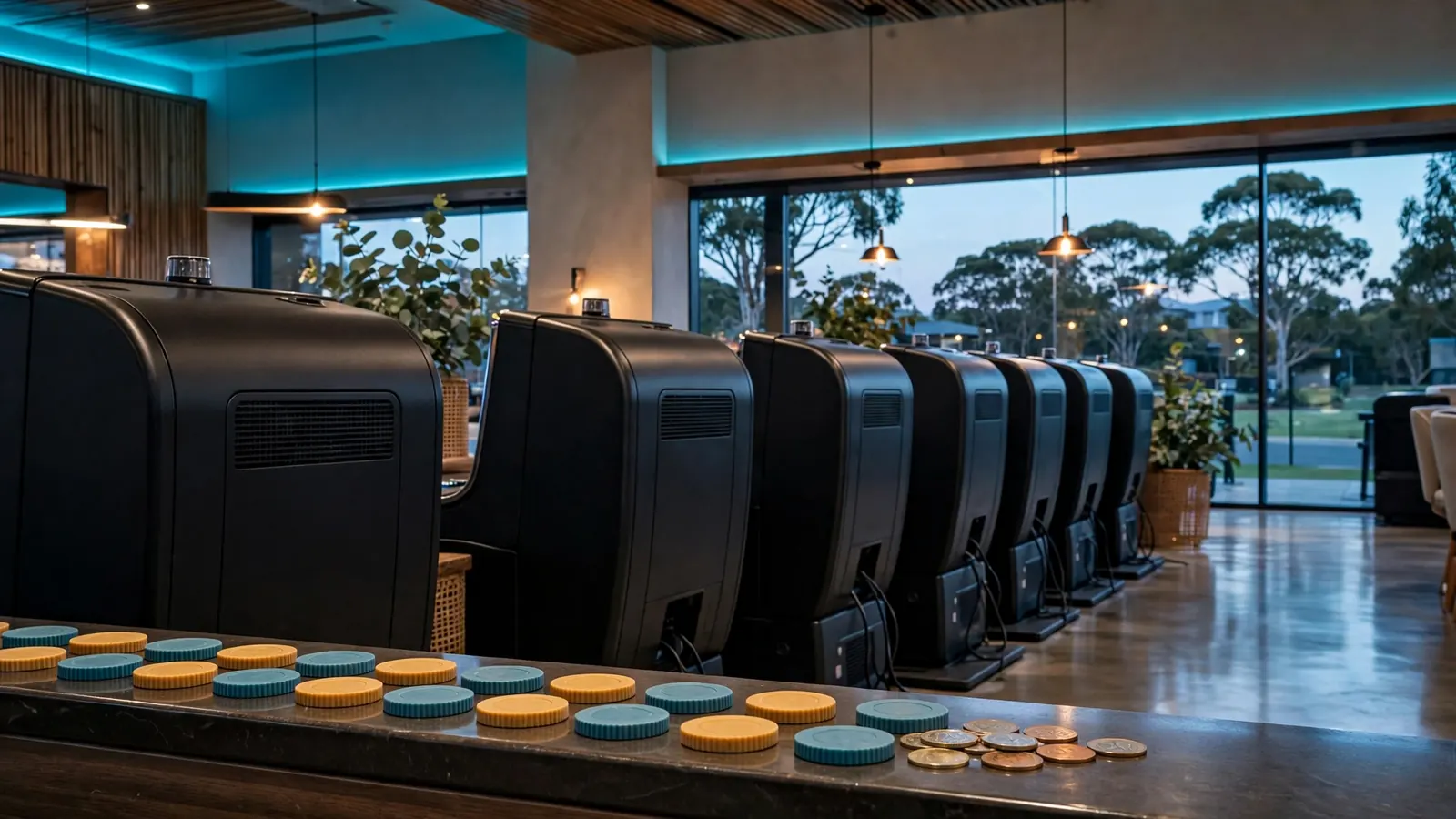
Volatility describes the pattern of wins in a pokie: how often payouts occur and how much they tend to vary. A low-volatility profile is associated with frequent wins that are generally smaller, alongside less fluctuation in winnings. The term is about the shape of the results, not a promise that a particular spin will pay.
That distinction matters because a win is not defined by how satisfying it feels or how often it appears in a short stretch. Volatility concerns the broader pattern attributed to a game. A succession of modest payouts can be consistent with low volatility, but a brief run alone cannot establish the game’s profile. Frequent small wins may indicate low volatility; they are a clue, not a guarantee or a complete measurement.
The simplest way to understand low volatility is to keep two questions apart. How often do wins occur? How much do the payouts vary when they do? Low volatility points towards a pattern in which wins occur more frequently and the winnings fluctuate less. The payouts are typically smaller rather than concentrated in occasional large results.
Slot volatility is a game-specific feature, so treat this list as a starting point rather than proof that a casino offers low-volatility games. Check the details of individual slots before choosing where to play.
Bizzo Casino
Bizzo Casino is listed with a Curacao Gaming Control Board license held by TechSolutions Group N.V.
Kingmaker
Kingmaker lists crypto payouts at around 90 minutes and fiat payouts at 1–5 days. The minimum deposit is A$30.
Vegaz Casino
Vegaz Casino lists Curacao license OGL/2024/1335/0780 and a minimum deposit of EUR 20.
JeetCity Casino
JeetCity Casino is listed with a Curacao eGaming license held by Dama N.V.
Thor Casino
Thor Casino lists a Curacao license from Antillephone N.V. for Versus Odds B.V. Its minimum deposit is EUR 20.
LevelUp Casino
LevelUp Casino lists Curacao eGaming license OGL/2023/174/0082, held by Dama N.V. The minimum deposit is A$15.
LuckyVibe
LuckyVibe is listed with a Curacao Gaming Control Board license, OGL/2023/176/0095, held by Hollycorn N.V.
JustCasino
JustCasino is listed with a Curacao Gaming Control Board license.
Ricky Casino
Ricky Casino lists crypto payouts in under an hour and PayID payouts in 1–3 business days. The minimum deposit is A$20, or A$30 to qualify for the bonus.
Wild Tokyo
Wild Tokyo lists a Curacao license, crypto payouts in 30–60 minutes, and fiat payouts in 1–5 days. The minimum deposit is A$10.
Frequency alone does not describe the full profile. A game could produce repeated wins, but the size and variation of those payouts still matter to the volatility description. Likewise, looking only at a single payout misses the question of how results are distributed over time. The label refers to the combined pattern, not one isolated event.
This is why “frequent” and “small” belong together in the basic meaning. Frequent payouts are not necessarily large payouts, and a low-volatility description does not imply that each win is identical. It indicates a tendency towards more regular, smaller results and less movement in winnings, rather than a fixed sequence that must appear spin after spin.
A low-volatility label is not a schedule. It does not specify when the next win will occur, how many wins will appear in a particular run, or the amount of an upcoming payout. Nor does it turn a series of previous results into a reliable forecast. Each observed outcome is only part of the play history; the profile describes a general tendency, not an instruction for what should happen next.
The same caution applies to a short sample. A game may produce several small wins close together, yet that observation by itself does not confirm its volatility. A run with fewer wins does not, on its own, disprove a low-volatility profile either. Short stretches can look uneven. The useful question is whether the overall pattern is characterised by relatively frequent, smaller wins and less fluctuation, not whether every brief sequence looks orderly.
 Bonus Buy Slots in Australia: How Features WorkLearn how paying a displayed price enters a bonus round, why it does not guarantee a return, and what demo play can…
 Live casino online in Australia: legal contextLearn how the Interactive Gambling Act 2001 treats online casinos, why offshore licences do not equal Australian approval, and what evidence is…
This helps distinguish the meaning of volatility from ordinary descriptions such as “steady” or “safe”. Low volatility refers to a pattern of payouts. It does not remove uncertainty from a game, and it does not promise a particular result. The label is descriptive, not a guarantee of consistency in every session.
Frequent small wins are often the feature that makes a game appear low in volatility. A payout may occur without being large, so counting wins without considering their size can create a misleading impression. The pattern is better understood by considering both how often wins happen and how much winnings fluctuate.
There is also a difference between seeing a win and assessing what it says about the game. One modest payout is simply one result. Several small payouts may look like the pattern associated with low volatility, but they do not establish that a game will continue in the same way. The word “may” is important: frequent small wins can be an indicator, not definitive evidence based on a handful of outcomes.
A single unusually large result does not necessarily settle the question in the opposite direction. Volatility is a description of the wider pattern, so one result should not be treated as a full profile. The point is not to label each spin. It is to understand the tendency used to describe the game as a whole.
Attention: A low-volatility label is descriptive and not a guarantee of consistency or a schedule for when the next win will occur.
When a pokie is described as low volatility, the plain-English interpretation is that its pattern tends towards more frequent, smaller wins and less fluctuation in winnings. This is the core of the low-volatility meaning in slots. It is not a claim that payouts arrive at regular intervals, that every result is small, or that a win is due after a particular sequence.
The word “low” can sound like a rating of overall quality, but here it identifies the degree of variation in the payout pattern. It does not mean that a game is predictable. It also does not tell a player what an individual outcome will be. Those conclusions would stretch the label beyond what it describes.
A useful mental model is to treat volatility as a summary of the character of results rather than a forecast. Frequency asks how often payouts tend to occur; size and fluctuation describe how those payouts tend to vary. For a low-volatility game, the defining picture is more frequent wins at smaller amounts, with less variation in winnings. Any single session may not neatly reflect that picture.
That is why “what is a low-volatility pokie?” has a concise answer, even if individual results remain uncertain: it is a game associated with frequent, smaller wins and comparatively limited fluctuation in winnings. The description can help explain the style of its payout pattern, but it cannot tell what will happen on the next spin.
 Best Video Slots in Australia: RTP and RNGLearn how independent RNG spins differ from long-run RTP, and how free play, Australian access and slot comparisons fit into evaluating video…
 Pokies in Sydney: How to Check Venues and Online PlaySeparate nearby venue searches from online play, and see why addresses, opening times and return figures need careful verification.
A lower-volatility profile is associated with wins that arrive more often but tend to be smaller. The trade-off is straightforward: a game may return modest amounts at a steadier pace, while a game with a different volatility profile may offer the possibility of larger payouts, including larger jackpots. Neither pattern means that every spin will produce a win or that a particular payout is due.
The difference is about the shape of possible results, not a promise about what any individual play will deliver. Frequent small wins can make a game feel more consistent because there are more occasions when a payout appears. But the size of those payouts matters as much as their frequency. A run of modest wins is not equivalent to a large prize, and a higher-volatility game’s larger potential prizes do not mean that one will occur.
That distinction helps make sense of the comparison between high- and low-volatility pokies. Lower volatility generally points towards more frequent, smaller wins; higher volatility can involve less frequent wins and the possibility of larger ones. These are broad profiles, not fixed schedules. A low-volatility game can still have a losing stretch, and a higher-volatility game can produce a small payout. The label describes a tendency in the distribution of outcomes, not a sequence that can be predicted spin by spin.
For players comparing the two profiles, the practical question is what kind of payout pattern is preferable. A preference for smaller amounts appearing more often aligns more closely with low volatility. A preference for the possibility of a larger payout, with less frequent wins, aligns more closely with higher volatility. That is a comparison of potential outcomes, not a ranking of which type is better. The answer depends on which trade-off is acceptable.
Associated with more frequent, smaller wins and less fluctuation in winnings.
Associated with less frequent wins and the possibility of larger payouts and jackpots.
The phrase “stretching a bankroll” can describe why frequent small payouts appeal to some players: small returns may offset part of the amount staked across play. It should not be read as a guarantee that funds will last longer, or that the total returned will exceed the total staked. A payout is not automatically a profit. The amount received on a winning spin must be considered against the amount spent, and repeated small returns can still leave an overall loss.
Conversely, the prospect of larger prizes is not a reliable substitute for frequent smaller wins. A high-volatility profile may have greater potential payouts, but that possibility comes with a less frequent pattern of wins. The larger figure that attracts attention says little on its own about how often a payout occurs or whether it will appear during a particular period of play. A maximum prize is an available outcome, not an expected one.
This is why comparisons based only on a headline jackpot can be misleading. The prize size describes one possible result; volatility concerns the broader pattern of win frequency and size. A game with a smaller top prize may still produce smaller wins more often, while a game with a larger possible prize may offer a less frequent payout pattern. The two features answer different questions.
The same care applies when a game is described as low volatility and high payout. “High payout” can refer to a notable prize, while low volatility refers to the general pattern of wins. Those descriptions do not necessarily conflict, but neither should be taken to mean that a large prize is likely or that wins will arrive at regular intervals. A prominent prize and a frequent modest payout are distinct elements of a game’s possible results.
There is no universal winner in a low-versus-high volatility comparison. Lower volatility trades the possibility of larger prizes for a pattern more associated with smaller, more frequent payouts. Higher volatility places more emphasis on the possibility of larger returns, without making them certain or frequent. The useful distinction is not which label sounds more attractive, but whether the expected style of outcomes matches the level of variation a player is willing to accept.
A lower-volatility profile can change the pace of a pokies session. More frequent returns may slow the rate at which a balance falls, so a fixed starting amount can last longer than it might in a game with sharper swings. That is a possible effect, not a promise: each spin remains uncertain, and a run of small wins does not guarantee that the balance will hold or grow.
“Reduced risk” needs a narrow reading. It describes comparatively less fluctuation in winnings, not protection from losing money. A session can still end with the entire amount set aside for play gone. Frequent returns may soften the visible movement of a balance without changing that basic exposure. The distinction matters because a longer session is not automatically a better-value session; it can simply mean more time in play.
Financial Risk
A session can still end with the entire amount set aside for play gone, regardless of the game's volatility profile.
Session length is also shaped by decisions made while playing. A steady sequence of small returns can make continued play feel less costly, particularly when the balance appears to recover after a loss. But a return is not a refund of the full amount wagered, and a temporary rise does not establish a trend. Treating each result as evidence that the next spin is more likely to pay would turn a description of past outcomes into an unsupported forecast.
The practical control is the session budget: a fixed amount allocated before play, separate from money needed for ordinary expenses. The amount should reflect the person’s tolerance for losing it, not an expectation that wins will replenish it. Once that budget is exhausted, adding money changes the cost of the session; it does not improve the underlying odds. Matching game choice to both risk tolerance and session budget is more coherent than selecting a game for its label alone.
This is particularly relevant to the temptation to extend play. When small returns arrive regularly, it can be easy to count them as fresh playing funds while overlooking how much has already left the original balance. A useful record separates deposits, total stakes and the balance remaining. The gross amount returned during play is not the same as net winnings: money can be wagered repeatedly, and a returned amount may be smaller than the stake that produced it. A balance check should therefore include the session’s overall position, rather than relying on the latest win.
A specialist review has reported that frequent wins can prompt players to add funds to their casino accounts. That observation should be treated as a reported behaviour, not a universal pattern or a prediction about any individual. The mechanism is understandable: repeated small returns may create a sense that another deposit will keep the session going. Yet extra funds increase the amount exposed to loss. They do not convert a low-volatility profile into a safer financial outcome.
A written stop point can reduce the room for that decision to shift mid-session. It can be based on the starting budget, a set end time, or both. The point is not to forecast when a game will pay; it is to decide in advance when play ends. Continuing because a session has lasted longer than expected, or because a win has just occurred, replaces a defined limit with a reaction to recent outcomes.
Low volatility therefore affects the texture of a session more than its certainty. It may support longer play and less pronounced swings, but neither feature establishes that a session will be profitable, or that the balance will last for a particular period. No gambling format removes the possibility of losing money. This affiliate-driven content includes sponsored links; that disclosure does not change the financial risk. Online gambling content is for people aged 18 and over.
The legal distinction in Australia is mainly about who provides online casino games, not whether a game is described as low volatility. The Interactive Gambling Act 2001 prohibits operators from offering real-money online casino games, including pokies, to people physically located in Australia. The category covers casino-style services such as slots, poker and table games. A low-volatility label does not change how the law classifies the service.
Legal Status
The Interactive Gambling Act 2001 prohibits operators from offering real-money online casino games to people physically located in Australia.
The Act’s restriction on operators is distinct from the stated position for residents. Playing at an offshore casino that accepts an Australian resident is not itself made illegal for that resident under the Act. That distinction does not make the service lawful to provide in Australia, nor does it mean access is assured. The rules apply to the operator’s conduct, while the legal position described for a player is separate.
ACMA, the Australian Communications and Media Authority, is the federal regulator responsible for enforcing the Act and monitoring compliance with federal interactive gambling laws. Its role includes action against prohibited services. ACMA can ask Australian internet service providers to block websites that provide prohibited interactive gambling services or advertise them in Australia. Blocking is an enforcement measure directed at access to the site; it does not convert an offshore casino into an approved local service.
The regulator’s published enforcement totals show the scale of that activity. Following enforcement actions, ACMA reports having blocked more than 1,455 illegal gambling and affiliate websites since November 2019. Reports on services withdrawing from the Australian market since enforcement began in 2017 do not agree: one figure is more than 210, while another is over 190. Both describe withdrawals after ACMA enforcement began, but they are different totals and should not be collapsed into a single number.
For anyone assessing descriptions such as “low-volatility pokies Australia,” the legal boundary comes before the game label. A claim about frequent smaller wins is a description of game behaviour; it is not evidence that the service may lawfully be offered in Australia. Nor does a foreign licence override the Australian restriction on operators supplying real-money casino games to people in the country. These are separate questions, and treating one as an answer to the other is a category error.
Searches for low-volatility online slots or the best low-volatility online slots can therefore blur two issues: how a game is described and whether the underlying service is permitted. No volatility classification creates an exception to the Interactive Gambling Act 2001. Equally, a site being reachable at a particular time does not establish that its offer complies with Australian law; ACMA’s blocking actions are part of the enforcement landscape.
The practical meaning of “available” is also narrower than a page loading in a browser. ACMA can seek blocks against prohibited services and advertising, so access may be interrupted. The regulator’s reported blocking and withdrawal totals indicate that enforcement has consequences for websites operating in this area. They do not amount to an endorsement of any remaining service, and they cannot be used to infer that a particular offshore provider is authorised locally.
A low-volatility profile may be considered a good fit in slots by people who prefer smaller, more frequent outcomes, but that preference has no bearing on the legal status of an online casino service. The game characteristic and the operator’s legal position answer different questions. In Australia, the relevant boundary is that operators cannot offer real-money online casino games to people in the country, while the Act does not impose personal illegality on a resident merely for playing at an offshore casino that accepts them.
This page is affiliate-driven and includes sponsored links. That commercial disclosure does not endorse or recommend an offshore casino, and it does not change the legal position described above. Online gambling can result in losing money; a lower-volatility label does not remove that possibility. Online gambling content is for people aged 18 and over.
Volatility describes the pattern of a game’s payouts; it does not state how much of the money wagered is returned over time. A low-volatility label therefore cannot, by itself, show whether a particular game configuration has a higher or lower return. These are separate pieces of information, and treating one as a substitute for the other can lead to a poor comparison.
The distinction matters when assessing pokies across the wider casino-games context. A volatility label concerns the variability of outcomes, while RTP is a separate game setting or stated return measure. Two games described as low volatility need not have the same RTP. Nor does a low-volatility description establish the RTP of every configuration of one game. The label is useful for understanding the shape of payouts, not as a complete financial specification.
A specialist review has reported that some sites use lower-RTP configurations. That is a report about particular offerings, not a basis for assuming that every site or game is configured the same way. The practical check is the game’s information panel: its displayed RTP is more relevant to the return question than its volatility label. If the panel gives no clear configuration information, the volatility description alone cannot fill that gap.
The same separation applies when comparing low-volatility casino games. A title may be described as low volatility and still have a return figure that differs from another title with the same label. Conversely, a return figure does not explain how often wins occur or how unevenly they may be distributed. Neither measure tells the whole story on its own.
For anyone considering what low volatility means in slots, the useful reading order is simple: treat volatility as information about payout variation, then inspect the game-specific RTP separately. This avoids turning a description of play patterns into a claim about value. A “low” label is not a discount, and it does not promise a favourable result.
This page is affiliate-driven and may contain sponsored links. Gambling involves the risk of losing money; no volatility label or RTP figure guarantees a return.
A provider name alone does not establish a game’s volatility. For Pragmatic Play titles, the relevant question is whether a particular game shows a lower-variance pattern in play, not whether the provider’s name appears on its screen. No title should be assigned a profile solely on that basis.
Demo mode offers a way to observe a game without wagering real money. Where it is available, play can show how often wins occur and how their amounts vary across spins. A run with frequent small wins may be consistent with lower volatility, but a short sequence is only a sample of outcomes; it is not a guarantee that future play will follow the same pattern.
The practical method is to assess each game separately. In demo mode, note whether wins appear regularly and whether payouts remain relatively modest, rather than relying on a provider-wide assumption. If the results are uneven or the pattern is unclear, the available sample has not established a low-volatility profile. Demo play can help distinguish observed patterns; it cannot make an uncertain outcome certain.
This distinction matters when comparing games under the Pragmatic Play name. A provider may offer titles with different mechanics and payout behaviour, so a label attached to one game should not be transferred to another. Nor does a lower-volatility description state how much a particular configuration returns. That requires separate game information; volatility and return are different measures.
This is informational material, not an invitation to gamble. Gambling involves the risk of losing money, and online casino games are restricted under Australian law. Access to gambling content is for adults aged 18 and over. This page is affiliate-driven and may include sponsored links.
On a game with multiple paylines, the recommended approach is to use smaller bets. This is intended to maximise the chances of a win on each spin; it does not guarantee a win or change the outcome of any individual spin. The distinction matters: a bet size is a choice about how much is staked, not a promise about what a game will return.
For pokies described as having low volatility, this advice concerns a specific setup rather than a separate class of game. Multiple paylines create the context for the smaller-bet recommendation. Without that feature, the stated advice does not apply in the same way.
Bet size should therefore be considered alongside the game’s payline arrangement. A larger stake is not required by the lower-volatility label, and the label alone does not establish that a particular stake is suitable. The recommendation is narrower: where multiple paylines are available, smaller bets are advised to increase the chance of a win on each spin. That is a probability-oriented rationale, not a claim that the total amount returned will be higher.
This section is informational, affiliate-driven and includes sponsored links; it does not recommend or direct readers to gambling services. Gambling carries a risk of losing money. Access to gambling content is for adults aged 18 and over.
A wagering requirement is a turnover condition: it specifies how much must be staked before a bonus-related balance can be withdrawn. The multiplier is applied to the stated bonus amount, not treated as a promised return. Completing the required turnover does not mean that the original balance will remain intact; money can be lost while bets are placed.
A specialist review gives this illustration: a 30x requirement attached to $10 produces $300 in required wagering before cash-out. The calculation is $10 multiplied by 30. The result is the total amount wagered, not an additional $300 payout, a target profit or a guarantee that $10 will still be available afterward. The figure describes that review’s example, not a universal bonus condition.
The distinction matters when a promotion is considered alongside low-volatility games. A game’s volatility describes its payout pattern; it does not reduce a wagering multiplier or change the arithmetic. Frequent smaller wins cannot be counted as a guaranteed route to meeting a turnover condition, because each outcome remains uncertain and the required wagers can consume the available balance.
The relevant calculation therefore begins with the amount to which the multiplier applies and the multiplier itself. Those terms need to be read together: a multiplier without its base amount does not give the required turnover. The total wagering figure is a measure of required activity, not the amount deposited, the amount won or the amount eligible for withdrawal.
In the cited illustration, $300 is the turnover threshold. It says nothing by itself about the balance left when that threshold is reached. That is the entire arithmetic—and the limit of what the arithmetic establishes.