Australian law restricts online casino operators, while offshore play can involve limited recourse, payment blocks and conditions on withdrawals.

The phrase “best Australian online casino” describes a demand, not a category of locally licensed businesses. Under the Interactive Gambling Act 2001, companies cannot provide real-money online pokies to people in Australia without a domestic licence. No such licences have been issued, so there is no Australian-licensed online casino.
The restriction covers online casino-style games, including pokies, poker and table games. Its target is the operator providing the service, not the individual placing a bet. Australians do not face a fine or criminal prosecution simply for playing on an offshore site that accepts them. That distinction does not make the service locally regulated, however, or give a player Australian protections against the operator.
The Australian Communications and Media Authority (ACMA) is the primary domestic regulator responsible for enforcing the Act. It can block access to illegal offshore gambling sites, and internet service providers must comply with its blocklist. Blocking is an enforcement measure against the service; it does not turn an offshore casino into a licensed Australian business, nor does it create a domestic route for resolving a dispute with one.
Choosing an online casino in Australia means checking the details that matter to you, such as licensing, deposit requirements and payout options. Use these short verdicts as a starting point, then confirm the terms that apply to your account.
Bizzo Casino
Bizzo Casino is listed with a Curacao Gaming Control Board license under TechSolutions Group N.V.
Kingmaker
Kingmaker lists crypto payouts at around 90 minutes and fiat payouts at 1–5 days. Its minimum deposit is A$30.
Vegaz Casino
Vegaz Casino lists a Curacao OGL license, reference OGL/2024/1335/0780, and a minimum deposit of EUR 20.
JeetCity Casino
JeetCity Casino is listed with a Curacao eGaming license under Dama N.V.
Thor Casino
Thor Casino lists a Curacao license from Antillephone N.V. under Versus Odds B.V. Its minimum deposit is EUR 20.
LevelUp Casino
LevelUp Casino lists a Curacao eGaming license, reference OGL/2023/174/0082, under Dama N.V. Its minimum deposit is A$15.
LuckyVibe
LuckyVibe is listed with a Curacao Gaming Control Board license, reference OGL/2023/176/0095, under Hollycorn N.V.
JustCasino
JustCasino is listed with a Curacao Gaming Control Board license.
Ricky Casino
Ricky Casino lists crypto payouts in under an hour and PayID payouts in 1–3 business days. The minimum deposit is A$20, or A$30 to qualify for the bonus.
Wild Tokyo
Wild Tokyo lists a Curacao license, crypto payouts in 30–60 minutes and fiat payouts in 1–5 days. Its minimum deposit is A$10.
That leaves two separate questions that are easy to conflate: whether an operator may lawfully offer the service in Australia, and whether a player is personally liable for using it. The law prohibits the former, while the player is not penalised simply for playing. An offshore site may nevertheless accept Australian customers, but acceptance is not evidence of Australian authorisation. The absence of a local licence is the central legal fact, not a minor qualification to a site’s marketing.
The distinction matters most when money is disputed. If an offshore casino refuses to pay winnings, an Australian player has no legal recourse in Australia against that casino. A payment dispute therefore does not become an Australian consumer claim merely because the customer lives here or the site accepted the account. The operator’s willingness to serve Australian players and the player’s ability to enforce a claim in Australia are different matters.
A site may describe its rules, account procedures or dispute process, but those terms do not supply the missing domestic licence. Nor does a site’s use of familiar casino language make it an Australian casino in the legal sense. For a real-money offer, the decisive distinction is between a locally authorised service and an offshore operator acting outside the framework that applies to Australian customers. There is no locally licensed online casino to compare on equal legal footing.
 Live casino online in Australia: legal contextLearn how the Interactive Gambling Act 2001 treats online casinos, why offshore licences do not equal Australian approval, and what evidence is…
 Pokies in Sydney: How to Check Venues and Online PlaySeparate nearby venue searches from online play, and see why addresses, opening times and return figures need careful verification.
 Perth Casino Hotel Stays and Room DealsCompare Perth casino room deals by total stay cost, room type, dates and guest details, and check whether package extras and charges…
The statutory penalties also underline that the regulatory focus is on providers. The maximum daily penalty is $360,000 for an individual who violates the Act and $1.8 million for a body corporate. These are penalties for breaching the law, not charges imposed on a customer for placing a bet. The figures do not alter the player’s practical position if an offshore operator withholds a payout: Australian recourse remains unavailable.
Age is a separate requirement. The legal age for gambling in Australia, including online pokies, is 18. Meeting that age threshold does not change the status of the operator or supply a local licence. A person may therefore be old enough to gamble while the company offering the game still lacks permission to provide it in Australia.
A search for the best Australian casino can suggest that several locally regulated choices exist. Legally, that premise does not hold for online casinos: no Australian licence has been issued, and the Act prohibits operators from offering real-money casino games to people in Australia without one. Offshore sites may still appear in the market and accept Australian customers, but their presence does not create local oversight or a domestic remedy if winnings go unpaid.
The practical reading is narrow. The law places the prohibition on the company, not the player; ACMA enforces that prohibition, including through site blocking; and an offshore operator’s acceptance of Australian customers does not make it locally licensed. For a player, the most consequential limitation is not a personal criminal penalty. It is the lack of an Australian legal route if the operator fails to pay.
No Local Recourse
If an offshore casino refuses to pay winnings, Australian players have no legal recourse in Australia against that operator.
A site can be reachable, present a polished interface and describe its games in confident terms without establishing what happens when a dispute arises. For Australian players, the central limit is not how persuasive the site looks; it is the lack of a domestic route to enforce a claim against an offshore casino. If the operator declines to release winnings, Australian legal recourse is unavailable.
That changes the value of every assurance displayed on a site. A stated policy, customer-service promise or account balance is not the same as an outcome that can be compelled. The practical question is not simply whether a site appears credible at the point of registration, but what remedy exists if its own decision is disputed. In this market, appearance cannot supply the missing local remedy.
Access is also not a reliable measure of standing. The Australian Communications and Media Authority (ACMA) blocks illegal offshore gambling sites, and internet service providers are required to follow its blocklist. A site that cannot be reached through a particular connection may be affected by that process; a site that remains visible is not thereby shown to be authorised, fair or able to meet a claim. Availability is a technical condition, not a consumer-protection guarantee.
 Live dealer casinos online in Australia: legal guideLearn how Australia’s Interactive Gambling Act 2001 affects offshore live dealer casinos, and what bonus turnover and withdrawal terms require checking.
 Best pokies in Canberra: availability and venue checksLearn why a venue listing may not confirm that pokies are available, and how to check current operating status, opening hours and…
This distinction matters when comparing claims attached to Australian-facing casino sites. A site may use Australian currency, refer to local players or display familiar payment language. Those details do not establish that an Australian body can intervene in a dispute. Nor does a smooth sign-up process prove that later decisions about an account or winnings will be handled in the player’s favour. The relevant protection is the remedy available after something goes wrong, not the ease with which the site presents itself before it does.
The word “trusted” therefore needs a narrower meaning than a reader might expect. It can describe an impression formed from a site’s presentation, but that impression does not establish enforceable accountability in Australia. Without a domestic forum able to require payment, a complaint can remain a disagreement between the customer and an offshore operator. A response from the operator may resolve it; if it does not, the customer has no Australian legal recourse to secure the unpaid winnings.
The same limit applies to positive claims. A site’s own statements about reliability, customer care or its treatment of players remain statements made by the business. They may help explain how the operator says it works, but they are not independent evidence that a disputed balance will be paid. The distinction is basic accounting: a claim on a page is not cash received, and a displayed balance is not a completed withdrawal.
Searches for the best Australian casino sites can also blur unlike questions. A list may compare presentation or features, but ranking does not create legal protection. A site placed first in a comparison is still offshore if it operates from outside Australia, and a favourable description does not change the recourse available if winnings are withheld. The ranking is an editorial judgement, not a substitute for an enforceable local remedy.
ACMA’s blocking role adds another practical complication: access may be interrupted by a block, while access itself says nothing conclusive about the operator’s conduct. Neither outcome answers the question that matters most in a payment dispute. The existence of a site, its visibility from Australia and its willingness to accept an account are separate from the ability to make it honour a claim.
For an Australian reader, confidence should therefore be measured against what can actually be established, not against the tone of a site’s promises. Offshore sites may accept Australian players, but if an operator refuses to pay, the Australian legal system does not provide a route to recover those winnings. That is the material limit behind any claim of trust.
A balance shown on an account is not the same as money available to withdraw. For real-money play, access to winnings can depend on identity checks and on the operator’s withdrawal rules. Both need to be understood before a balance becomes a cash-out request.
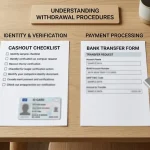
Identity verification is a practical condition of withdrawal. Specialist reviews report that casinos commonly request documents before a first payout. The checks can include a photo of government-issued identification and proof of residential address; some operators may also ask for a selfie holding the identification document. These requirements are separate from the result of a game: a win does not remove the need to establish who owns the account and where that person lives.
The documents should be ready to match the account details. A difference between the name or address on the account and the submitted records can create a further check. A document that is unclear or incomplete may also need to be replaced. The relevant point is procedural: verification is part of accessing the balance, not an optional step that can safely be left until after a large win. Account holders should complete identity and address checks before requesting a first withdrawal.
Withdrawal limits create a second constraint. A specialist review reports that some casinos impose weekly or monthly caps of $5,000–$10,000. The cap sets the maximum amount that can leave the account within the stated period; it does not necessarily determine the total amount owed. A larger balance may therefore need to be paid in instalments rather than as one transfer.
For a $50,000 jackpot, a $5,000–$10,000 cap would restrict each eligible withdrawal to that range. The actual schedule depends on whether the cap applies weekly or monthly and on the operator’s written terms. The distinction matters: the same cap amount has a different effect when renewed weekly than when renewed monthly. A headline balance alone does not show how much can be accessed at once.
The terms should be checked for the cap period, the amount covered by it, and whether a pending withdrawal counts against the limit. It is also important to establish whether the limit applies to each account or to all withdrawals combined. These details determine the pace of access, while the stated jackpot determines only the gross balance. A large figure on screen can therefore represent a series of smaller payments.
Verification and withdrawal limits should be read together. Identity checks can hold up a first request until documents are accepted; a cap can then restrict the amount paid in each period. Neither condition changes the displayed win, but both affect when and how much of it becomes accessible. The useful comparison is not simply between balances. It is between the balance, the documents required to release it, and the withdrawal ceiling that governs each payment.
Accessing a Jackpot
Identity Verification
Complete the required identity and address checks, providing documents such as government ID and proof of residence.
Reviewing Withdrawal Caps
Check the operator's terms for weekly or monthly withdrawal limits (e.g., $5,000–$10,000).
Planning the Payout
If the win exceeds the cap, arrange for the balance to be paid in instalments according to the reset period.
A low minimum deposit and a low-cost deposit are separate conditions. A specialist review reports that minimums at operators can fall between AU$10 and AU$20, with some accepting AU$5. These figures describe reported account terms, not a standard available at every site. The amount shown at the cashier may also depend on the selected payment method, so a displayed minimum does not establish that every listed method can be used for that amount.
The more consequential question is what the bank does with the transaction. A specialist review reports that Australian banks and card companies are increasingly blocking payments to gambling sites they identify as such. A declined transaction can therefore reflect the issuer’s controls rather than a problem with the account balance or the casino cashier. Repeated attempts do not change the bank’s decision and may make the payment trail harder to interpret.
Card deposits also carry a cost risk beyond the amount transferred. A specialist review notes that a bank or card issuer may classify a gambling deposit made with a credit or debit card as a cash advance. Under that treatment, the transaction may attract a fee of 3–5% and interest from the transaction date. The practical cost is set by the card terms and the issuer’s classification, not by the minimum deposit displayed by the site. A small deposit can therefore carry a separate charge, while interest can begin before a statement balance is due.
 Online Keno Casinos in Australia: Legal StatusLearn how Australian law treats real-money online keno and why an offshore site accepting registrations does not establish authorisation. No domestic licence…
 Best Pokies in Adelaide: Venue Hours and ChecksLearn why a venue’s general opening hours may not confirm pokies availability, and how to assess comparisons, travel, online risks and payment…
This is why the cashier’s payment label is not a complete price. The relevant total includes the deposit, any issuer fee and any interest charged under the account terms. If a card transaction is declined, switching to another route is not automatically cheaper: the alternative has its own account requirements and charges. Payment choices should be assessed by their effect on the bank account, not only by whether a deposit button is available.
E-wallets such as Skrill and Neteller are described as popular in specialist reviews for speed and relative anonymity. “Relative” matters: a payment intermediary does not make an account untraceable or remove the checks attached to financial services. Nor does a familiar wallet name establish the cost, availability or treatment of a particular transaction. Those points depend on the relevant provider and account terms, which can change.
A “no-deposit” label is not a payment-cost disclosure. It does not establish that every later transaction will be accepted, that a particular payment method will be available, or that a withdrawal can be made without conditions. Likewise, a small initial minimum says nothing by itself about fees imposed by a bank or card issuer. The useful comparison is between the stated deposit threshold and the full transaction cost, including the possibility of a block or cash-advance treatment.
Payment access is not evidence of approval, fairness or financial protection. A working card, wallet or transfer option can only show that a transaction route is open at that moment. It does not settle what the issuer may charge, whether later payments will clear, or what recourse exists if a dispute arises. Those are distinct questions, and the cashier’s list of methods answers none of them on its own.
Card Transaction Costs
Attention: Banks may classify gambling deposits as cash advances, potentially attracting fees of 3–5% and immediate interest.
A new offer is a set of conditions, not evidence that a newly launched casino is safer, more generous or easier to deal with. Its headline value says little about the amount that can ultimately be withdrawn. The useful comparison is between the promotional promise and the rules governing access to any resulting balance.
Start with the withdrawal terms. A specialist review has reported that some casinos set weekly or monthly cash-out limits between $5,000 and $10,000. Under such a limit, a $50,000 jackpot could be paid in instalments over several years. That example is not a market-wide rule; it shows why a large displayed balance and a practical payment schedule are different things. The relevant terms are the limit, how often it resets, and whether it applies to all withdrawals or only particular balances.
An offer should also be read alongside the account’s identity-check requirements. Specialist reviews report that casinos may require verification before the first withdrawal. The requested material can include a photo of identification and proof of address, with some operators also asking for a selfie holding the identification document. Those requirements can affect when a payout is processed, so the documents and the point at which they must be submitted matter more than a broad claim that cash-outs are available.
The name “new” supplies no answer to either question. A recently launched site may publish detailed terms, but publication alone does not establish how a disputed payment will be handled. Nor does a polished offer page establish that its withdrawal rules are favourable. Each claim needs to be checked against the applicable account terms, including any conditions that apply specifically to promotional funds.
A practical review can be kept narrow:
If the terms do not make the payout schedule clear, the uncertainty is part of the offer’s cost. A large advertised reward does not compensate for a limit that delays access to the balance, and a verification requirement discovered only at withdrawal can hold up the process. The comparison is therefore not between launch dates or headline rewards, but between documented conditions and the amount that can be accessed, and when.
A casino bonus has a face value and a turnover condition. The face value is not the amount available to withdraw: wagering requirements specify how much must be bet before bonus-related winnings become eligible for cash-out. The multiplier matters, but so does its calculation base. A requirement applied to the bonus alone produces a different total from one applied to the deposit and bonus together.
A specialist casino review treats a wagering requirement of 35x or lower as a more manageable benchmark and describes anything above 40x as punishing. That is an assessment of the burden, not a guarantee that the bonus will return its advertised value. Even at a lower multiplier, the required turnover can be large relative to the amount credited.
For a $500 bonus with a 40x requirement on the bonus alone, the turnover is $20,000 ($500 × 40).
For a $500 deposit plus a $500 bonus with 35x turnover on the combined amount, the turnover is $35,000 (($500 + $500) × 35).
Consider a $500 bonus with a 40x requirement applied to the bonus alone. The calculation is $500 × 40, or $20,000 in bets, before any winnings can be withdrawn. The $500 is therefore not a $500 cash payment; it is the base for a condition requiring $20,000 of turnover.
The basis changes the total. In a specialist review’s worked calculation, a $500 deposit plus a $500 bonus is subject to 35x turnover on the combined amount: ($500 + $500) × 35 = $35,000 in bets. The deposit is included in the calculation, so the required turnover is not merely 35 times the bonus. The two examples cannot be compared by multiplier alone: one uses a higher multiple on the bonus, while the other applies a lower multiple to twice the base.
For an Aussie casino signup bonus, or a no-deposit offer, the same distinction applies: the label does not reveal the turnover base. A bonus code does not alter the arithmetic unless its terms specify a different basis or condition. The relevant figures are the amount counted, the multiplier, and the resulting turnover—not the headline value in isolation.
A specialist casino review also notes that free-spin winnings may be subject to a cash-out cap. That cap can reduce the amount payable even after any applicable wagering condition has been met. The final amount is therefore governed by both the turnover rule and any limit on cashable winnings. A large displayed win does not settle the calculation; the offer terms determine what can leave the account.
An app label describes a way of accessing a service, not the mathematical terms of a pokie. A polished mobile interface cannot establish a game’s return-to-player percentage (RTP), the version of the game in use or whether the displayed figures match its configured settings. The same distinction applies to claims about a new casino: age, presentation and access method do not supply game-performance data.
Crypto claims require the same separation. A mention of cryptocurrency does not establish that a payment option is available to Australian players, or reveal anything about a pokie’s mechanics. Payment branding and game data answer different questions. Neither can be used as a substitute for the other.
RTP needs particular care because a game title does not necessarily identify one fixed percentage across every casino. A specialist review reports that some providers let casinos choose between several RTP settings for the same pokie. On that account, the same title may return different percentages at different sites. A figure attached to a game name alone therefore may not identify the setting in use. The relevant detail is the RTP configuration for that particular game at that particular operator.
RTP is a long-run statistical measure, not a forecast of the result of a short session. It does not promise that a player will receive a stated share back during a given stretch of play. Nor does an advertised percentage establish that a particular spin is due to pay. Each spin is generated independently by the game’s Random Number Generator (RNG), so earlier results do not determine the next one.
RTP Independence
Return-to-Player (RTP) is a long-run statistical measure; each spin is generated independently by the Random Number Generator (RNG), meaning previous results do not influence the next outcome.
That independence has a practical consequence for claims about patterns. A run of losses does not make a win more likely on the next spin; a recent win does not make another one less likely. The sequence can look suggestive while providing no information about the next random outcome.
For a meaningful comparison, the game identity, the RTP figure and the selected setting need to refer to the same version and operator. If those details are not aligned, a percentage may be accurate for one configuration yet uninformative about another. App availability, crypto references and launch claims do not resolve that gap. The useful evidence is specific game data tied to the setting in play; presentation alone is not a calculation.
A phone changes the screen, not the financial exposure. Deposit limits, loss limits and session time limits remain the relevant controls for mobile play, whether access is through a browser or another interface. Self-exclusion is also a standard responsible-gambling tool. These measures concern the amount deposited, the amount lost and the time spent; a smaller display does not alter any of those figures.
The controls are useful only when their terms are clear. A deposit limit restricts funds added to an account; a loss limit addresses losses; a session limit sets a boundary on playing time. They are different constraints, not interchangeable labels. A low deposit ceiling does not, by itself, define how long a session can continue or how much of a balance may be lost. The settings should therefore be understood separately rather than treated as one general safety feature.
 Australian Pokies Online: Payments, Bonuses and RisksUnderstand offshore casino status, withdrawal risks, PayID deposits and bonus conditions, including why an Australian-facing site is not locally licensed.
 Best Pokies in Brisbane: Hours and Venue ChecksLearn why a venue’s listed opening hours may not match gaming-room availability, and what to check when searching Brisbane areas or online…
Mobile access can make it easier to return to a game during spare moments. That convenience has no accounting value: it does not make a limit more effective or reduce the cost of exceeding a budget. Time controls matter for the same reason. Without a boundary, short visits can accumulate into a longer period of play that is harder to assess from any single session.
Self-exclusion is a more decisive control than a reminder or a spending threshold because it is intended to prevent access. Its scope matters. BetStop applies to Australian-licensed operators and does not bind offshore sites, so it cannot be treated as a universal block on mobile casino access. A tool’s name is not evidence of its reach.
The sensible comparison is therefore between controls that can be set and enforced, not between screen sizes or interface labels. Deposit, loss and time limits address distinct forms of exposure, while self-exclusion addresses access. None changes the underlying risk simply because play takes place on a phone. For a mobile account, the practical question is whether each control is available, what it covers and whether it applies to that operator. When those details are unclear, the safeguard cannot be counted as a dependable limit.
A free-spin offer can produce winnings without making the full balance cashable. A specialist review has reported that some such offers set a maximum on winnings that may be withdrawn. The cap is therefore a separate condition from the number of spins or the value assigned to them: the displayed result can exceed the amount ultimately eligible for cash-out.
The relevant figure is the withdrawal ceiling, not the headline value of the promotion. If winnings fall below that ceiling, it may not affect the payout. If they exceed it, the terms may limit the cashable amount to the stated maximum. The difference is not a fee deducted from a larger payout; it is value that the offer may not permit to be withdrawn.
For a free-chip promotion, the same assumption should not be made automatically. Terms for chips and spins can be different, and a condition reported for free spins does not establish that a free-chip offer has an identical cap. The offer’s own rules need to specify whether winnings are withdrawable and whether a maximum applies.
A useful comparison separates three things: what is credited, what can be won under the promotion, and what can leave the account as cash. A promotional balance may be visible without being fully withdrawable. If the rules set a cap, the amount available for withdrawal can be smaller than the balance generated by play. If the rules do not clearly explain the treatment of winnings, the final cash value cannot be calculated from the promotional headline alone.
The cap should also be read alongside any other conditions attached to the offer, rather than treated as the entire payout rule. The practical result depends on the wording that governs conversion to cash and withdrawal eligibility. A large promotional figure has little value for comparison if the cashable portion is restricted.
For anyone assessing an offer described as free spins or a free chip, the material question is not how generous it sounds. It is what amount, if any, can be withdrawn after the offer’s conditions are applied. The ceiling is the number that determines whether a displayed win and a payable win are the same thing.
PayID is not a separate bank account or a gambling wallet. It is an alias attached to the New Payments Platform (NPP), allowing a transfer to be addressed to an email address, mobile number or ABN instead of a BSB and account number. The NPP is supported by all major Australian banks and uses end-to-end encryption. For real-money play, the PayID must first be linked to a bank account.
That infrastructure describes how a payment is addressed and transmitted; it does not establish whether a receiving gambling site is lawful, fair or transparent about a pokie’s return to player (RTP). No Australian-licensed online casino exists, and PayID acceptance cannot supply a licence that the market does not have. A payment method is not an audit.
 Pokies in Perth: Checking Venue Hours and AccessLearn why general opening times and “open now” listings may not confirm gaming-room access, and what venue-specific checks can establish.
 Melbourne pokies: locations, hours and legal contextLocation labels alone do not confirm a venue is inside an airport or Melbourne Central. Learn what searches can and cannot establish.
A specialist review reports that some Australian banks, including members of the Big Four, sometimes block PayID transfers to identified gambling merchants. The bank’s controls can therefore interrupt a transfer even when PayID is technically available. Availability at the site is not the same as approval by the bank, and neither guarantees that a payment will clear.
The practical limit is consequently not just the amount a bank permits. A transaction may depend on the bank’s merchant restrictions and the receiving site’s payment process, while PayID itself only routes the transfer through the linked account. If a payment fails, repeatedly sending it through another alias does not change the underlying account or merchant restriction.
Online casino-style services are prohibited for operators under the Interactive Gambling Act 2001 when offered to people in Australia. Players are not the target of that prohibition, but an offshore site’s PayID option does not create Australian oversight or a local route to recover disputed funds. Payment convenience and consumer protection are separate entries in the ledger.
Yes. Some game providers let casinos choose between different RTP settings for the same pokie, so a game’s return percentage can vary between casinos.
Compare the bonus with its wagering requirement: a $500 bonus at 40x requires $20,000 in bets, while a 35x requirement on a $500 deposit plus a $500 bonus requires $35,000. Free spins may also have a cap on cashable winnings.
You must be at least 18 to gamble in Australia, including on online pokies.