The guide separates operator restrictions from player liability and outlines practical limits around payments, bonuses, mobile access and gameplay.

The legal distinction in Australia is between the conduct of an online casino operator and that of an individual using an offshore site. Under the Interactive Gambling Act 2001, an operator must not provide real-money online casino-style games to people located in Australia. That prohibition covers casino formats such as poker and table games as well as other casino-style play. It applies to the service being supplied in Australia, not merely to where the operator is based.
An individual punter is treated differently. The Act does not make it illegal for an Australian player to use an offshore mobile casino. That does not make the service lawful for the operator to provide, or turn an offshore casino into an Australian-regulated business. The two positions can coexist: the operator may be prohibited from supplying the service in Australia while the individual user does not incur liability under this law for playing there.
This distinction matters because a foreign address or overseas licence does not displace the Australian rule. A licence issued elsewhere is not an Australian authorisation to offer online casino games to people in Australia. Nor does the word “international” change the legal character of the service. The relevant question is whether real-money casino-style play is being supplied to someone physically in Australia.
The Interactive Gambling Act sets substantial daily penalties for breaches by service providers: up to $360,000 for an individual and up to $1.8 million for a body corporate. These figures describe the maximum penalties applicable to those violating the Act; they are not fines imposed on an individual merely for playing at an offshore casino. Confusing operator exposure with player liability leads to a false account of the law in either direction.
Enforcement also affects access. The Australian Communications and Media Authority, or ACMA, can intervene against illegal gambling services and arrange for access to such sites to be blocked. A site that cannot be reached from an Australian connection may therefore be facing an access restriction; that does not establish that the site has disappeared, become lawful, or become safe to use. A blocked site and an accessible site are not different legal categories.
Using a VPN to reach a blocked casino carries a separate practical risk. The operator may treat VPN use as a breach of its terms, with possible consequences including voided winnings or account closure. A change in apparent location does not remove the Australian legal framework. It can instead add a dispute about whether the account complied with the operator’s rules, without providing an Australian route to enforce a payout.
There is also no Australian government body that can be approached to compel an offshore casino to pay winnings if it refuses. The absence of player liability under the Interactive Gambling Act is not a payment guarantee or a government-backed complaint process. The legal position is narrower: the Act prohibits operators from supplying the service to people in Australia, while it does not criminalise the individual player’s use of an offshore site.
Age remains a separate threshold. A person must be at least 18 to register and gamble in Australia. Meeting that age requirement does not make an offshore operator’s service lawful to provide locally; it only addresses the minimum age condition for an individual.
 KA Gaming Online Casinos in Australia: BonusesLearn how slot weighting affects bonus turnover, how wagering requirements shape withdrawals, and what to check in deposit and free-spin terms.
 Online Craps Australia: Formats, Bets and Bonus TermsLearn how electronic and live-dealer craps differ, what listings cannot confirm about Australian access, and why bonus terms need separate scrutiny.
Any site’s own claim about its location policy cannot establish that it accepts Australian users, and its terms may restrict access by country. Before any deposit, the site’s location acceptance must be confirmed directly. That check does not alter the legal prohibition on operators supplying casino games in Australia.
The practical boundary is therefore clear, even if a website’s branding is not. Offshore availability does not equal Australian authorisation, and technical access does not settle legality. For operators, offering real-money casino-style games to people in Australia is prohibited by the Interactive Gambling Act 2001. For individual Australian players, using an offshore casino is not illegal under that Act. Neither point should be stretched into a claim that offshore play is protected, locally regulated, or free of the risk that a site will block access or refuse a withdrawal.
For Australian mobile users, browser access is the usual route to casino-style games, with the same account generally used on mobile and desktop. That does not make a mobile session identical to a desktop one. A page may open while its games load slowly, controls respond late or a session becomes unstable. The distinction matters: opening an international casino site is not proof that its content will run reliably on a particular phone or connection.
Specialist casino reviews identify a poor connection, limited device memory, an outdated browser and too many background apps as possible causes of mobile problems. These are practical faults, not evidence that a particular site is at fault. A slow or interrupted session can have more than one cause, and repeated attempts do not necessarily resolve it. Where a game stops responding, continuing to tap may create uncertainty about which actions registered. The safer approach is to stop interacting and establish whether the page and session have recovered before doing anything further.
A mobile browser has to load the casino page and maintain the session while the game is running. The connection is one part of that process; the phone and browser are others. If the connection is weak, content can stall or fail to load. If available memory is low or many other apps are active, the browser may have less capacity to keep the session responsive. An outdated browser can also contribute to compatibility problems.
A useful first check is whether the difficulty appears limited to one game or affects the whole page. If the entire site is slow, the connection or browser may be involved. If the rest of the page works but one game does not, that points to a narrower problem, though it does not establish its cause. Closing unused background apps, checking the connection and using an up-to-date browser are straightforward steps that address the conditions commonly associated with mobile faults. They cannot guarantee that a game will work.
 Novomatic Casinos in Australia: Games and LegalityLearn what Novomatic casino listings can and cannot confirm, how bonuses are calculated, and why offshore sites are not locally licensed in…
 QuickSpin Casinos in Australia: Bonus Wagering RulesLearn how eligible QuickSpin slot stakes are credited toward wagering, and why offer conditions still determine whether a bet qualifies.
Browser access also means that performance can change between sessions. A page that loaded properly earlier may respond differently when the connection or device conditions change. It is therefore unwise to treat a successful test as a promise of uninterrupted play. A stable-looking page is only a snapshot of the session, not a service guarantee.
An interruption has a financial dimension if play is taking place for money. A frozen screen can leave uncertainty about whether an action was accepted, while a dropped connection can break the flow of a session. The browser display alone may not settle what happened. Repeating an action immediately can add confusion rather than clarify the record.
The practical priority is to avoid further activity while the state of the session is unclear. A page can be refreshed or reopened only after considering whether that could affect an active session; no general browser step guarantees the outcome. If a problem continues, the operator’s support channel may be the only route to ask about the account record. That does not provide independent recourse: there is no Australian government body to complain to if an offshore casino refuses to pay winnings.
The options discussed in this context are offshore and crypto-friendly, not Australian-licensed domestic casino services. Their pages may be reachable at one time and blocked at another: the Australian Communications and Media Authority actively blocks access to illegal gambling sites. A working browser connection should not be confused with local authorisation or a stable right of access.
VPN Risks
Using a VPN to access blocked casinos may breach operator terms, leading to voided winnings and account closure.
Before any deposit, the site’s acceptance of the user’s location needs to be confirmed. Using a VPN to reach a blocked casino can breach the operator’s conditions; winnings may be voided and the account closed. Masking location also makes it harder to establish whether the site accepted the account on accurate terms. A page loading successfully through a browser does not remove those risks.
Browser performance is only one condition among several. It can indicate whether the phone, connection and page are cooperating, but it cannot establish the operator’s reliability or the status of a withdrawal. Those are separate matters. For mobile pokies, the usable session is the one that remains clear and responsive enough to show what is happening; when that clarity disappears, continuing to play turns a technical fault into an account uncertainty.
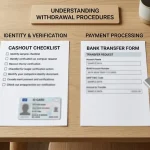
A deposit is only the first step in a cash transaction. The payment method accepted at checkout may not be available for withdrawals, and a successful deposit does not establish that an account is ready to receive a payout. For offshore casino transactions, the relevant terms are the permitted funding route, the identity checks and the withdrawal rules.
Payment options vary between operators. A specialist review reports that PayID, POLi, BPAY, cards and cryptocurrency have been listed as deposit methods, but availability and processing times differ. POLi ceased Australian operations in September 2023 and no longer handles local transactions, so a site listing it should not be treated as evidence that it can process a current Australian payment. PayID being described as near-instant and typically free also comes from a specialist review, not a dependable guarantee for a particular transaction.
Card deposits can fail even when the card is active. A specialist review reports that some Australian banks block or flag gambling-related card charges. A decline may therefore reflect the bank’s handling of the transaction rather than an error in the casino account. Repeating the same payment attempt does not resolve a bank restriction; the available alternatives depend on the operator’s current cashier terms.
Withdrawal rules need to be checked separately. A specialist review reports that some casinos require a withdrawal to use the same method as the deposit, while other methods are deposit-only. That distinction can affect the route and timing of a cashout, so the withdrawal menu matters before funds are transferred. The same type of review reports that some operators apply weekly or monthly withdrawal ceilings, with cited weekly figures in the $4,000–$10,000 range. Those limits are operator-specific, not a market-wide standard.
The first withdrawal commonly triggers identity verification. A casino may request a selfie or identity document and proof of address before releasing funds. If documents are incomplete or details do not match the account, processing can stop while the operator requests further evidence. Verification is therefore a condition of access to a payout, not merely an account-opening formality.
The sites discussed in this guide are offshore and crypto-friendly; that description is not an endorsement or a statement that they are authorised to provide casino services in Australia. Before depositing, the site’s terms must confirm that it accepts the punter’s location. Using a VPN to reach a blocked casino may result in winnings being voided and the account closed. If an offshore casino refuses to pay, there is no Australian government body to which the punter can complain for recovery of the winnings.
A payment route is usable only if it works at both ends of the transaction and its restrictions are clear. Deposit acceptance, withdrawal eligibility, verification requirements and payout ceilings determine whether a displayed balance can be turned into money received.
A no-deposit label describes the entry condition, not the value of a bonus. The usable amount depends on what must be wagered before any resulting balance can be withdrawn, whether a deposit is required later, and how much time is allowed. If any condition makes completion unrealistic, the headline offer has little practical value.
A specialist review describes welcome-bonus wagering requirements in the range of 30x to 50x the bonus amount. The multiple is applied to the amount specified in the terms; it should not be assumed to apply only to winnings. The exact calculation basis matters. A requirement above 40x is considered steep in that review, but the multiple alone does not settle the question: game restrictions can affect which wagers count, and an expiry deadline can cut off progress before the requirement is met.
The basic test is whether the stated wagering requirement can be completed within the offer’s time limit, using only eligible games and under any applicable cashout cap. A bonus can look generous while requiring substantial wagering relative to its value. Without checking the calculation basis and eligible play, the displayed amount is not a useful measure of what may ultimately be withdrawable.
Minimum-deposit conditions also change the calculation. An offer may be described as no-deposit while other terms require a deposit to activate, continue, or withdraw a bonus-related balance. The terms need to be checked for such conditions before the offer is treated as genuinely deposit-free. If a minimum deposit applies, it is part of the cost of taking up the offer, not a minor footnote.
A specialist review reports that many bonuses have to be cleared within 7–10 days; missing the stated deadline can mean losing the bonus. That period is not a universal rule, so the specific offer’s expiry date controls. A short window combined with a high wagering multiple leaves less room to complete the required play. If the deadline passes first, progress may have no remaining value.
Before claiming, the full bonus terms should be read for wagering requirements, game restrictions, expiry dates and cashout caps. The minimum deposit, if any, should be included in the cost assessment. The important figure is not the advertised bonus amount but the balance that could remain after all conditions are satisfied.
The arithmetic is straightforward: establish the wagering base, apply the stated multiple, then check whether eligible play can be completed before expiry. Finally, account for any cap that limits the amount available to cash out. If the operator’s wording does not make these terms clear, the offer’s final value cannot be calculated reliably.
A no-deposit bonus is therefore not equivalent to cash. It is a conditional balance with a deadline and restrictions. The label explains what may not be required at the start; it does not establish what must happen before the balance can be withdrawn.
For Australian users, access to casino-style services on a phone is generally based on a mobile browser or a Progressive Web App (PWA), rather than a conventional app-store download. That distinction matters: a site described as having an “international casino app” may mean a website shortcut, not software listed in an official app store.
Direct website access via a browser; avoids installations and uses the same account as desktop.
A website shortcut added to the home screen that behaves like a native app.
Software installed via sideloading, as they are rarely available in official Australian app stores.
A mobile browser is the default route because casino apps are seldom available through Google Play or Apple’s App Store in Australia. The same account can be used on desktop and mobile, so browser access does not necessarily mean creating a separate profile for a phone.
The browser option also avoids installing a separate application package. The casino website is opened directly in the browser, and access remains tied to that site. A browser bookmark may make it easier to return, but it is still a link to the website rather than an installed app. The distinction is useful when a page uses app-style language: the label alone does not establish that a native application exists.
A Progressive Web App is a shortcut to a website that is designed to behave more like a native app on a mobile device. It does not turn the casino site into an app-store product. Instead, the website offers an installation prompt, often labelled as an install option or an instruction to add the site to the home screen.
The installation process is straightforward: tap the prompt, then confirm the addition on the device. Afterward, the shortcut appears alongside other home-screen icons and opens the casino website. The format changes how the site is reached; it should not be mistaken for evidence that the operator has a native app distributed through Google Play or Apple’s App Store.
A PWA can therefore sit between ordinary browser use and a native app in presentation, while remaining connected to the website. The key practical question is whether the shortcut is being created from the casino’s own website and what it opens when tapped. An icon on a home screen, by itself, says little about the underlying software or the operator.
A native app is software installed on the device, but such casino apps are rarely listed in Australia’s official app stores. If a site instead offers an app file for direct installation, that is sideloading, not an ordinary store download. Sideloaded casino apps carry security risks, and their safety depends on the operator. The convenience of an icon does not remove that exposure.
The formats should not be treated as interchangeable assurances. Browser access means using the website; a PWA adds a home-screen shortcut with app-like behaviour; a native app is a separate application. The method offered by a particular site should be checked before any installation, and an unexpected download prompt should not be treated as proof of legitimacy. Since browser access is the default in Australia, a claim that an app is available warrants checking where it comes from and whether it is a PWA or independently installed software.
A review is an assessment, not proof that an offshore casino will honour every term or accept every Australian account. Its most useful claims are those that can be checked independently. Licensing deserves that treatment: jurisdictions commonly associated with casinos accepting Australians include Curaçao, the Malta Gaming Authority (MGA) and Gibraltar. A jurisdiction named in a review is only a starting point. The relevant question is whether the operator’s own licensing details can be matched to an authoritative record, rather than whether a badge appears on a webpage.
Licensing Jurisdictions
Common jurisdictions for casinos accepting Australian players include Curaçao, the Malta Gaming Authority (MGA), and Gibraltar.
The distinction matters because “licensed” is not a complete verdict. A review should identify the jurisdiction it refers to and make clear which operator holds the licence. If it relies on a logo, an unexplained statement or a general description of regulation, the claim is difficult to assess. A polished review cannot turn an offshore licence into Australian government oversight.
Review language also needs separating from evidence. Terms such as “trusted,” “fast” or “player-friendly” are conclusions, not measurable conditions. More useful assessments explain what information supports those conclusions and where uncertainty remains. A page that names an offshore crypto-friendly casino as an option should make its offshore status explicit; that description is not a substitute for checking the site’s terms or suitability.
Location acceptance is a separate point that promotional summaries can obscure. Australian players must confirm that a site accepts their location before depositing. A review’s inclusion of a casino does not establish that access will remain available or that a particular account is eligible. VPN use to reach a blocked casino may void winnings and lead to account closure, so it cannot be treated as a routine workaround.
The same scrutiny applies to bonus coverage. Before claiming an offer, the terms should be read for wagering requirements, game restrictions, expiry dates and cashout caps. A headline amount or a favourable review score cannot show the final value without those conditions. Where a review omits them, its bonus assessment is incomplete.
Finally, reviews cannot provide an Australian complaint route for an offshore dispute. If an offshore casino refuses to pay winnings, there is no Australian government body to complain to. That consequence belongs beside any assessment of operator claims, not in fine print. A review can help organise questions; it cannot remove the limits of offshore recourse or guarantee an outcome.
A list of games says little about the conditions attached to play. Menus can change, and a title displayed on a site does not establish how it works, what rules apply or whether it is suitable for a particular punter. For that reason, a catalogue of international casino games should not be treated as a measure of value or as a reliable basis for comparing sites.
The more useful distinction is between the content on offer and the controls available around it. Game descriptions concern the activity; account controls concern how much money or time can be put at risk. Those are separate questions. A polished menu does not make the financial exposure more manageable, and a control setting does not change the underlying terms of a game.
A specialist review describes responsible-play tools such as deposit caps, loss limits, wager limits, session timers and self-exclusion. Their functions differ: some restrict money added or lost, some limit wagering, and others interrupt access for a period or more broadly. Availability on a site is not the same as a limit being active. The terms should explain how each control is set, when a change takes effect and what happens once the selected boundary is reached. Without those details, a control label is not enough to calculate its practical effect.
Self-exclusion is distinct from a routine spending limit because it is intended to restrict further access, rather than simply set a financial ceiling. Its scope and operation therefore matter. A site’s description should make clear whether the restriction applies to the account and how it can be lifted or maintained. Where the wording is unclear, the control cannot be assigned a dependable protective value.
No control removes the possibility of loss. A deposit limit can bound funds entering an account, but it does not make the games profitable; a session timer can mark elapsed time, but it does not change the result of a wager. The sensible calculation is to treat controls as boundaries, not as a guarantee of an outcome.
Content claims deserve the same restraint. Broad labels such as table games or poker do not verify the rules, availability or conditions of any particular title. A punter assessing an offshore site should separate what the site says it offers from what its terms and functioning controls establish. Where those terms do not explain the limits clearly, the uncertainty itself is part of the cost.
Live roulette may look different from a digital table game because a streamed dealer and a physical wheel are part of the presentation. That format does not change the legal classification of the service. Under the Interactive Gambling Act 2001, operators are prohibited from offering online casino-style games to people in Australia. Roulette remains a casino-style game whether its wheel is shown on a live video feed or rendered on screen.
The relevant boundary is the service being offered, not the game’s production method. A live table presented by an offshore operator is still an online casino service. Calling it an international roulette venue, a studio game or a live-dealer product does not create a separate legal category for Australian users. Nor does the presence of a real dealer make the offer equivalent to attending a casino in person: access and play are provided online.
This distinction matters when evaluating claims about an international live roulette casino. A foreign location, offshore licence or live broadcast describes aspects of the operator or product; none changes the Australian rule on operators offering online casino-style games to people in the country. The legal restriction is directed at the operator’s provision of the service. It does not make roulette lawful merely because the operator is based elsewhere.
For punters, an offshore service also carries a practical boundary separate from the game itself. The Australian Communications and Media Authority actively blocks access to illegal gambling sites, so a site’s availability at a particular moment is not evidence that it is authorised to serve Australia. Using a VPN to reach a blocked casino may breach the site’s terms, void winnings or result in account closure. Access can therefore be interrupted, and a displayed table does not establish a reliable route to funds.
Offshore casinos accepting Australian punters are offshore and crypto-friendly, but that description is not a recommendation or a sign of Australian approval. A site’s location rules must be confirmed before any deposit; acceptance at registration does not settle whether the operator will later treat the account as eligible. If an offshore casino refuses to pay winnings, there is no Australian government body to complain to about that unpaid withdrawal.
The distinction is therefore straightforward: live presentation changes how roulette is delivered, not the operator’s legal boundary in Australia. A streamed wheel remains an online casino-style service, and an offshore label does not remove the risks of blocked access or an unpaid claim.
Attention There is no Australian government body available to compel an offshore casino to pay winnings if it refuses.
An offshore crypto-friendly casino may offer cryptocurrency as a withdrawal route, alongside e-wallets. The method alone does not determine when funds arrive: the casino’s review and release process comes first, followed by the payment network’s settlement. A quoted processing window should therefore be read as a condition, not a promise of cleared funds by a particular time.
A specialist casino review reports that crypto and e-wallet withdrawals are processed in under 24 hours. That is a reported timeframe, not a guaranteed market-wide standard. It may describe the casino’s handling stage rather than the full time until funds are available. The distinction matters: a request can be approved promptly while settlement still depends on the chosen route and its processing conditions.
E-wallets including MiFinity, Skrill and Neteller are used for both deposits and withdrawals. A specialist review places e-wallet withdrawals within 24 hours after the casino’s pending period. The pending period is separate from the stated transfer window, so the total wait may exceed the headline figure. The account holder should check both stages in the operator’s terms.
The same review type reports that bank-transfer withdrawals can take up to five business days. That comparison makes crypto or an e-wallet look faster on paper, but only if the casino releases the transaction without additional delay. A business-day estimate also does not mean calendar days. The practical comparison is between the full stated process for each method, not just the point at which the casino marks a withdrawal as approved.
Before selecting a route, the relevant terms are the supported currency, any conversion applied, the destination-account requirements and whether the selected method is available for withdrawals. A balance displayed in one currency may not equal the amount received after conversion or network costs. Those details are operator-specific; a general processing estimate cannot settle them. Cryptocurrency also introduces price movement between requesting and receiving a transaction, so the value may change even when the transfer completes as described.
Any offshore casino considered for this purpose is outside Australia’s locally permitted online casino framework. Its location acceptance must be confirmed before depositing. Using a VPN to reach a blocked casino may void winnings and lead to account closure. If an offshore casino refuses to pay, there is no Australian government body to complain to about that unpaid withdrawal. These are material transaction risks, not footnotes to a faster payment route.
International casinos can differ in licensing, payment details and minimum deposits. This list gives Australian players a concise overview of the information available for each option.
Bizzo Casino
Bizzo Casino is listed with a Curacao Gaming Control Board licence held by TechSolutions Group N.V.
Kingmaker
Kingmaker lists crypto payouts at around 90 minutes and fiat payouts at 1–5 days. Its minimum deposit is A$30.
Vegaz Casino
Vegaz Casino lists licence number Curacao OGL/2024/1335/0780 and a minimum deposit of EUR 20.
JeetCity Casino
JeetCity Casino is listed as licensed by Curacao eGaming, with Dama N.V. named as the operator.
Thor Casino
Thor Casino lists a Curacao licence issued through Antillephone N.V., with Versus Odds B.V. named. Its minimum deposit is EUR 20.
LevelUp Casino
LevelUp Casino lists Curacao eGaming licence OGL/2023/174/0082, with Dama N.V. named as the operator. Its minimum deposit is A$15.
LuckyVibe
LuckyVibe lists a Curacao Gaming Control Board licence, OGL/2023/176/0095, held by Hollycorn N.V.
JustCasino
JustCasino is listed with a Curacao Gaming Control Board licence.
Ricky Casino
Ricky Casino lists crypto payouts under 1 hour and PayID payouts in 1–3 business days. The minimum deposit is A$20, or A$30 to qualify for the bonus.
Wild Tokyo
Wild Tokyo lists a Curacao licence, crypto payouts in 30–60 minutes and fiat payouts in 1–5 days. Its minimum deposit is A$10.
A useful assessment is not a ranking. Offshore, crypto-friendly casino services differ in whether they accept Australian residents, what account checks they apply and how they handle withdrawals. A site’s general availability does not establish that it accepts a punter’s location. Location acceptance should be confirmed with the operator before any deposit; terms can change, and an account opened from an excluded jurisdiction may be restricted.
Access is also not a substitute for permission to provide the service. The Interactive Gambling Act 2001 prohibits operators from providing real-money online casino games to people in Australia. The Australian Communications and Media Authority blocks access to illegal gambling sites. Using a VPN to reach a blocked casino can breach the operator’s terms, void winnings and lead to account closure. A connection that works today does not settle either the legal position or the operator’s withdrawal obligations.
The main financial risk is what happens after funds have been sent. An offshore operator’s terms govern its own procedures, but they do not create a local complaints route. If winnings are withheld, there is no Australian government body to which a punter can complain for recovery through a domestic casino regulator. That distinction matters more than a headline offer: the potential balance and the available remedy are not the same thing.
Before any promotion is accepted, its wagering requirement, eligible games, expiry date and cashout cap should be checked together. Each term can reduce the amount that can ultimately be withdrawn; a large advertised bonus alone says little about the final value.
The decision therefore turns on conditions that can be verified before money moves: explicit acceptance of Australian residents, clear account and withdrawal terms, and an understanding that access may be blocked and local recourse is absent. Where any of those points is unclear, the uncertainty is part of the cost, not a minor detail.
Yes. Most are accessed through a mobile browser, and some offer a Progressive Web App that can be added to your home screen.
No. Browser play is the usual option, as casino apps are rarely listed on the Australian app stores.
There is no Australian government body that can compel an offshore casino to pay. The fact that playing is not illegal for an individual under the Interactive Gambling Act does not guarantee payment.
Using a VPN may breach the casino’s terms and could lead to voided winnings or account closure. It does not remove the Australian legal framework or provide a local route to enforce a payout.
They specify how many times the bonus amount must be wagered before the bonus is cleared. Common requirements are 30x to 50x, and many bonuses must be cleared within 7–10 days.
Check the wagering requirement, minimum deposit and expiry period before accepting. Requirements above 40x are steep, and missing a 7–10-day clearance deadline can mean losing the bonus.
Yes. Mobile and desktop generally use the same casino account.