The guide explains Australian operator restrictions alongside account checks, payments, withdrawals, game claims and harm safeguards.

In Australia, “safe” cannot be treated as a synonym for “available” or “legal”. A website may accept Australian customers, but that does not make its online casino offer lawful under Australian rules. The relevant distinction is between the conduct of the operator and the position of the individual player.
The Interactive Gambling Act 2001 bars domestic operators from providing online casino games to people in Australia. The restriction concerns the service being offered, not merely the location of a company’s website or the wording used to describe a game. A casino-style service does not become permissible because it is hosted offshore or uses a foreign-facing brand. For the legal boundary, the key issue is whether the operator is supplying the prohibited service to customers in Australia.
That boundary should not be confused with a claim that an individual player is criminalised for using an offshore casino. The Act does not explicitly make individual players liable simply for using such a site. This difference matters: a rule aimed at operators does not automatically create a matching offence for customers. It also does not turn an offshore offer into an authorised Australian service. Operator legality and player liability are separate questions, and neither answers every practical question about safety.
The Australian Communications and Media Authority, generally known as ACMA, is the primary regulator for online gambling. Its role places the legal status of a service within a national regulatory framework rather than leaving the question to a site’s own marketing language. A claim such as “safe casino online” therefore has to be read carefully. It might refer to account security, the treatment of payments, or a company’s internal procedures; none of those descriptions establishes that the operator may lawfully provide online casino games to Australians.
The word “licensed” also needs a precise object. Australians are encouraged to consult ACMA’s public register to check whether a wagering service holds a valid Australian licence. That is a relevant check for services that may lawfully be licensed in this market. It should not be read as evidence that a real-money online casino can obtain local approval to offer prohibited casino games to Australian residents. A register entry for a wagering service does not, by itself, authorise every product or activity associated with that business.
This is why general assurances about a “safe online casino in Australia” can collapse several different tests into one label. A site may describe itself as secure or refer to an offshore licence, but neither statement changes the domestic rule for online casino games. An offshore licence is not an Australian licence. Equally, the fact that Australian law does not explicitly criminalise an individual player does not amount to government approval of the service.
A practical reading of the legal position is therefore narrow. The operator’s offer must be considered separately from the player’s exposure to criminal liability, and a service’s own assurances must be separated from its status under Australian law. ACMA’s public register can help verify whether a wagering service has a valid Australian licence; it is not a shortcut to treating an online casino as locally authorised.
The legal boundary is less reassuring than a simple “safe” label suggests. An individual’s lack of explicit criminal liability does not cure an operator’s prohibited offer, while the presence of a register entry for a wagering service does not establish that online casino games are permitted. Those distinctions define what the word “safe” can and cannot mean in this market.
PayID describes a way to transfer money, not a safety rating for the service receiving it. A payment can move through a banking network without establishing that the recipient is authorised to offer online casino games in Australia, or that a player has a reliable route to recover money if a dispute arises. The Interactive Gambling Act 2001 prohibits operators from providing real-money online casino games to people in Australia. A familiar payment option does not change that position.
A specialist gambling review describes PayID transfers as running over the New Payments Platform and potentially clearing within minutes once released. That is a qualified statement about transfer processing, not a promise that every transaction will be immediate. “Once released” matters: the time for a bank transfer to clear is separate from any delay before a payment is sent or approved. A fast-moving transfer can therefore sit inside a slower overall process.
Attention: A fast transfer speed describes the banking network processing and does not guarantee that a service is authorised or that a withdrawal will be released promptly.
The same distinction applies to deposits and withdrawals. A service accepting PayID for a deposit has shown that it can receive a transfer by that route. It has not thereby shown that it will return funds through PayID. The incoming and outgoing transactions are separate actions, and the existence of one does not prove the availability of the other. Treating a deposit button as evidence of a cash-out route is a bookkeeping error, not a safety check.
Before any transfer, the relevant terms are those that describe the direction of payment: whether PayID is listed for deposits, whether it is listed for withdrawals, and what conditions apply to each. A payment page that names PayID only beside deposits answers only the deposit question. If the withdrawal method is not stated clearly, the practical position remains unresolved. A projected transfer time cannot fill that gap.
There are also two different meanings of “safe” in a payment context. One concerns the movement of money through the transfer system. The other concerns the recipient, the transaction’s purpose and the ability to obtain funds back. A transfer that clears quickly may satisfy the first meaning while doing nothing to resolve the second. PayID is not a regulator, a guarantee of an operator’s conduct or evidence that a casino service is lawful in Australia.
The timing claim should be read narrowly as well. The specialist review’s reference to clearance within minutes applies after release; it does not establish that the receiving service releases a withdrawal promptly, or that a withdrawal is available through PayID at all. Those are distinct stages. The first is bank processing after a transfer begins. The second depends on the service’s own payment arrangements. Combining them into one headline time would conceal the point at which the delay occurs.
For a deposit, a PayID option can indicate that the service is prepared to accept that kind of transfer. It cannot establish what happens if a withdrawal is refused, delayed or sent by another route. Nor does the speed of a deposit establish that a no-deposit offer, bonus or account promotion is safe: promotional terms and payment processing are separate questions, and neither makes a prohibited casino offer lawful.
A deposit route and a cash-out route are separate entries; the availability of a PayID deposit button does not prove that PayID is available for withdrawals.
The sound conclusion is limited. PayID may be a rapid transfer rail after a payment is released, according to the cited specialist review. That fact describes possible processing speed; it does not certify the casino, guarantee a withdrawal, or make an Australian online casino offer safe. A deposit route and a cash-out route must be assessed as separate entries.
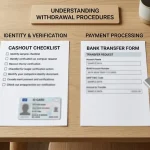
A withdrawal from a real-money casino account may require identity checks before it can be processed. These checks are commonly described as Know Your Customer, or KYC, procedures. They concern the identity attached to the account and the payment method used; completing them is not evidence that an operator is licensed in Australia or that its service is lawful here.
The documents commonly requested cover three separate points:
The purpose of separating these requests is practical: an identity document does not, by itself, establish an address or show who owns a payment method. A real-money account can therefore involve more than a single identity check. The relevant question is not simply whether a platform asks for documents, but whether the requested evidence matches the account and payment details it is checking.
Before submitting anything, the account information and document details should be consistent. A name or address entered in one place but shown differently in another can make it harder to establish that the records refer to the same person. Payment-method evidence has its own test: it should connect the method used with the account holder, rather than merely confirm that a transaction occurred.
This is an administrative process, not a quality rating. A request for photo ID, address evidence and proof of payment-method ownership does not establish that a site is a safe Australian real-money casino. Nor does a completed KYC check change the legal status of an online casino service offered to people in Australia. Verification describes an operator’s account procedure; it does not create Australian authorisation.
That distinction matters when evaluating claims in a safe casino review. A description of the documents requested can tell something about the operator’s withdrawal checks, but it cannot establish that the operator is licensed in Australia, that a withdrawal will be paid, or that a player has consumer protections. Treating an identity check as a safety seal would combine separate questions into one conclusion the check cannot support.
The same limitation applies to mobile accounts. A phone may be the device used to open an account or upload records, but mobile access does not reduce the underlying verification requirement. The evidence still needs to identify the account holder, support the recorded address and show ownership of the payment method. Convenience of access and verification of identity are different matters.
For records, the useful distinction is between what is being proved and what document is being used to prove it. Photo identification addresses identity; address evidence addresses residence details; payment-method evidence addresses ownership. A platform’s instructions may specify what it accepts, so the category of document alone does not guarantee that a particular file will meet its requirements.
KYC should therefore be treated as a condition attached to an account withdrawal, not as a guarantee about the result. It indicates that identity verification is required before funds are released. It does not certify the operator, validate an offshore licence for Australian activity, or establish that the service is safe for Australian players. A neat document checklist can resolve an identity question; it cannot resolve the larger legal and consumer questions around an online casino.
“Best” and “safe” are promotional descriptions, not regulatory categories. A polished comparison, a prominent badge or repeated assurances do not establish that an online casino is authorised to offer real-money games in Australia. The useful test is narrower: can the claimed status be checked against an official source, and does that source cover the product being promoted?
ACMA has urged Australians to consult its website and the national register for information about legal gambling products. That is a check on the product’s status, not a general endorsement of every service that appears in an advertisement or review. A register entry relating to a legal gambling product cannot be stretched into proof that an online casino or its slots are licensed in Australia. The scope of the entry matters as much as the name attached to it.
A site may describe itself as “trusted”, “secure” or the best safe online casino in Australia. Those words do not answer the regulatory question. Nor does an offshore licence establish local authorisation: real-money online casino games cannot lawfully be offered to people in Australia by domestic operators, and an offshore licence does not change that boundary.
A sound assessment therefore starts with the precise service being promoted. If the offer is for online casino games, a claim of Australian licensing should not be accepted at face value. Look for the service in the relevant official register and read what the entry actually covers. If the claim cannot be matched to an official record for the relevant product, the claim remains unverified. A logo, copied licence number or statement in the site’s own terms is not an independent check.
The wording “safe bet” can also blur two different ideas: a legal wagering product and a real-money online casino. The first does not make the second lawful. A valid status for one category of gambling should not be treated as permission to provide another. In this market, the distinction is not fine print; it determines whether the comparison is about an authorised product at all.
Even where a product is legally available, “safe” can refer to different things: regulatory status, account security, payment handling or the chance of receiving a payout. Evidence for one does not establish the others. A register can help confirm the legal category of a product; it does not, by itself, prove every claim a business makes about its operations.
A ranking headed “best safe online casinos” is especially weak if it gives no verifiable basis for the ranking. The order of names is not evidence, and a confident verdict cannot substitute for an official record. The same applies to claims about safe online casino slots: calling a game or site safe does not alter the legal status of providing online casino games to Australians.
 Top-Rated Online Casinos in Australia: What Ratings MeanLearn what casino ratings assess, why most sites serving Australians operate from Curaçao, and how wagering terms and withdrawals affect comparisons.
 Platipus Casinos in Australia: Bonus Wagering GuideSee how slot wagers can count at their full contribution rate, why that is separate from payout or odds, and which promotion…
 Online Craps Australia: Formats, Bets and Bonus TermsLearn how electronic and live-dealer craps differ, what listings cannot confirm about Australian access, and why bonus terms need separate scrutiny.
 KA Gaming Online Casinos in Australia: BonusesLearn how slot weighting affects bonus turnover, how wagering requirements shape withdrawals, and what to check in deposit and free-spin terms.
 New Online Casinos in Australia: What “New” MeansLearn how to distinguish a recent launch from a newly noticed offshore casino and assess PayID, wagering rules and withdrawals; most are…
 Novomatic Casinos in Australia: Games and LegalityLearn what Novomatic casino listings can and cannot confirm, how bonuses are calculated, and why offshore sites are not locally licensed in…
For a comparison that uses “best” or “safe” responsibly, the claim should be specific, its basis should be stated, and the relevant official record should support any assertion about legal status. Where that chain breaks, the safest conclusion is not that the service has passed an informal review. It is that the promotional label has not demonstrated what it implies.
A website becoming unavailable in Australia can reflect regulator action, not a technical fault or a judgment about the site’s security. ACMA can ask internet service providers (ISPs) to block sites offering prohibited interactive gambling services to Australian customers, as well as unlicensed services offered to adults in Australia. ACMA can also fine operators that breach the Interactive Gambling Act 2001.
The distinction matters when assessing claims about safe Australian casino sites. A page that loads is not thereby authorised to provide online casino games in Australia; a page that does not load may have been affected by a block. Availability is a practical access condition, not a safety certificate. Nor does a polished website or a functioning sign-in page establish that its gambling offer is lawful.
ACMA Blocking
ACMA can request ISPs to block access to illegal gambling and affiliate websites that breach the Interactive Gambling Act 2001.
ACMA uses blocking as one part of enforcement against illegal gambling services and related websites. Since its first blocking request in November 2019, it has restricted access to 1,369 illegal gambling and affiliate websites. The total includes affiliate sites, so it should not be read as a count of casino operators alone. It does, however, show that enforcement can affect both gambling services and pages that direct people towards them.
A blocking request is directed to ISPs, which are asked to prevent access to the named websites. For a user, the result may be that a site no longer opens through an internet connection subject to the block. That outcome does not, by itself, establish whether the site has closed, changed its web address, or remains available elsewhere. It establishes only that access has been restricted in that way. A different address or a temporary return of a page would not prove that the service is permitted to operate.
This is why availability checks are an incomplete way to judge online casino sites. A site can be reachable without being licensed in Australia, and a regulator’s block is not a review of its payment terms, privacy practices or game fairness. Those are separate questions. The relevant point here is narrower: ACMA can act against prohibited or unlicensed services, and that action can change whether their websites are accessible from Australia.
The reverse inference is also unsafe. A site loading normally does not mean ACMA has approved it, and the absence of a visible block does not confer Australian authorisation. Blocking is an enforcement measure, not a public endorsement system. For anyone comparing claims that a service is a safe and secure casino, a working page is weak evidence: it describes access at that moment, not legal status or consumer protection.
ACMA’s activity therefore has a direct effect on the availability of gambling websites, but a limited meaning for an individual site. It can signal that a service has come within enforcement action; it cannot turn access status into a general quality rating. In practical terms, a block can stop a route to a site. A page remaining open cannot settle the more important question of whether the operator may offer the service in Australia.
A deposit limit is a control on money entering an account, not evidence that the service is safe or lawful in Australia. A specialist review describes licensed online casino accounts with limits that can be set daily, weekly or monthly. That is a description of a feature, not confirmation that an online casino is licensed in Australia or authorised to offer casino games to people in the country.
The distinction matters because a setting only governs the activity it is designed to govern. A deposit cap concerns deposits; it does not, by itself, establish the legality of the operator or provide a remedy if a dispute arises. Nor should the presence of a limit be treated as proof of broader consumer safeguards. In a market where online casino games are prohibited, a tool that controls spending does not change the status of the underlying service.
A useful check is whether information about gambling-related harm is easy to find and whether it points to professional support in Australia. Reputable platforms provide such information and direct players to support services. That information is a separate safeguard from account controls: a limit may constrain deposits, while support services address harm and its consequences.
Gambling Help Online is one Australian support service; the National Debt Helpline can also be relevant where gambling has affected finances. Their presence in a platform’s help material is not a substitute for checking what the service actually offers, and a link does not establish that the casino itself is authorised. Support information should be clear enough to identify the service and how to reach it, rather than buried among promotional claims.
The practical assessment is therefore not simply whether an account offers a daily, weekly or monthly cap. It is whether the available information explains the limit’s scope, and whether the platform provides a direct route to professional help. A menu setting may be visible; the legal status of the service is a different question. Combining the two into a single idea of “safe play” would make a spending control carry more weight than it can bear.
For Australian residents, responsible-gambling features should be read as harm-reduction measures, not permission to use a prohibited online casino. Deposit limits and support links can be useful information, but neither turns an unlawful offer into a lawful one. A safeguard has a defined job; it cannot settle every other risk attached to the account.
A game’s return-to-player figure and its legal status answer different questions. RTP describes a game setting; it does not establish that the game may lawfully be offered to people in Australia. Online slots and casino games such as blackjack fall within the services that operators cannot provide to Australian customers. A favourable RTP figure does not change that position.
RTP is a stated return setting, not a forecast of what an individual session will return. It is useful for comparing versions of a game, but it cannot establish that a particular play will produce a gain or that a site offering the game is safe. The number describes the game configuration, not the legal standing of the service through which it is accessed.
For a pokie, the RTP can be found in the game’s information or help screen, often opened through an “i” symbol or a menu. The figure displayed there is more relevant than a general description elsewhere because the same game title may be issued in multiple RTP versions. The operator selects which version to run. As a result, a figure associated with a title in one place may not describe the version presented in another.
That distinction matters when a game is labelled as having a high or generous return. The title alone does not identify the RTP version, and promotional wording cannot replace the information shown in the game itself. Even a correctly displayed RTP remains a game attribute, not a safety certificate or permission to offer online casino play in Australia.
Free-play access does not settle the question either. A demonstration may show how a game works or where its information screen is located, but it does not make real-money online casino games lawful for Australian customers. Nor does a displayed RTP tell whether a particular service is authorised. Those are separate matters, and merging them turns a technical figure into a claim it cannot support.
For a pokie, the return-to-player (RTP) figure can typically be found in the game’s information or help screen, often accessed via a menu or an “i” symbol.
The practical reading is narrow: check the game’s own help or information panel for its RTP, and treat that number as applying to the version selected by the operator. It can clarify what setting is attached to the game being shown. It cannot establish that the service is safe, that another version has the same return, or that the game may lawfully be offered in Australia.
A mobile page can protect a connection without making the gambling service lawful or safe to use. Casinos use SSL encryption to protect transactions and sensitive information as it moves between a device and a site. That is a technical safeguard for data in transit; it does not establish who controls the service, how account information is handled after it arrives, or whether winnings will be paid.
The distinction matters on a phone, where a login may be entered while moving between networks or using a device shared with other people. A saved password, an unlocked screen or an account left open can expose access even when the site connection is encrypted. A unique password, a device lock and signing out after use reduce those avoidable exposures. None changes the legal status of online casino games offered to people in Australia.
A padlock or secure-connection indicator is therefore a narrow signal, not a certificate of trustworthiness. It says something about the connection, not whether the operator is authorised to provide casino games in Australia. A polished mobile layout and a working login screen answer the same limited question: whether the page loads and accepts credentials. They do not settle the risk attached to the service or its terms.
Location tools create a separate problem. Using a VPN to access a casino may lead to winnings being voided, the account being closed and the deposit being lost. A changed apparent location does not remove the Australian legal restrictions on operators providing online casino games to people in Australia. It can instead create a mismatch between the location detected by the service and the location associated with the account, giving the operator grounds under its terms to dispute access or balances.
This applies to mobile access as much as desktop access. A VPN is not a consumer-protection measure, and encryption does not reverse the consequences of a location or account dispute. Where a service’s terms permit closure or withholding after location rules are breached, the practical exposure is the account balance as well as the login itself.
A safe mobile experience cannot be inferred from speed, design or encryption alone. For Australian users, the central calculation remains the gap between a protected connection and a service that is legally permitted to offer casino games. Mobile security can reduce some exposure of credentials and data; it cannot supply legal authorisation or guarantee that funds will be returned.
Choosing an online casino safely means checking what is actually known about its licensing and payments rather than relying on a label. Use these short profiles as a starting point, and verify the details that matter to you before signing up.
Bizzo Casino
Bizzo Casino is listed with a Curacao Gaming Control Board license held by TechSolutions Group N.V. That licensing detail is the available basis for assessing it here.
Kingmaker
Kingmaker lists crypto payouts at around 90 minutes and fiat payouts in 1–5 days. Its minimum deposit is A$30.
Vegaz Casino
Vegaz Casino lists Curacao license OGL/2024/1335/0780 and a minimum deposit of EUR 20. These are the available details for an initial review.
JeetCity Casino
JeetCity Casino lists a Curacao eGaming license under Dama N.V. No payment or deposit details are provided here.
Thor Casino
Thor Casino lists a Curacao license issued through Antillephone N.V. for Versus Odds B.V., and a minimum deposit of EUR 20. The available information does not describe its payout options.
LevelUp Casino
LevelUp Casino lists Curacao eGaming license OGL/2023/174/0082 under Dama N.V. Its stated minimum deposit is A$15.
LuckyVibe
LuckyVibe lists Curacao Gaming Control Board license OGL/2023/176/0095 under Hollycorn N.V. No deposit or payout details are provided here.
JustCasino
JustCasino is listed with a Curacao Gaming Control Board license. The information available here is limited to that licensing detail.
Ricky Casino
Ricky Casino lists crypto payouts under 1 hour and PayID payouts in 1–3 business days. The minimum deposit is A$20, or A$30 to qualify for the bonus.
Wild Tokyo
Wild Tokyo lists a Curacao license, crypto payouts in 30–60 minutes, fiat payouts in 1–5 days, and a minimum deposit of A$10. These details give readers a starting point for checking its terms.
“Safe” can mean that a player is not expressly criminalised for using an offshore casino, or that the player has a dependable way to enforce the account terms and recover money. Those are separate questions. The Interactive Gambling Act 2001 does not explicitly criminalise individual players for using offshore casino sites. That does not give an unlicensed service permission to operate in Australia, or create a consumer remedy when it refuses to pay.
For a player, the practical risk appears when a balance or claimed winnings are disputed. An unlicensed gambling service lacks the consumer protections available through a locally authorised service. If it withholds winnings, Australian laws may not assist in recovering them. The absence of a player offence therefore cannot be treated as a guarantee of access to funds, a local complaints route, or an enforceable payout.
This is the protection gap: legal exposure for the player and practical recourse against the operator are not the same measure. “Not criminalised” describes one narrow part of the position. It says nothing about whether an offshore operator will honour its own terms, whether a dispute can be resolved, or whether money can be recovered once the operator refuses payment.
Protection Gap
While individual players may not be explicitly criminalised for using offshore casinos, they lack the consumer protections required to recover funds if a dispute arises.
A polished website, a familiar payment option or a claim of an offshore licence does not close that gap. Nor does a “safe” label establish that a service is licensed in Australia. Safety claims need to be read against the service’s actual status and the consequences of a dispute, not as a promise that deposits or winnings are protected.
There is no reliable list of safe online casinos in Australia where the underlying services are unlicensed. A ranking cannot supply the consumer protection that the legal arrangement does not provide. The relevant calculation is stark: if funds are withheld, the player may have no effective Australian route to recover them. The fact that using the site is not explicitly criminalised does not change that outcome.
Safety, in this context, is not a design feature or a reassuring badge. It depends on enforceable protection when a transaction goes wrong. Without that protection, a service can be accessible in appearance while leaving the player to bear the financial loss.
An Australian-dollar balance removes currency conversion from the displayed account total, but it does not establish when money can be withdrawn or which route will carry it. Deposit timing and withdrawal timing are separate terms. A payment option shown at checkout is not, by itself, evidence that the same option is available for cash-outs.
A specialist payment review describes PayID and some e-wallets as potentially quick after approval, while bank transfers and card payments may take several business days. That is a reported comparison, not a standing service standard: processing depends on the route and the conditions attached to the account. Approval also matters. A transfer waiting for approval has not yet entered the payment network, so the network’s transfer speed cannot settle the total waiting time.
Cards have a further limitation. A specialist payment review reports that card withdrawals can be slower or unavailable, depending on the processor. If a card is accepted for deposits but cannot receive withdrawals, the payout must use another permitted route. That can change the expected cash flow even when the account balance is displayed in AUD.
A useful comparison therefore separates three points: the payment method used to fund the account, the method permitted for a withdrawal, and the stated processing time after approval. Any fee or exchange treatment should be assessed from the terms actually presented for that transaction; the currency label alone does not answer either question.
Wallets can make the transfer leg quicker in some cases, but “wallet” is not a guarantee of immediate access to funds. The relevant terms are the operator’s stated withdrawal options and the payment processor’s role. A safe wallet arrangement is not established by the payment brand or by a fast deposit. The withdrawal route, approval stage and any processing delay determine when the displayed balance becomes money received.
For a practical cash-flow comparison, the decisive figure is not the time taken to deposit. It is the stated withdrawal route and the timing attached to that route after approval. If card cash-outs are unavailable, or if the permitted alternative takes several business days, the account balance is not equivalent to immediately accessible cash.
PayID and some e-wallets may be quick after approval; bank transfers and cards can take several business days. POLi is mainly for deposits, and card withdrawals may be slower or unavailable. Check the payment terms separately for deposits and withdrawals.
The Interactive Gambling Act 2001 does not explicitly make individual players criminally liable simply for using an offshore casino. The Act prohibits operators from offering online casino games to Australian residents, and ACMA can take enforcement action against operators.
PayID transfers can clear within minutes once released, and PayID or some e-wallets can be quick after approval. Bank transfers and cards can take several business days; card withdrawals may also be slower or unavailable.
You may be asked for photo ID, proof of address, and proof that you own the payment method used. Identity verification is commonly required before withdrawals.