Bitcoin can secure transaction records, but it cannot establish how an operator handles accounts, funds or disputes.

Bitcoin pokies are digital slot machines that accept Bitcoin as a payment method. The label describes how funds are used; it does not describe a separate kind of game or establish anything about the business operating it. A Bitcoin payment can be part of the process, but the word “Bitcoin” is not a safety rating.
That distinction matters when assessing what “safe” means. Payment security concerns the movement and recording of funds. The wider safety of an online gambling service also depends on the operator’s handling of accounts, funds and game access. These are separate questions. A payment method may have technical protections without providing a remedy if a dispute arises with the operator.
Bitcoin transactions use blockchain technology, which is associated with a high level of transaction security. That property concerns the transaction record and the payment network. It does not verify that a casino is reliable, ensure that account terms are applied fairly, or establish that a withdrawal will be handled as expected. Treating a secure transaction as proof of a safe gambling service confuses the payment rail with the business receiving the funds.
The same separation applies to the word “online”. A digital game can be accessed through a website, but the website remains a service run by an operator. Its conduct is not guaranteed by the technology used to send Bitcoin. The game, the account and the payment each belong to a different part of the arrangement, and confidence in one part cannot be transferred automatically to the others.
For Australian readers, “safe online pokies” is therefore not a single measurable property. It can refer to technical security, financial exposure, privacy, the operator’s conduct, or the legal and consumer-protection setting. A statement about one dimension should not be read as covering all the rest. In particular, an encrypted connection or a recorded blockchain transaction would not, on its own, settle a disagreement about an account.
The practical boundary is straightforward: Bitcoin can be the payment method for a digital game, but it does not make the operator safer by definition. Nor does a payment method determine whether the service is appropriate for Australian residents. The legal and consumer-protection position is a separate issue, not something resolved by the currency accepted at checkout.
“Safe” also should not be read as “risk-free”. Real-money gambling involves the possibility of losing money, and Bitcoin’s value can change. The amount represented by a balance in Bitcoin is not necessarily stable when expressed in Australian dollars. That creates a distinction between the value shown in a wallet and the amount a person may regard as their available spending money. A clear assessment has to keep both the gambling activity and the asset used to fund it in view.
This is why the phrase “safe pokies in Australia” needs careful interpretation. It can describe a search for a technically secure way to pay, but it may also suggest that a service has been reviewed, authorised or protected for local customers. Those implications do not follow merely because a game accepts Bitcoin. Payment technology answers a narrower question than operator conduct or consumer recourse.
Any discussion of Bitcoin-paid games should therefore be read as an explanation of the payment and service model, not an endorsement or an assurance. This page is affiliate material and may include sponsored links. That commercial relationship does not turn a payment feature into evidence of operator reliability. Real-money gambling is for adults aged 18 or older, and this explanation is not an offer to play.
The useful starting point is not whether Bitcoin pokies are “safe” in the abstract, but which part of the arrangement a safety claim refers to. Bitcoin is the payment form; the game is digital; the operator remains responsible for the service it provides. Keeping those categories separate prevents one technical feature from being mistaken for a guarantee about the whole experience.
The word “licensed” needs a jurisdiction attached to it. In Australia, a licence held overseas does not make a real-money online casino lawful to provide its service to people located in the country. The legal boundary concerns the operator’s conduct, not whether the website accepts Australian registrations or displays a foreign regulator’s name.
Legal Prohibition
The Interactive Gambling Act 2001 bars operators from providing online casino-style gambling, including real-money pokies, to customers in Australia.
The Interactive Gambling Act 2001 bars operators from providing online casino-style gambling to customers in Australia. That category includes real-money pokies as well as online poker and table games. A locally licensed casino therefore cannot offer these games to Australian residents as a lawful domestic service. The practical consequence is that a site presenting itself as available for Australian play is not thereby operating under an Australian online-casino licence.
The operators discussed in this market instead hold offshore licences, chiefly from Curacao eGaming or the Anjouan Gaming Authority. Those authorities are not Australian regulators. An offshore licence describes a relationship between an operator and a regulator in another jurisdiction; it does not displace Australian law or confer local authorisation. A licence badge is therefore not a substitute for the legal permission that would be required to provide real-money casino games within Australia.
The statutory prohibition is directed at the provision of the service. The maximum daily penalties specified under the Act are substantial: up to AUD 360,000 for an individual who violates it and AUD 1.8 million for a corporation. Those figures concern offending operators or other responsible parties; they should not be confused with a penalty imposed on a player simply for using an offshore casino. The legal framework described here does not make the player criminally liable for that use.
That distinction does not turn offshore play into a locally regulated activity. Australian authorities actively block and enforce restrictions against offshore online casino services, and advertising real-money interactive gambling services to Australian audiences is also prohibited. A site’s availability at a particular time, or an advertisement appearing online, does not establish that the service is lawful or endorsed in Australia. Access and legality are separate questions.
The central consumer-protection issue is jurisdiction. Australian consumer protection laws do not apply to the offshore operators discussed here. If a dispute arises, an overseas licence does not give the customer the same domestic consumer-law protections that would apply to a business operating within the Australian framework. Nor does the existence of a regulator abroad make that regulator an Australian authority or provide an Australian consumer-law remedy.
This matters because “safe” can be read as a broad claim about the whole relationship: who is responsible for the account, what happens when a dispute occurs, and which legal system can provide protection. The licence alone answers only the question of where the operator is licensed. It does not establish that Australian protections cover the service, or that Australian authorities supervise the operator as a local casino.
A foreign regulator may have rules for the businesses it licenses, but those rules do not become Australian consumer law. Likewise, an operator’s use of Australian currency, local language, or Australian-facing material would not change the legal status set by the Act. The relevant distinction remains between a locally authorised service—which cannot provide real-money online pokies to Australian residents—and an offshore service operating under a foreign licence.
Jurisdiction Gap
Australian consumer protection laws do not apply to offshore operators, meaning an overseas licence does not provide domestic legal remedies for disputes.
For Australian residents, this is the legal context for any discussion of offshore pokies, including Bitcoin-paid play. A payment method does not alter the operator’s regulatory position. Bitcoin does not create an exception to the Interactive Gambling Act, and an offshore licence does not create an Australian consumer-protection framework. The payment rail and the legal status of the service are different matters.
This page is affiliate material and may include sponsored links. That disclosure does not confer approval, licensing or consumer protection on any operator mentioned elsewhere. Gambling is for people aged 18 or older; this age condition does not change the restrictions on operators or advertising in Australia.
Bitcoin payment instructions involve two different address transfers. For a deposit, the operator displays an account address; the sender copies it and uses a Bitcoin wallet to send funds there. For a withdrawal, the direction is reversed: the wallet’s receiving address is copied into the operator’s withdrawal form. These are separate transactions, and a completed deposit does not mean a later withdrawal request has already been sent to the blockchain.
The address is the critical input in each step. Bitcoin transactions sent to an incorrect address are generally unrecoverable because the network does not provide a routine cancellation or reversal. A copied address can be checked against the destination shown in the wallet or withdrawal form before confirming a transfer. This is not a guarantee against error: it is a final opportunity to catch a mismatch before the transaction is submitted.
The same caution applies when moving funds from an operator to a personal wallet. The withdrawal form needs the wallet’s receiving address, not a deposit address copied from an earlier transfer or another service. An address belongs to a particular destination; it is not an account name that can be corrected after submission. If funds are sent to the wrong destination, contacting the operator may not restore them, because the transaction itself is irreversible.
A Bitcoin withdrawal also has an operator stage and a network stage. Submitting an address and requesting payment starts the process, but the request may still await the operator’s handling before a transaction is broadcast. A specialist review reports that most Bitcoin withdrawal transactions are completed within an hour. That is a reported outcome, not a fixed service deadline: a withdrawal request can take longer, and a statement about transaction completion does not establish when the operator will approve or send the payment.
“Confirmation” can refer to a transaction being recognised by the Bitcoin network, while a casino may separately show a deposit as credited to the account. Those are related but distinct events. The payment moves between addresses; account crediting is an operator-side record. A wallet or network status should therefore not be treated as proof that an account balance has already updated. Equally, an account balance is not a substitute for checking the destination address used for a withdrawal.
Fees are another part of the transfer amount. Bitcoin transactions incur miner’s fees, and the fee can vary over time. A specialist review describes these charges as usually minuscule, but that description is not a fixed price or a promise that every transfer will cost the same. The amount deducted or requested can depend on the transaction and the wallet’s fee settings. The total leaving a wallet may therefore differ from the amount intended for the receiving address if a fee is added on top.
Before sending, the amount, the destination and the fee treatment should be read together. A transfer can be technically successful while still delivering less than expected if the amount entered did not account for a fee. Conversely, entering a larger amount does not make a wrong address safer. Once broadcast, the transfer cannot ordinarily be recalled to correct either kind of mistake.
PayID is a different payment method from Bitcoin. Bitcoin address instructions do not describe a PayID transfer, and a claim that Bitcoin steps make PayID safe would confuse two distinct systems. The relevant comparison is practical: each payment route has its own destination details, processing conditions and error consequences. For Bitcoin, the central payment risk at the point of sending is the address, while the fee and the time before a withdrawal is released affect the final amount and timing.
Bitcoin is not a way to remove all uncertainty from a payment. The address can be copied incorrectly, the fee can vary, and an operator may not process a withdrawal request immediately. A reported completion time for most transactions does not settle the separate question of when a particular request is approved. The amount available after fees and the time until funds arrive both depend on stages that should not be conflated.
This material is affiliate content and may include sponsored links. It does not constitute an offer of real-money online gambling services to Australian residents.
A “best” label compresses several different questions into one, without showing how they were weighed. Reviews, licence information and game selection can help describe an operator, but none settles whether playing there is safe. For Australians, the distinction matters: an offshore licence is not Australian approval or access to Australian consumer protections.
A specialist review identifies positive reviews, licensing and a broad selection of pokies as points to examine. Those are screening criteria, not proof of reliable conduct. Reviews may describe a particular experience or repeat claims made by an operator; neither tells the full story of how an account will be handled. The useful question is not whether a page calls a service “safe”, but what evidence supports that label and what remains outside its scope.
A review has more value when it explains the basis for its assessment. Specific descriptions of account conditions, payment handling or complaint outcomes are easier to evaluate than a row of star ratings or broad assurances. Consistency also matters: several detailed accounts may reveal a pattern, while one favourable comment cannot establish how an operator behaves across different cases.
The commercial context should be visible. This page is affiliate material and may include sponsored links. That disclosure does not validate any operator or change the legal position. A review that earns revenue from referrals should be assessed with the same care as the claims it presents; a positive rating is not an independent guarantee.
Licence information can identify which regulator an offshore operator claims to answer to. It should be checked against the regulator’s own records where possible, rather than accepted solely because a badge appears on a website. The name of a regulator and the scope of its oversight matter more than the mere presence of a logo.
For an Australian reader, however, an offshore licence does not make the operator locally licensed or bring it under Australian consumer protection law. It cannot be used as a substitute for those protections. The licence is one piece of information about the operator’s stated oversight, not a conclusion about whether a player can resolve a dispute or recover funds.
A diverse catalogue may show that an operator offers a range of games, but variety is not a safety measure. It says little by itself about account handling, complaint resolution or the terms attached to play. A large selection can make a site look substantial; appearance is not an audit.
The same separation applies to the word “safe” in descriptions of Bitcoin pokies in Australia. It may refer to a narrow feature, such as payment technology, while leaving the operator’s conduct unassessed. Each claim needs to be read for its scope: what it covers, who is making it and what evidence is offered.
Real-money gambling is restricted to adults aged eighteen or over. That threshold does not change the limits of reviews, licences or game selection. A cautious assessment keeps each item in its proper column and avoids turning a collection of favourable signals into a guarantee.
Blockchain technology is the security layer behind Bitcoin transactions. It records transfers in a shared ledger, making the transaction history difficult to alter once a transfer has been confirmed. That gives Bitcoin payments a strong degree of integrity: the record can show that funds moved between addresses and that the transaction was not quietly rewritten afterwards.
That protection has a defined boundary. It applies to the transaction record, not to the business receiving the funds. A secure Bitcoin network cannot establish that a casino will credit a deposit correctly, safeguard account information, approve a withdrawal or resolve a dispute fairly. Those decisions sit with the operator, outside the blockchain.
The distinction matters when assessing safe online play. A payment can be technically valid while the account experience remains unreliable. The blockchain does not inspect an operator’s records, enforce its published terms or compel it to release a balance. Nor does a confirmed transfer certify the recipient as trustworthy. It confirms the movement of Bitcoin, not the quality of the service attached to the receiving address.
Attention: Blockchain records preserve completed transfers and do not provide a mechanism for reversing payments or correcting errors at the sender's request.
This also means that transaction security should not be confused with reversibility. Blockchain records are designed to preserve completed transfers; they do not provide a customer-service mechanism for correcting an error or reversing a payment at the sender’s request. The network can perform as intended while the outcome is still financially inconvenient.
A sensible assessment therefore separates two questions: whether the Bitcoin network can maintain an accurate transaction record, and whether the operator handles the account and funds dependably. The first is a property of the payment technology. The second depends on the business and its conduct. Treating one as proof of the other is a category error, not a security strategy.
Bitcoin’s blockchain can reduce uncertainty about what happened to a transaction. It cannot, by itself, make Bitcoin pokies in Australia safe or make an operator accountable. This page is affiliate material and may include sponsored links.
Choosing a safe online pokies site in Australia means checking the operator details that are available before you play. This list gives a concise reference to each selected operator, using only the stated licensing, deposit, and payout information.
Bizzo Casino
Bizzo Casino is listed with a Curacao Gaming Control Board license held by TechSolutions Group N.V.
Kingmaker
Kingmaker lists crypto payouts at around 90 minutes and fiat payouts at 1–5 days. Its minimum deposit is A$30.
Vegaz Casino
Vegaz Casino lists Curacao license OGL/2024/1335/0780 and a minimum deposit of EUR 20.
JeetCity Casino
JeetCity Casino is listed with a Curacao eGaming license held by Dama N.V.
Thor Casino
Thor Casino lists a Curacao license from Antillephone N.V. (Versus Odds B.V.) and a minimum deposit of EUR 20.
LevelUp Casino
LevelUp Casino lists Curacao eGaming license OGL/2023/174/0082, held by Dama N.V. Its minimum deposit is A$15.
LuckyVibe
LuckyVibe lists Curacao Gaming Control Board license OGL/2023/176/0095, held by Hollycorn N.V.
JustCasino
JustCasino is listed with a Curacao Gaming Control Board license.
Ricky Casino
Ricky Casino lists crypto payouts in under an hour and PayID payouts in 1–3 business days. The minimum deposit is A$20, or A$30 to qualify for the bonus.
Wild Tokyo
Wild Tokyo lists a Curacao license, crypto payouts in 30–60 minutes, and fiat payouts in 1–5 days. Its minimum deposit is A$10.
Safety depends on which part of the arrangement is being assessed. A Bitcoin transaction can be recorded on the blockchain without alteration, but that does not establish that the operator will manage an account fairly, protect its records or release a balance promptly. Payment integrity and operator conduct are separate exposures.
An irreversible transfer creates a direct loss risk if funds are sent to the wrong address. Bitcoin and Ethereum transactions sent to an incorrect address are generally unrecoverable. Once funds reach an operator, the risk changes: the account and withdrawal decision sit with that business. A secure transaction cannot reverse an operator’s refusal to pay or compensate for weak account handling.
A further concern is the use of security reviews after a significant win. Some operators may invoke a review as a stalling tactic, particularly when the account is new or the withdrawal is the first large one. A review can have a legitimate purpose, but the stated reason, requested evidence and status updates matter. A vague hold with no clear process leaves the player dependent on the operator’s own decision-making.
A stuck withdrawal is not a reason to send more money to unlock it. That request adds another potential loss without resolving the original one. If a payout is held, records of the balance, withdrawal request and operator messages provide a clearer basis for assessing what has happened than further deposits do.
For Australian residents, offshore operators are outside Australian consumer protection laws. That limits the remedies available if a dispute concerns an account or an unpaid balance. Real-money online casino games are not locally licensed for Australian residents, so an offshore operator’s licence should not be mistaken for Australian consumer protection.
Anyone considering gambling must be at least 18. This page is affiliate material and may contain sponsored links; that commercial relationship does not establish that an operator is safe. The practical assessment is narrower: transaction security can reduce some payment risks, but it cannot remove the risks created by an operator’s control of accounts, reviews and withdrawals.
A Bitcoin deposit can leave a wallet without appearing in an account straight away. That does not establish whether the problem is a transfer error or an operator-side delay. The cause needs to be identified before any further payment is considered.
Address reuse can make a deposit harder for an operator to identify, particularly if the same payment address has been used for more than one transfer. An amount below the operator’s stated minimum may also fail to register as expected. In other cases, the operator may simply detect the deposit late.
Deposits may not appear immediately due to address reuse, amounts falling below the operator's minimum threshold, or delayed detection by the operator's system.
The useful distinction is between what the wallet records and what the account displays. A wallet record can show whether a transfer was sent and which address received it; the account balance shows whether the operator has credited it. If those records do not match, retain the transaction details and ask the operator to investigate the specific transfer. Sending another payment before the first is accounted for can increase the amount exposed without resolving the original issue.
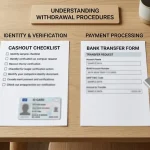
A withdrawal request can remain pending while it waits in an operator’s approval queue. Incomplete KYC can also hold up processing. Some operators handle withdrawals in batches during business hours, so a request made outside those hours may not move immediately.
These are operator-side processes, not evidence that a Bitcoin transfer itself is slow. A requested withdrawal and a completed transfer are separate stages: approval must occur before the operator sends funds to the wallet. Check the account’s stated status and any outstanding requests for information, then keep a record of the request and correspondence.
A request for additional checks can add time, but a vague delay with no clear status is harder to assess. Do not deposit more money to unlock a stuck withdrawal. Requiring a further deposit as a condition of releasing funds is not a remedy for a pending payment; it adds another sum at risk.
No “safe pokies in Australia” claim can make these operational failures disappear. Where a payment is sent to an incorrect Bitcoin address, blockchain transfers are generally irreversible and recovery is unlikely. That is different from an uncredited deposit or pending withdrawal, where the operator may still need to reconcile its own records.
An account may pass its initial registration checks and still face further verification before money can be released. Stage-two checks may be requested at the first withdrawal or once cumulative deposits reach a threshold set by the operator. The reported range is AUD 2,000–5,000; the applicable point depends on the operator’s terms. A withdrawal request can therefore become a document check rather than an immediate payment instruction.
Identity and address documents may be part of that review. Crypto-related checks can add a separate question: whether the person requesting payment controls the wallet used to deposit. A specialist review reports that an operator may ask for a message signed from the deposit address or a wallet screenshot showing the sending transaction. These are possible requests, not a uniform procedure. The evidence available can also depend on the wallet used.
Completing the additional checks before submitting a withdrawal can remove verification as one cause of delay. A specialist review recommends completing the later verification stages before the first withdrawal, ideally within 24 hours of registration. That timing is advice attributed to the review, not a universal operator deadline or a guarantee of faster payment. It does not resolve other processing issues.
A practical account record can keep the process coherent: retain the deposit transaction details, use a wallet that can provide the requested evidence, and ensure submitted identity details match the account. If an operator requests proof, the request should be specific enough to show what is needed and how it will be submitted. Sensitive documents and wallet information should not be sent through an unrelated channel.
Verification is an account-control measure, not proof that an operator will handle funds reliably. It also does not change the legal position of offshore services in Australia. The content is affiliate material and may include sponsored links.
Online pokies may offer a free-play mode or a real-money mode. The distinction is the stake: free play uses game credits without putting Bitcoin into play, while real-money play uses funds with monetary value. Free credits can show how a game works, but they do not establish what a real-money session will cost or return.
The credits are not a common unit shared across every game. A specialist review notes that their Bitcoin value depends on the particular game and the current BTC price. A displayed credit balance therefore needs to be read in context: the same number of credits in two different games does not necessarily represent the same Bitcoin amount. Nor does a credit count, by itself, state the value of a real-money stake.
That distinction matters when comparing a free-play screen with a real-money balance. Free mode can present a numerical balance without that balance being withdrawable money. In real-money mode, the relevant calculation is the Bitcoin value attached to the game’s credits at the time of play. If the BTC price changes, a credit’s Bitcoin equivalent can change as well; the number shown on screen is not a fixed fiat value.
Free play can therefore be treated as a demonstration of game mechanics, not as a financial comparison or evidence of likely results. It does not reproduce the cost of real-money play, and a result achieved with free credits does not establish an equivalent cash outcome. For accounting purposes, the two modes belong in separate columns: one records game activity without a Bitcoin stake, while the other involves funds whose value is tied to the game’s credit settings and the prevailing BTC price.
Real-money gambling is restricted to people aged eighteen or older. This section is affiliate material and may include sponsored links.
Bonus value depends on the rules attached to it, not just the amount credited. One term requiring close reading is the wagering contribution: the share of a bet on a particular game that counts towards any bonus conditions. If the terms describe this vaguely, the operator and player may calculate progress differently, creating a dispute over whether the conditions have been met.
Contributions can vary by game type. Table games may contribute 0%, while pokies may contribute 100%. Some high-return-to-player (RTP) pokies may be capped at 50%. Under those terms, the same stake can count fully, partially or not at all, depending on the game. A displayed balance therefore does not establish how much qualifying progress a play has generated.
The practical check is to match the contribution rule to the game before bonus play begins. A general statement that games count towards wagering is not enough if the detailed terms assign different percentages by category or apply a cap to particular games. Where the wording does not make the applicable rate clear, the value of the bonus cannot be calculated reliably.
Maximum-bet rules are a separate condition. Bonus play may be voided if a bet exceeds the permitted maximum. That consequence can apply even when the game otherwise contributes towards the bonus conditions. The relevant limit and the consequences of breaching it need to be read together; a contribution rate does not override a bet restriction.
For an adult aged 18 or older considering real-money gambling, these are conditions of play rather than safeguards. A bonus can increase the amount of play required without increasing the cash value available for withdrawal. Its useful value depends on the contribution rates, any game-specific cap and the maximum-bet rule. If any of those terms are unclear, the bonus calculation is unclear too.
This material is affiliate content and may include sponsored links. That disclosure does not alter the terms or make an offer suitable.
Bitcoin can be used as a payment method, but it does not make an online casino lawful to provide to Australians. Australian law prohibits operators from offering real-money online pokies to residents, and an offshore licence does not change that.
Verification may be required, often at the first withdrawal or after cumulative deposits reach AUD 2,000–5,000, depending on the operator. Crypto checks may include signing a message from the deposit address or showing the wallet transaction.
An offshore licence does not mean a casino is authorised to offer real-money games in Australia or guarantee that it is reliable. Bitcoin’s transaction security does not verify the operator or guarantee fair handling of accounts and withdrawals.