General acceptance across Australia does not verify an individual casino’s payment options, withdrawals, or availability.
Google Pay is widely accepted in Australia. That describes the payment environment across the country; it does not establish that an online casino accepts Google Pay, or that a particular site is available to Australians. These are separate claims, even when they appear together in a search for Australian online casinos or pokies that accept the wallet.
The distinction is between a payment method’s general presence and an individual merchant’s acceptance of it. A wallet can be familiar and broadly usable in Australian commerce without being offered by every merchant, in every setting. Country-level acceptance therefore cannot be converted into a site-level answer. It says something about the Australian payments landscape, not about a particular offshore casino’s cashier.
This matters because the phrase “Google Pay accepted in Australia” can sound more specific than it is. It may be read as evidence that an Australian online casino accepts Google Pay, or that a mobile casino serving Australian users has been checked. Neither conclusion follows from the general statement. The geographic word describes where the wallet is widely accepted; it does not identify the merchants, industries or individual websites involved.
Google Pay availability can vary by casino and by payment method, so check the cashier before making a deposit. This list is a starting point for reviewing the available operator details alongside that payment check.
Bizzo Casino
Bizzo Casino is listed with a Curacao Gaming Control Board licence held by TechSolutions Group N.V.
Kingmaker
Kingmaker lists a minimum deposit of A$30. Its stated payout times are around 90 minutes for crypto and 1–5 days for fiat.
Vegaz Casino
Vegaz Casino lists a Curacao OGL licence, number 2024/1335/0780, and a minimum deposit of EUR 20.
JeetCity Casino
JeetCity Casino lists a Curacao eGaming licence held by Dama N.V.
Thor Casino
Thor Casino lists a Curacao licence from Antillephone N.V. (Versus Odds B.V.) and a minimum deposit of EUR 20.
LevelUp Casino
LevelUp Casino lists a Curacao eGaming OGL licence, number 2023/174/0082, held by Dama N.V. Its stated minimum deposit is A$15.
LuckyVibe
LuckyVibe lists a Curacao Gaming Control Board OGL licence, number 2023/176/0095, held by Hollycorn N.V.
JustCasino
JustCasino is listed with a Curacao Gaming Control Board licence.
Ricky Casino
Ricky Casino lists a minimum deposit of A$20, or A$30 to qualify for the bonus. Its stated payout times are under an hour for crypto and 1–3 business days for PayID.
Wild Tokyo
Wild Tokyo lists a Curacao licence and a minimum deposit of A$10. Its stated payout times are 30–60 minutes for crypto and 1–5 days for fiat.
The same boundary applies to searches for Australian online pokies with Google Pay. The wording combines a location, a type of entertainment and a payment method, but the combination itself does not verify that any particular service offers that payment option. “Australian” may refer to the intended audience or to the wording used to describe a site. It does not, by itself, establish the site’s location, legal status or payment arrangements. A familiar wallet name in a page title is not a cashier confirmation.
Mobile wallets, including Google Pay and Apple Pay, are accepted almost everywhere in Australia. That is a broad description of acceptance in the Australian market. It does not mean that every business accepts every wallet, nor does it identify online gambling merchants as a category with confirmed acceptance.
The difference can be stated plainly: widespread acceptance is not universal acceptance. “Almost everywhere” describes reach while leaving exceptions; it is not a guarantee about a named merchant. Even where a payment method is common in everyday Australian transactions, the merchant still determines which methods it makes available. A casino-specific claim needs casino-specific evidence. General familiarity with Google Pay cannot supply it.
That is why “Australian online casino Google Pay” is not a single fact. It contains at least two distinct propositions: that a casino is relevant to Australia, and that the casino accepts Google Pay. General Australian wallet acceptance bears on neither proposition at the individual-site level. It cannot confirm a site’s customer eligibility, the contents of its cashier or the terms attached to a payment method.
 Casinos That Accept Litecoin in Australia: What to KnowLearn how Australian law treats offshore online casinos, what ACMA’s role is, and why Litecoin payment claims and offers remain unverified.
 Bitcoin casinos in Australia: how deposits workUnderstand how blockchain confirmations affect deposits and payouts, how operators set confirmation requirements, and what to check about offshore access and
The difference is not semantic hair-splitting. Payment claims influence decisions about whether a transaction can be made and what service is being offered. If a page moves from “Google Pay is common in Australia” to “this casino accepts Google Pay,” it has crossed from a general market observation to a merchant-specific assertion. The first does not substantiate the second.
A “mobile casino” label does not close the gap. It can describe a service accessed by phone, but that description does not establish that Google Pay is among its payment options. Likewise, the fact that Google Pay is a mobile wallet does not establish that a mobile gambling site supports it. The word “mobile” refers to different things in those statements: one concerns a payment product, the other a way of accessing a service. Putting them in the same sentence does not make them one verified feature.
The Australian setting explains why broad wallet acceptance is relevant to the question. Google Pay is not an unfamiliar payment method in the country: mobile wallets are widely accepted across Australia. But that context remains general. It does not establish that an offshore gambling site accepts the wallet from an Australian customer, or that a payment option shown in one context would be available in another.
Broad acceptance of Google Pay across Australia does not establish that an offshore gambling site accepts the wallet from an Australian customer.
Nor does “Australian casino” settle what kind of operator is being described. The phrase may be used casually to mean a site aimed at Australian users, but an Australian audience is not proof of Australian operation or approval. A site can use Australian language or currency in its presentation without those details establishing its legal or commercial status. The label and the payment claim need to be treated as separate matters.
There is also a legal boundary to keep clear. Under the Interactive Gambling Act 2001, operators cannot provide real-money online casino games to people in Australia. The fact that a site or payment method is discussed in Australian terms does not alter that rule. Australian consumer law does not protect players who use offshore casinos. These points are not evidence for or against Google Pay acceptance; they prevent a payment description from being mistaken for an endorsement or an assurance about the service.
Accordingly, a phrase such as “Google Pay pokies Australia” should not be read as proof that there is a locally authorised casino product behind it. It is possible to describe the wallet’s broad Australian acceptance without implying that real-money casino services may be offered to Australian residents. A payment method’s reach does not change the legal status of the activity for which a merchant might seek to use it.
A statement that a particular casino accepts Google Pay would need to refer to that casino, rather than to Australian payment habits in general. The relevant claim is not merely that the wallet exists in Australia or is widely used there. It is that an identified merchant makes it available to the relevant customers in the relevant transaction context. Broad acceptance does not establish those details.
 Casinos That Accept PayID in Australia: What Can Be VerifiedLearn why search terms do not confirm casino acceptance of PayID, and how to assess payment claims without assuming a method is…
 Casinos That Accept Tether USDT in AustraliaLearn what a USDT casino payment claim must confirm, including separate deposit and withdrawal support, and why general crypto claims are not…
This is especially important where information is presented as a “best” or “new” list. A ranking can make a payment claim look settled simply by placing a site name next to Google Pay. But a label or list position does not turn a general market fact into proof of a site’s current options. The more specific the claim, the more specific its basis must be. An Australian-wide observation cannot support a ranking of casinos by wallet acceptance.
The same reasoning applies when a page calls itself a guide to online casinos that accept Google Pay in Australia. The title alone does not confirm that any operator has been checked. It does not show whether a payment option is available to Australian users, whether the site accepts the wallet for the transaction being discussed, or whether the service is lawful to offer in Australia. Those are distinct questions, not consequences of the wallet’s popularity.
No inference should be drawn from the fact that mobile-wallet payments are common in ordinary Australian commerce. A consumer may encounter Google Pay across many settings and reasonably recognise it as a familiar wallet. That familiarity does not make every online merchant a participant. A payment method is not automatically carried from one merchant category to another.
The reverse inference is also unwarranted. The absence of a casino-specific claim in a broad statement about Australian acceptance does not show that a particular merchant rejects Google Pay. It leaves the merchant question unanswered. General market context is neither confirmation nor denial of an individual site’s arrangements.
“Accepted in Australia” can refer to the country-level reach of a wallet. “Accepted by this casino” refers to an individual merchant’s payment choices. Those statements use the same verb but operate at different levels. The first can be true without the second being established. Treating them as interchangeable creates a certainty the broad statement does not provide.
It does not identify a list of casinos, support a “best” label, or establish that a casino is newly available. Those descriptions would require information about individual operators, which cannot be inferred from general wallet acceptance.
This also separates payment convenience from service eligibility. A wallet may be broadly accepted in a country while a particular merchant does not serve residents there. Conversely, a website may describe a payment option without that description establishing that Australians can use its service. Acceptance, customer access and legal permission are separate questions; one does not answer the others.
For the same reason, “Australian online casino that accepts Google Pay” should not be treated as a single verified category merely because both terms appear together. The phrase combines a market label with a payment feature. The former does not certify the latter, and neither term settles whether the underlying service may be offered to people in Australia. A precise description keeps those questions apart rather than letting the familiar wallet name carry more meaning than it has.
The useful conclusion is narrow. Google Pay is widely accepted in Australia, alongside other mobile wallets. That establishes the wallet’s broad presence in the country and nothing site-specific about an online casino. It is not evidence that any particular offshore casino accepts the wallet, that a site is appropriate for Australian residents, or that a payment claim amounts to legal approval. A general payment fact remains general; attaching a casino label does not make it a merchant-level confirmation.
A payment method’s presence in everyday Australian commerce does not establish that an online merchant accepts it. Contactless card payments are accepted almost everywhere in Australia, and consumers are comfortable moving between cards, mobile wallets and bank-linked services such as PayPal. Those habits describe the local payment environment. They do not determine which methods an individual online service can process.
That distinction matters when Google Pay appears in a payment discussion. A wallet can be familiar and widely used while a particular merchant does not offer it. Acceptance depends on the merchant’s own payment arrangements, not simply on whether a wallet works at shops or other services. A general statement about Australian mobile payments therefore cannot establish that a casino accepts Google Pay for deposits.
The same separation applies to a cashier. A payment option has practical relevance only if it is displayed and available for the specific transaction. A wallet icon elsewhere on a site, or a general claim that the site supports mobile payments, is not enough to show that Google Pay can be selected for a deposit. Nor does a payment method’s availability for one type of purchase establish availability for gambling transactions.
A mobile wallet is part of the payment process, but it is not the merchant. The wallet may hold or connect to a payment source; the merchant still needs to accept the transaction through its own arrangements. The two sides must align for a payment to go through. Familiarity with the wallet settles only one part of that calculation.
A mobile wallet acts as a connector to a payment source, but the merchant must still independently accept the transaction through their own arrangements.
This is why “Google Pay is common in Australia” and “this merchant accepts Google Pay” are different claims. The first concerns consumer payment habits. The second concerns a specific merchant and a specific transaction. One cannot be substituted for the other without evidence that the merchant actually provides that option.
The distinction also prevents a second category error: treating a successful payment at a physical point of sale as proof of online acceptance. Contactless cards work across much of Australia, but that does not make every online checkout a contactless checkout. The setting, payment flow and merchant arrangements differ. Broad acceptance in one setting is not a guarantee in another.
A deposit is not established merely because a wallet can be used in other contexts. It would have to be offered for the relevant transaction in the merchant’s cashier. Without that confirmation, a claim that Google Pay funds a casino deposit goes beyond what general Australian payment habits can show.
A wallet should not be treated as an independent source of funds. It may connect to a card or another payment source, and the transaction may depend on the rules applied to that source as well as on the merchant’s setup. The wallet’s name on a screen does not, by itself, explain which underlying payment route is involved or whether that route is available for the transaction.
That distinction is particularly important for gambling payments. Australian market constraints do not permit credit card payments for online gambling services. A digital wallet label does not change the nature of a credit card-funded payment. Describing a transaction as a wallet payment cannot be used to treat a prohibited credit card payment as a different kind of transaction.
It follows that payment descriptions need to be precise. “Mobile wallet accepted” is not the same as “every funding source linked to that wallet is accepted,” and neither phrase establishes that an online casino can lawfully offer the transaction to an Australian resident. A payment interface cannot alter the rules applying to the merchant or the funding source.
 Casinos That Accept POLi in Australia: What Is VerifiedThe article separates claims about Australian access from POLi support and explains why casino names, pokies and payment labels do not verify…
 Casinos That Accept MiFinity in Australia: What’s VerifiedLearn why a MiFinity listing does not prove an Australian casino accepts it, permits local customers, or is lawful to use; no…
The practical distinction is simple: a wallet may be part of a payment chain, but its presence does not establish the full chain. The merchant, transaction type and underlying source all matter. If one part is unsupported or unavailable, a general statement about the wallet does not resolve it.
A figure in a search for a small Google Pay deposit does not establish that the payment method is available, that a merchant accepts it, or that the amount can be processed. The amount and the method are separate conditions. A stated minimum, even if displayed somewhere, would not prove that Google Pay is among the available options for that particular transaction.
The same applies to claims about a “best” casino for Google Pay deposits. A comparative label cannot substitute for confirmation of the payment method, and a list of merchants would imply verified acceptance that general payment habits cannot support. No operator can be identified as accepting Google Pay on the basis that mobile wallets are familiar in Australia.
A reliable transaction claim would need to match the merchant, payment method, funding source and intended transaction. If any one of those changes, the claim may no longer apply. A payment option offered in one account, location or transaction context cannot automatically be carried over to another. Broad wording conceals those distinctions rather than resolving them.
There is no useful calculation to make from a deposit amount alone. The amount says nothing about whether the cashier offers Google Pay, whether a linked funding source is supported, or whether the merchant may offer the transaction to Australian residents. The payment method must not be inferred from the amount, and the amount must not be inferred from the method.
A sound description of payment acceptance should identify what is actually established and stop there. Australian consumers’ comfort with cards, mobile wallets and bank-linked services explains why several payment types may feel interchangeable in ordinary use. It does not make them interchangeable at every checkout. Merchant acceptance remains a separate condition.
This also explains why generic payment badges can be weak evidence. A badge may indicate that a service uses a payment provider somewhere in its business, but it does not necessarily show which transaction types are enabled for a particular customer. A cashier’s available options are more specific than a site-wide reference to digital payments, but even a displayed option cannot override the legal limits on online gambling services in Australia.
Australian consumer law does not protect players who use offshore casinos. That is a material condition, not a payment-method detail: using a familiar wallet does not create consumer protection or change the status of the service. A familiar interface can make the process look ordinary; the underlying legal and commercial arrangement remains separate.
The useful conclusion for deposits is narrow. General acceptance of cards and mobile payments across Australia describes the broader payment environment. It does not prove that a particular online merchant accepts Google Pay, that a linked funding source is permitted, or that a casino deposit can be made. Those are distinct questions, and a wallet’s popularity answers none of them on its own.
A payment method shown for deposits does not, by itself, establish that the same method can receive a withdrawal. A Google Pay symbol beside a cashier option concerns a particular payment function. Paying money into an account and returning a balance to its source are separate transaction directions, and the available route may differ between them.
That distinction matters when a claim describes an instant Google Pay withdrawal from an Australian casino. “Google Pay accepted” is not a complete description of the payment terms. It leaves unanswered whether the wallet is available for withdrawals, whether the account is eligible to use it for that purpose, and what processing conditions apply. Without those details, the word “instant” has no reliable financial meaning.
Payment systems are not necessarily reversible in the way a customer might expect. A cashier can offer one method for deposits while withdrawals follow a different route. A displayed wallet option therefore cannot be treated as evidence that winnings, balances or refunds will be credited to that wallet.
Legal Warning
Under the Interactive Gambling Act 2001, operators cannot lawfully provide real-money online casino games to people in Australia.
The relevant claim needs to specify the transaction being described. Deposit acceptance, withdrawal eligibility and the time taken for a withdrawal to be processed are distinct terms. Combining them into a single statement—such as “Google Pay casino”—conceals the difference. A method can be available at one stage without being available at another.
The same distinction applies to requests for a new casino with Google Pay or an instant withdrawal option. A new name or a recent payment-method label does not establish how the cashier handles outgoing funds. Nor does a general statement about mobile-wallet use in Australia establish a particular merchant’s withdrawal process. These are separate claims and require separate terms.
“Instant” can refer to different points in a payment chain: a casino’s review of a withdrawal request, the release of funds by the operator, or the time until the receiving account displays the money. Those stages are not interchangeable. A payment method’s general availability cannot establish the duration of any of them.
A useful withdrawal statement would identify the relevant method and transaction direction, then make clear which processing stage its timing describes. If those conditions are not stated, the label does not provide a dependable estimate of when funds will be accessible. The missing distinction is not a technicality; it changes what the claim promises.
Searches for instant Google Pay withdrawals, including those mentioning real-money pokies or a no-deposit bonus, can also combine unrelated conditions. A bonus is not proof of a withdrawal route, and a withdrawal label is not evidence that a bonus balance is eligible for payment. Terms governing a balance and terms governing its transfer are separate. An appealing label does not reconcile them.
The same caution applies to “no deposit” wording. It describes a promotional condition, not the mechanics of a withdrawal. It cannot establish whether a payout is available through Google Pay, whether an account has met the applicable conditions, or how long an outgoing payment takes. A payment claim should not be read as proof of a separate offer or its terms.
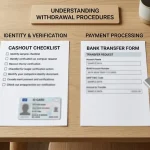
Financial transactions may be subject to identity assessment before they proceed. Online casinos commonly require customers to complete a Know Your Customer check before handling financial activity. This means that a withdrawal request and the verification of the account are related, but they are not the same step.
A payment method does not replace identity checks. Having access to a wallet, or having used a payment option previously, does not by itself establish that a customer’s account has cleared the required assessment. Verification can therefore be relevant to whether a financial transaction is processed at all; it should not be confused with the time taken by a payment network after a transaction is released.
For a withdrawal claim, the practical sequence is consequently broader than selecting a wallet. The account must meet the applicable verification requirements, the payment route must be available for withdrawals, and the transaction must pass through the relevant processing stages. A statement that names only Google Pay describes none of those conditions in full.
Withdrawal Process
Account Verification
The customer must first complete a Know Your Customer (KYC) check to clear required identity assessments.
Route Availability
The merchant must offer the specific wallet or payment method for outgoing transactions.
Processing Stages
The transaction must pass through the operator's review and the payment network's transfer stages.
A sound comparison separates four questions: whether a wallet is offered for deposits, whether it is offered for withdrawals, what account or verification conditions apply, and what the stated timing covers. Treating one answer as if it answered all four produces a false sense of certainty. In particular, a wallet’s broad acceptance in Australian retail settings cannot be used to infer the withdrawal policy of an online casino.
There is also a material consumer-protection limit. Australian consumer law does not protect players who use offshore casinos. That makes an unsupported claim about an instant payout more than a question of wording: it can shape expectations about access to funds without establishing the terms on which a transaction would actually be handled.
Accordingly, “instant Google Pay withdrawal” should be treated as a specific claim about an outgoing transaction, not as a general description of wallet compatibility. The payment label alone says nothing conclusive about withdrawal availability, account verification or the point at which funds become accessible. Each condition has to stand on its own.
A Google Pay option does not change the legal status of an online casino. In Australia, the relevant boundary is whether an operator provides real-money casino games to people physically in the country. The Interactive Gambling Act 2001 makes that provision unlawful. The restriction covers casino-style services such as poker, blackjack, roulette and pokies; changing the payment method does not make the service lawful.
The Act places the prohibition on operators. It does not explicitly make an Australian player’s use of an offshore casino a criminal offence. That distinction is narrow: the absence of an explicit player offence is not approval of the service, and it does not turn an offshore site into a locally authorised casino. Nor does it make a payment feature evidence that an operator is permitted to serve Australians.
The Australian Communications and Media Authority (ACMA) is responsible for enforcing the Act. The legal question is therefore not settled by a site’s marketing, its payment page, or a claim that it accepts customers from Australia. A site recommendation based on Google Pay acceptance would address a payment feature, not whether offering the casino service to Australians is lawful.
That distinction also limits what a “best” or “instant withdrawal” label can responsibly establish. Such descriptions do not answer the legal question, and a comparison framed around them can make an offshore service appear like an ordinary local option. No operator ranking can remove the statutory restriction or confer Australian approval. In particular, a fast payment claim is not a substitute for a lawful basis to provide real-money casino games in the country.
Australian consumer law does not protect players who use offshore casinos. That matters independently of whether the player is explicitly criminalised under the Interactive Gambling Act. The two points should not be collapsed into a reassuring promise: one concerns the operator’s prohibition on supplying the service, while the other concerns the lack of consumer-law protection for someone using an offshore site. A payment dispute or an unmet site promise does not become a locally protected casino transaction merely because the interface is accessible.
Accordingly, a list of casino websites that claim to accept Google Pay cannot be presented as a list of recommended or approved Australian casinos. The word “best” would imply a consumer endorsement that the payment detail alone cannot support. A site’s stated availability, branding or cashier options do not alter the law governing the underlying games.
The practical conclusion is limited but clear: Australian residents should not treat offshore casino recommendations as a reliable route to a lawful, locally protected service. The Interactive Gambling Act 2001 bars operators from supplying real-money online casino games to people in Australia, and ACMA enforces that framework. Google Pay acceptance, where claimed by a site, does not create an exception.
Limits are set by each casino and can vary. Check the casino’s cashier or payment terms for its current Amex deposit and withdrawal limits.
Check the casino’s cashier for American Express as a deposit option. If it is available, select it, enter your card details and deposit amount in AUD, then submit the payment.
Sometimes, but not all casinos allow withdrawals to American Express. You generally need to have made a previous deposit with Amex, and a withdrawal fee may apply.
Amex may block payments to particular websites, and Australian banks may also block gambling-related transactions on Amex cards. Some casinos do not accept American Express.
Amex deposits typically have no fee, but a casino may add a 1.5% surcharge, and a 3% currency conversion fee may apply. Withdrawal fees can also apply depending on the casino.
Yes, at a casino that accepts American Express, but an Amex gift card can be used for deposits only.