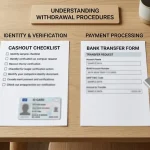
A request, operator approval and a completed transfer are separate steps, while identity checks and payment routes can affect the timing.

A withdrawal has two separate timing stages: the operator’s review and approval, followed by the payment provider’s transfer. A request submitted on the same day as a win begins the first stage; it does not establish when the money will arrive. “Same-day withdrawal” can therefore describe a request, an approval or a completed transfer. Those are different events, and only the last means the funds have reached the receiving account.
The distinction matters in Australia because real-money online casino games, including slots and table games, are prohibited interactive gambling services when provided to people in the country. The Interactive Gambling Act 2001 makes it illegal for operators to provide these services to people physically located in Australia. Timing information is not an endorsement of using such a service.
After a withdrawal request is submitted, the operator must review it before releasing funds. The review can include confirming the account holder’s identity and checking that the payment details are consistent with the account. Casinos are required to complete identity checks before processing withdrawals. Until approval is complete, the payment has not entered the transfer stage, regardless of how quickly the chosen payment method can move money.
If getting your winnings quickly matters, payout method and processing time are useful details to check when choosing a casino. This list highlights the available payout information and other stated details for each operator.
Bizzo Casino
Bizzo Casino is listed with a Curacao Gaming Control Board license held by TechSolutions Group N.V. No payout-speed details are provided here.
Kingmaker
Kingmaker lists crypto payouts at around 90 minutes and fiat payouts at 1–5 days. Its minimum deposit is A$30.
Vegaz Casino
Vegaz Casino is listed under Curacao license OGL/2024/1335/0780, with a minimum deposit of EUR 20. No payout-speed details are provided here.
JeetCity Casino
JeetCity Casino is listed with a Curacao eGaming license held by Dama N.V. The available details do not specify payout speed.
Thor Casino
Thor Casino is listed under a Curacao license from Antillephone N.V. for Versus Odds B.V., and has a minimum deposit of EUR 20. No payout-speed details are provided here.
LevelUp Casino
LevelUp Casino is listed under Curacao eGaming license OGL/2023/174/0082, held by Dama N.V. Its minimum deposit is A$15; payout speed is not specified.
LuckyVibe
LuckyVibe is listed with Curacao Gaming Control Board license OGL/2023/176/0095, held by Hollycorn N.V. No payout-speed details are provided here.
JustCasino
JustCasino is listed with a Curacao Gaming Control Board license. The available details do not specify payout speed.
Ricky Casino
Ricky Casino lists crypto payouts in under an hour and PayID payouts in 1–3 business days. The minimum deposit is A$20, or A$30 to qualify for the bonus.
Wild Tokyo
Wild Tokyo lists crypto payouts at 30–60 minutes and fiat payouts at 1–5 days. It is listed as Curacao-licensed and has a minimum deposit of A$10.
A specialist review reports that an initial withdrawal may prompt an identity-verification request. That review step can add time if documents have not already been supplied or if the operator needs to resolve a discrepancy. Completing verification ahead of a withdrawal can reduce the chance that the first request pauses while checks are carried out, although it does not remove the operator’s responsibility to review a later transaction.
Approval is not merely a button between the request and the bank. An operator may need to confirm that the withdrawal is being sent to an account linked to the player profile and, where possible, return funds through the same method used for the deposit. If the requested destination does not match the payment history or account details, additional checks may be needed. A request can remain pending during this stage; no payment provider can transfer money the operator has not yet released.
The timing should therefore be read as a sequence: request submitted, checks completed, funds approved and released. A same-day request only confirms the first event. Even approval on the same day says nothing by itself about whether the receiving institution will post the funds that day.
Once funds are released, the payment method determines the second part of the clock. E-wallet withdrawals are commonly described as being processed within a 24-hour period. Bank transfers and card payments can take several days. These are broad processing descriptions, not a guarantee that every transaction follows the same schedule or that the operator’s review is included in the quoted time.
For a same-day result, both stages must fit within the same calendar day: the operator has to finish its checks and release the payment, and the payment route has to complete the transfer in time. If approval takes longer, a fast payment method does not recover the lost hours. If approval is prompt but the payment route takes longer, the request may be authorised that day while receipt occurs later. The word “instant” is meaningful only when it refers to the transfer after release, not the whole process from clicking submit to seeing a balance in another account.
A useful timing record separates the timestamps rather than treating “withdrawal time” as one figure. The request time shows when the player initiated the process. The approval or release time marks the end of the operator’s stage. The credited time marks completion at the receiving account. Without that separation, an advertised processing estimate can appear faster than the actual wait experienced by someone whose request spent time in review.
The distinction also prevents a common accounting error: counting the operator’s processing window and the payment window as though they were concurrent. They are sequential. If a service describes only the period after approval, that figure cannot be applied to a request still awaiting verification. If it reports time from submission to receipt, the stated measure covers more of the process, but it still depends on the circumstances of the transaction and the payment route.
Attention: A same-day request or same-day approval does not guarantee that funds will reach your account on the same calendar day.
For any claim of a same-day withdrawal, the practical test is what event the claim measures. A same-day submission is not same-day approval; same-day approval is not necessarily same-day receipt. The only complete measure ends when funds arrive, and that outcome depends on the full chain rather than the fastest part of it.
Payment method changes the time funds spend in transit, but it does not turn every withdrawal request into money received that day. E-wallets, bank transfers and cryptocurrency have different transfer characteristics; the relevant comparison is the interval after a casino has released the funds. Any estimate that omits that starting point can make a slow process look fast.
The methods reported as available to Australian players include PayPal and Skrill e-wallets, bank transfers, cards and, at some casinos, cryptocurrency. Availability varies between operators. A method shown for deposits may not be available for withdrawals, and a payment route’s speed says nothing by itself about whether it can be used to receive a particular cashout. Those distinctions make the payment page and withdrawal terms more useful than a general claim about same-day payouts.
E-wallets can offer a shorter transfer interval than a traditional bank transfer. A specialist review describes e-wallet transactions as being completed within hours rather than days; separate payment guidance puts e-wallet withdrawals within a 24-hour processing window. These are reported timings, not a guarantee for every operator or transaction. The clock may depend on the operator’s release process as well as the wallet service.
PayPal and Skrill are among the e-wallets reported in the Australian market. Their presence does not establish that every casino accepts them for both directions of payment, or that a withdrawal will arrive as soon as it is requested. If a withdrawal is still awaiting the operator’s release, the wallet has not yet begun its part of the transaction.
For a same-day outcome, the distinction is practical: a transfer that takes hours after release may still miss the day if the request is submitted late or the release occurs later. The payment method sets one part of the schedule, not the whole schedule.
A traditional bank transfer can take longer. One specialist review reports a completion window of up to five business days. That figure should be treated as a report from that source, not a universal timetable for all banks, operators or transfer types. Bank processing windows can also affect when a released payment appears in the receiving account.
This makes “same day” a more demanding claim for a standard bank transfer than for a wallet route. A casino could release the funds promptly while the bank transfer remains in progress. Conversely, a shorter transfer interval would not establish that the casino approved the request on the same day. The status displayed by the operator and the final balance in the receiving account are separate milestones.
Some payment services connected to banking can operate differently from a traditional transfer. That is one reason payment labels need to be read precisely: “bank transfer” can describe a broad category rather than one identical rail or processing path. The timing should be tied to the method actually named in the withdrawal terms.
Transactions are often completed within hours or a 24-hour window after the operator releases the funds.
Traditional transfers can take longer, with some reports indicating a window of up to five business days.
Offers the potential for near-instant transactions once the payment leg begins after operator release.
Cryptocurrency can support near-instant transactions, according to a specialist review. That describes the potential speed of the payment leg, not a guaranteed withdrawal time from request to receipt. The operator still has to release the funds, and the receiving wallet must be the destination specified for the transaction.
The near-instant description also needs careful handling because it is not a market-wide service standard. It does not establish that every cryptocurrency, platform or transaction will complete at the same pace. A claim about transfer speed is only useful when it identifies which part of the process it measures and whether the estimate applies after release.
A route comparison is most useful when it separates the payment method from the operator’s handling. E-wallets are associated in specialist material with completion within hours, traditional bank transfers with a longer window that can extend to five business days, and cryptocurrency with the possibility of near-instant transactions. Each timing comes from a different kind of reported estimate and should not be read as a promise that every same-day request will arrive that day.
The available options also vary. Some market reviews list cards, PayPal, Skrill and bank transfers, with cryptocurrency offered by some operators. That inventory is not a guarantee of withdrawal eligibility, and a deposit option does not automatically function as a payout route.
For a defensible comparison, the key figure is the stated time from release to receipt for the exact method—not a broad “instant” label. The route may be quick once funds are sent; the calendar outcome still depends on when that stage begins.
PayID is a bank-to-bank payment method built on Australia’s New Payments Platform (NPP). It allows funds to move between participating bank accounts in real time. The payment identifier links to an account, so a transfer can be directed without entering the recipient’s full bank account details. The important distinction is that the payment network can move released funds quickly; it does not decide when an operator approves a withdrawal.
A withdrawal request and a completed transfer are separate events. Before funds can enter the payment rail, an operator would need to review the request and release it. That review may involve checking account details and identity. Until release, the money has not been sent through PayID, however quickly the network can process a transfer afterward. “Instant” therefore describes the payment phase, not necessarily the interval from submitting a request to receiving money.
A specialist report describes PayID transfers as near-instant, but that description concerns movement between accounts, not an operator’s internal handling time. Filmink.com.au likewise reports that PayID withdrawals can be processed almost instantly after release, contrasting them with bank transfers that may take several working days. These are descriptions of the payment stage; they are not a guarantee that a withdrawal request will be approved or completed on the same day.
The distinction matters when interpreting a same-day payout claim. A request could be submitted promptly and still remain pending while checks take place. If it is approved and released, the PayID leg may then be rapid. If approval is delayed, the speed of the NPP cannot recover the time already spent waiting. The two stages have different causes and should not be collapsed into a single promised time.
PayID utilizes Australia's New Payments Platform (NPP) and Osko network to enable real-time bank-to-bank transfers after a casino approves the withdrawal.
The payment rail also does not determine whether a particular operator offers PayID for withdrawals. Availability depends on the operator’s payment arrangements, and the account details used must be suitable for the transfer. A PayID identifier is not itself an approval credential or a way around the operator’s checks. It identifies the destination account; it does not establish that funds are eligible to be released.
For a transfer to reach the intended account, the recipient details need to match an account under the appropriate control. If the submitted identifier is incorrect or the destination cannot accept the transfer, the payment may not proceed as expected. That is a payment-detail issue, distinct from a pending request awaiting review. Keeping those causes separate makes a status message more useful: “pending” before release is different from a transfer that has already been sent.
A bank transfer can involve a different payment route and timing. A review of traditional bank transfers describes completion as potentially taking several working days, while PayID uses the NPP’s real-time transfer capability. That comparison concerns the route after funds are released. It does not establish that every PayID transaction finishes faster in every circumstance, nor that any operator’s approval process is equally prompt.
The practical accounting is simple: the time to receipt comprises the operator’s handling before release and the payment time afterward. PayID can reduce the second component when the transfer is successfully sent through the NPP. It cannot eliminate the first. A same-day request is therefore not equivalent to same-day receipt, and a near-instant payment rail should not be read as a promise about the entire withdrawal.
There is also a legal boundary specific to Australia. The Interactive Gambling Act 2001 prohibits operators from providing real-money online casino games, including slots and table games, to people physically located in Australia. Describing PayID’s bank-transfer function does not make an offshore casino service lawful or endorse its use. The payment system itself is a means of moving funds between accounts; the legality of a service using it is a separate matter.
A withdrawal request can be ready for payment in timing terms and still be ineligible for the full balance shown on screen. Bonus wagering rules determine whether funds are available to withdraw; cashout limits determine how much can leave under the operator’s terms. These are separate calculations, and neither is answered by the payment method’s transfer speed.
For Australian readers, an additional distinction matters: the Interactive Gambling Act 2001 prohibits operators from providing real-money online casino games, including slots, to people physically located in Australia. The terms described here explain how wagering and withdrawal conditions are structured; they are not an endorsement or offer of those services.
A bonus can come with a wagering requirement. That condition may apply only to the bonus funds, or to the combined value of the deposit and bonus. The difference changes the amount of activity required before a withdrawal can be attempted, even when the displayed balance is the same.
A specialist review has described bonus-funds-only wagering as preferable to a requirement calculated against the deposit and bonus together. The reason is arithmetic: when the deposit is included in the wagering base, more funds are subject to the condition. The bonus-only structure narrows that base. The applicable terms still determine the actual calculation, so the label “bonus” alone does not establish which structure applies.
Before requesting a withdrawal, the wagering condition must be completed. Until then, the balance may include funds that are visible but not yet eligible for cashout. A request made before the requirement is met may therefore fail to release the expected amount. The relevant check is not simply whether a bonus was accepted, but what value the wagering rule applies to and whether its condition has been satisfied.
The terms should also make clear which funds are subject to wagering and what happens to the bonus if it is not used or the condition is not completed. Those details affect the balance available for withdrawal; they should not be inferred from a headline bonus amount.
A cashout limit can operate at more than one level. A per-transaction maximum sets the largest amount that can be requested in a single withdrawal. Separate weekly or monthly limits can restrict the total released across a period, even if each individual request falls below the transaction cap.
A specialist review has noted that these period-based limits may sit alongside per-transaction maximums. The practical calculation is therefore not just “balance minus one transaction limit.” It is the amount eligible under the transaction rule, compared with any remaining allowance under the applicable period limit. A large balance does not, by itself, establish that the whole amount can be withdrawn at once.
Operator policy may also provide for large withdrawals to be released in instalments. In that case, the amount ultimately payable may not change, but the schedule and number of separate releases do. The terms need to distinguish an instalment arrangement from a cap that prevents some of the balance from being withdrawn. Both affect the cashout, but in different ways.
Limits should be stated clearly alongside any applicable fees and processing conditions. A maximum that appears only at the point of withdrawal is a poor substitute for a disclosed term: it leaves the amount available uncertain until after a request is made.
The amount requested and the amount received can differ if a transaction fee applies. A report by filmink.com.au notes that a fee may apply when PayID is used for a withdrawal. That possibility belongs in the net calculation: subtract any stated fee from the amount released to estimate what reaches the account. The fee’s existence and amount depend on the applicable terms; it should not be assumed to be zero or treated as a fixed charge without confirmation.
The useful comparison is therefore between the eligible balance, the maximum allowed under each limit, any instalment policy, and any fee. A same-day cashout claim addresses none of those figures by itself. Speed cannot make an unmet wagering requirement complete, raise a withdrawal cap, or remove a charge. The final payable amount is determined by the conditions attached to the funds and the operator’s published withdrawal rules, not by the speed label attached to the payment route.
Legal Prohibition
The Interactive Gambling Act 2001 makes it illegal for operators to provide real-money online casino games, including slots, to people physically located in Australia.
A slot balance and a completed withdrawal are separate stages. A win displayed in a game account is not money received in a bank account or wallet. It becomes a withdrawal matter only when the balance is eligible to be requested and the operator can verify the account and release the funds.
For anyone assessing claims about same-day payouts from slots, the key checkpoint is therefore not the game itself. Slot winnings do not have a separate payment speed simply because they came from a slot. The relevant event is the withdrawal request, followed by the operator’s checks and approval. Any later payment time depends on the route used; the game does not make the review disappear.
Identity verification is central to that checkpoint. Casinos must verify a player’s identity through KYC procedures before processing a withdrawal. A first cash-out may bring a request for identity documents, so an account that has not been checked can remain pending even when the balance is visible. Completing verification in advance can significantly speed up later withdrawals, because the identity review is less likely to be waiting at the point funds are requested.
That does not mean early verification guarantees same-day receipt. It addresses one potential administrative hold, not every stage between a request and money arriving. The request still has to be accepted and released by the operator, and the payment route still has its own processing stage. “Same day” is meaningful only when the claim says which stage it measures. A rapid display of winnings in an account is not evidence that a withdrawal has been approved.
The balance itself also needs to be distinguished from funds that are available to withdraw. A game result may appear in the account, while the account’s withdrawal request remains subject to the operator’s checks and applicable account conditions. The amount visible on screen is not, by itself, proof that funds have cleared all conditions for release. That is why the practical checkpoint is the status of the withdrawal, rather than the moment a slot round ends.
There is also a legal boundary specific to Australia. Under the Interactive Gambling Act 2001, providing real-money online slots and other casino-style games to people in Australia is prohibited.
In ordinary accounting terms, the sequence is straightforward: a game balance is recorded, a withdrawal is requested, identity verification is completed, and the operator processes the request. A same-day claim about online slots should not collapse those stages into a promise that a win will reach an account on the day it appears. Earlier identity checks can reduce one source of delay; they cannot turn a displayed slot win into an already completed payment.
A payment option shown at a cashier does not automatically work in both directions. Deposit eligibility and withdrawal eligibility are separate terms: a method may let money enter an account without providing a route for money to leave it. That distinction matters when assessing any claim about same-day cashouts, because a fast deposit says nothing about how winnings could be returned.
Deposit options, such as POLi or Neosurf vouchers, are not always available for withdrawals; always check the operator's specific payout routes.
Australian specialist reviews have reported that some real-money casino services list instant banking options such as POLi for deposits. That is a description of payment features, not a statement that the service is lawful in Australia. The Interactive Gambling Act 2001 prohibits operators from providing real-money online casino games, including slots, to people physically in the country.
Prepaid cards and vouchers, including Neosurf, have also been described in specialist reviews as deposit-focused options rather than withdrawal methods. The practical consequence is a possible mismatch: funds can be credited through a voucher, while any later payment may need to use a different eligible route. The cashier’s deposit menu is therefore not a reliable guide to the withdrawal menu.
The same distinction applies to other payment labels. A service may display bank transfer or an e-wallet as a way to fund an account, but the operator’s withdrawal rules determine whether that route can return funds. Operators may require returned money to go to the deposit method where possible, and identity checks and account ownership requirements can affect whether a request is accepted. A method name alone does not settle eligibility.
A useful comparison is a two-column check: which methods are accepted for deposits, and which are available for withdrawals. The second column is the one relevant to receiving money. If a prepaid voucher appears only in the first, its presence does not create a cashout route. Any alternative method should be checked against the operator’s stated conditions before funds are deposited; otherwise, the apparent convenience is only on the way in.
This is a payment-method distinction, not a recommendation to use offshore casino services. Real-money online casino games are prohibited for operators serving people in Australia, and advertising those services to Australian audiences is also prohibited. The legal position is not altered by a payment provider’s speed, the wording of a cashier page or a claim that funds can be paid on the day.
PayID is part of Australia’s New Payments Platform (NPP), which supports bank-to-bank transfers in real time. Osko is the network through which PayID transfers are processed. These describe the movement of money between accounts; they do not determine when a gambling operator approves a cashout or sends it.
A specialist review reported that funds sent through PayID move instantly once the operator releases them. The qualification is decisive: the transfer can be rapid after release, while the full time from request to receipt depends on what happens beforehand. Calling a payout “instant” therefore describes the payment phase, not necessarily the entire cashout process.
Where a service provides a PayID payout route, the request may involve entering a PayID identifier, specifying an amount and confirming the transaction. The receiving details should match the account linked to the player’s profile, and the same PayID details used for deposits should be used for withdrawals. A mismatch can lead to a security review rather than a direct transfer.
The route also depends on the operator actually supporting PayID for withdrawals. A payment method shown for deposits does not, by itself, establish that it can return funds. Before submitting a request, the relevant terms need to state whether PayID cashouts are available and disclose applicable fees, limits and processing conditions. Those terms define the operator’s part of the transaction; the NPP and Osko handle the bank transfer after funds are sent.
PayID Withdrawal Process
Submission
The player submits a withdrawal request, often by providing a PayID identifier.
Operator Review
The casino performs identity checks and verifies account details to approve the release.
NPP Transfer
Once released, funds move via the New Payments Platform (NPP) to the receiving account in real time.
There is a separate legal point for Australian readers. The Interactive Gambling Act 2001 prohibits operators from providing real-money online casino games, including slots and table games, to people physically located in Australia. A description of how PayID works is not an endorsement of a casino service.
For timing, the useful distinction is between “released” and “received.” PayID and Osko can move a released payment in real time, but that does not mean a withdrawal request has been approved, or that every service using the label will complete every stage at the same speed. The payment rail is only one part of the route.
“Same day” describes a target, not a complete sequence. A payout claim can refer to the time after an operator approves a request, while the request itself may still be waiting for identity checks or an internal review. Until approval is complete and funds are released, the payment stage has not begun.
A specialist review reported that some sites advertising “instant” withdrawals took as long as 24 hours because of internal review. That is a reported case, not a reliable timetable for every operator. It does show why the label alone is insufficient: a quick payment rail cannot remove time spent checking a withdrawal.
Identity verification is one possible delay. Casinos must complete KYC checks before processing withdrawals, and first-time requests may prompt a document review. If verification is still pending when a withdrawal is submitted, a same-day claim does not establish that the check will be completed that day.
A specialist review also identified requests above $2,000 and bank processing windows as possible sources of delay. A manual review can therefore affect the release time, while a bank’s processing window can affect when funds arrive. These are separate points in the process, even when an advertisement compresses them into a single speed claim.
The useful distinction is between a stated payment speed and the full elapsed time from request to receipt. A claim that omits approval conditions, identity checks, review triggers or banking windows leaves out variables that determine the actual completion time. “Instant” should describe only the payment phase after approval; it cannot reasonably mean that every request is approved and received immediately. A same-day label is meaningful only when the terms explain what starts the clock and which checks can pause it.
A fast payment route changes how quickly released funds can travel; it does not determine how much an operator will approve for cashout. Withdrawal amounts can be restricted by casino policy, as reported by filmink.com.au. A transfer may therefore move promptly after release while the requested sum is reduced, split into instalments or held within a stated cap.
The distinction matters when assessing a same-day payout claim. Speed describes a stage of processing, not the amount payable. A minimum withdrawal can make a small balance ineligible for cashout, while a maximum can prevent a larger balance from being withdrawn in one request. Where an operator releases larger withdrawals in instalments under its policy, the full balance does not arrive as one payment simply because the payment rail is fast.
A specialist review reported that reputable PayID casinos publish minimum and maximum withdrawal limits clearly. Disclosure should make the applicable figures and conditions findable before a withdrawal is submitted. Terms should also explain any fees and processing times; otherwise, the advertised speed says little about the net amount or the schedule for receiving it.
The useful comparison is therefore between the requested amount and the applicable withdrawal rules, not just between payment methods. A quick transfer cannot remove a cap, waive a minimum or override a staged-release policy. Those conditions affect the final amount available and the number of payments required.
In Australia, real-money online casino games are prohibited services under the Interactive Gambling Act 2001. Information about cashout terms does not change that legal position or make an offshore service lawful.
It depends on both the casino’s review and the payment route: e-wallets are typically processed within 24 hours, while bank transfers and card payments may take several days. PayID transfers can arrive almost instantly once the casino releases the funds, but verification or other checks can delay release.
Look for casinos that support a fast withdrawal route such as PayID, clearly publish withdrawal limits, and complete identity checks early. A fast payment method does not guarantee a fast payout if the casino has not approved the withdrawal.
Check the withdrawal methods and limits, whether the casino returns funds to the deposit method where possible, and how long its review takes before release. Compare the time from submission to approval separately from the time for funds to reach your account.
Australian players may find credit or debit cards, PayPal or Skrill, and bank transfers; some casinos also offer cryptocurrency. Prepaid vouchers such as Neosurf are usually for deposits rather than withdrawals, and available methods vary by operator.
The Interactive Gambling Act 2001 makes it illegal for operators to provide real-money online casino games, including slots and table games, to people physically located in Australia.