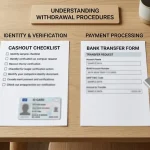
PayID identifies a bank payment, while the transfer and the receiving service each have separate roles.

PayID is a way to identify a bank payment, not a separate account or a guarantee attached to a gambling service. In Australia, it lets a payment be addressed using an identifier such as a mobile number or email address rather than relying only on traditional account details. The transfer itself moves between banks through the New Payments Platform (NPP), which supports quick payments.
When a payment page lists PayID, that label describes a possible route for moving funds. It does not establish who operates the page, what rules apply to its services, or what will happen to money after it reaches the recipient. A payment rail can carry a transaction; it cannot certify the business on the other end.
The distinction matters because payment interfaces often compress several separate stages into one simple-looking action. A user selects a method, enters or confirms payment information, and submits a transfer. The bank processes the transfer through its payment system. A receiving service may then associate the incoming amount with an account. Each stage has its own function. PayID concerns the transfer mechanism, while account crediting is a separate action by the receiving service.
For Australian players looking at new PayID pokies, payment details are worth checking before choosing a casino. This list highlights the specific licensing, deposit and payout information available for each operator.
Bizzo Casino
Bizzo Casino is listed with a Curaçao Gaming Control Board licence held by TechSolutions Group N.V.
Kingmaker
Kingmaker lists crypto payouts at around 90 minutes and fiat payouts at 1–5 days. Its minimum deposit is A$30.
Vegaz Casino
Vegaz Casino lists Curaçao OGL/2024/1335/0780 and a minimum deposit of EUR 20.
JeetCity Casino
JeetCity Casino is listed with a Curaçao eGaming licence held by Dama N.V.
Thor Casino
Thor Casino lists a Curaçao licence from Antillephone N.V. (Versus Odds B.V.) and a minimum deposit of EUR 20.
LevelUp Casino
LevelUp Casino lists Curaçao eGaming licence OGL/2023/174/0082, held by Dama N.V. Its minimum deposit is A$15.
LuckyVibe
LuckyVibe lists Curaçao Gaming Control Board licence OGL/2023/176/0095, held by Hollycorn N.V.
JustCasino
JustCasino is listed with a Curaçao Gaming Control Board licence.
Ricky Casino
Ricky Casino lists crypto payouts under an hour and PayID payouts in 1–3 business days. The minimum deposit is A$20, or A$30 to qualify for the bonus.
Wild Tokyo
Wild Tokyo lists a Curaçao licence, crypto payouts in 30–60 minutes and fiat payouts in 1–5 days. Its minimum deposit is A$10.
For online pokies, the cashier is the part of a site that displays available ways to pay or request funds. A PayID entry there is therefore a statement about the payment option presented by that site at that moment. It is not proof that the site is licensed, that its games are fair, that its published information is accurate, or that it will pay a withdrawal. Those are different questions, and the appearance of a familiar payment name answers none of them.
This is the basic distinction behind the phrase “new PayID pokies online”: “PayID” describes a payment method, while “pokies” describes the gambling product being offered. Combining the terms does not create a new kind of payment system. Nor does a newly displayed option mean that the underlying service has been independently assessed. A new button is still a button.
The payment flow can be understood without treating the cashier as a certificate. PayID uses a unique identifier to route a bank transfer through the NPP. On a receiving service, the payment may then be recorded against an account. The displayed status of a payment and the status of an account balance are not necessarily the same thing: one concerns movement through the payment system, the other concerns how the recipient handles the funds. That separation is central to reading any payment screen accurately.
PayID transfers are described as instant and secure, and deposits at online casinos are typically completed within seconds. Those characteristics concern the speed and structure of the payment transfer. They do not measure the quality of a venue’s customer service or establish that a balance shown on a screen can be withdrawn. “Secure” describes a payment-system property; it is not a substitute for assessing the recipient or the terms attached to an account.
The same point applies when a cashier presents PayID beside other payment choices. A menu of payment methods is an operational display, not a report on the recipient’s conduct. A venue can show a method without that method confirming the venue’s identity, oversight, game fairness, or treatment of customer funds. Payment availability and trustworthiness are separate variables; combining them would make the cashier do work it was never designed to do.
The role of PayID is narrower and more useful than that. It provides a way to direct a bank transfer using an identifier, with the NPP supporting movement between participating banks. That can make the payment step quick. Once the transfer has been initiated, however, the payment method does not control the recipient’s internal records or decisions. The mechanism carries funds; it does not determine how a service credits or later releases them.
A practical reading of a PayID option is therefore precise: it indicates that a service presents PayID as a payment route. It does not establish any broader claim about the service. The speed of the transfer is not evidence of the speed of every later process, and the presence of PayID does not imply a promise to honour a withdrawal. A fast rail can deliver a payment promptly; it cannot make a recipient reliable.
That distinction prevents the payment label from being mistaken for an endorsement. PayID is a bank-payment mechanism operating through the NPP. The cashier is a service interface. A gambling operator’s conduct and status are matters outside the payment method itself. Keeping those categories separate is the only sound way to interpret what the PayID label actually says—and, just as importantly, what it does not say.
A PayID transfer depends on two sets of details lining up: the identifier used for the payment must be registered with the sending bank, and the payment must be attributed correctly by the receiving service. A mismatch can turn a routine transfer into a tracing problem. The payment method itself does not resolve errors in the information entered before confirmation.
For a payment linked to a casino account, the PayID details need to match the identifier registered with the bank. Account-name consistency is also a practical control: the bank account holder’s name should match the name on the casino profile. If those records differ, a payment may not be accepted or may require review. The transfer screen can confirm the destination identifier, but it cannot establish that an operator is licensed, that its games are fair or that it will pay winnings. A payment rail carries funds; it does not certify the business receiving them.
That distinction matters because a new PayID option appearing in a pokies cashier is only a change in payment availability. It does not make the destination safer or alter the consequences of sending money to the wrong recipient. The transaction details should be treated as instructions with financial consequences, not as a signal about the operator’s standing.
PayID uses an identifier such as a mobile number or email address in place of conventional bank account details. The bank links that identifier to an account, and the payer selects or enters it as the transfer destination. The key control point is before confirmation: the destination must be the intended one, and the identifier used must be the one registered with the payer’s bank.
Typos, outdated details and selecting a different saved PayID can all create a discrepancy between the intended payment and the transfer submitted. A confirmation screen is therefore part of the transaction, not a formality. The recipient details should be checked against the information supplied for the payment before approval. If the displayed destination does not correspond to the intended recipient, confirming the transfer would convert an avoidable entry error into a completed payment.
A successful bank transfer also does not necessarily settle an account balance instantly at the receiving service. The bank’s confirmation and the service’s attribution of the payment are separate steps. Where details do not match, the payment may need to be investigated rather than credited automatically. The practical cost is time and uncertainty, even if the original transfer reached an account.
The daily PayID transfer limit is set by the sending bank. A specialist payment review describes the bank—not the payment method or casino cashier—as the party that determines this limit. It can therefore differ between account holders and banks, and the cashier’s displayed options do not override the bank’s controls.
Daily PayID transfer limits are determined by the sending bank, not by the payment method or the casino cashier.
A transfer may fail or be declined if it exceeds the limit that applies to the account. The relevant figure is the limit shown or confirmed through the bank, not an assumed universal PayID ceiling. Because bank settings can change, any payment planning based on an old limit can be wrong. The amount available for a transfer is a banking condition, separate from any amount accepted by a receiving service.
This separation is useful when diagnosing a rejected payment. A cashier may allow an amount to be entered, while the bank still applies its own limit when the transfer is authorised. Conversely, a bank may permit the transfer while the receiving service applies separate rules to how it handles or credits a payment. Those are distinct checks; passing one does not guarantee that the other has been satisfied.
PayID transactions cannot be reversed once confirmed. That makes accuracy before authorisation more important than speed after it. If a payment is sent to an incorrect identifier, the ordinary expectation of cancelling it after noticing the mistake does not apply. The transfer’s confirmed status is the dividing line between an editable instruction and a completed payment.
Where an error is suspected, the first useful distinction is whether the transfer was confirmed. An unsubmitted payment can be corrected before it leaves the bank. A confirmed one cannot simply be recalled through PayID. Any follow-up then depends on contacting the bank and the receiving party; that contact is an attempt to address the situation, not a guaranteed reversal mechanism.
A bank’s transfer confirmation should also be retained when investigating a discrepancy. It records what was submitted and can help distinguish a bank-side issue from a problem matching the payment to an account. It does not prove that the receiving service has credited the funds, and it does not change the irreversible nature of the transfer.
The practical risk calculation is straightforward: a bank-set limit controls how much can be sent in a day, matching details help direct the payment correctly, and confirmation removes the option of simply undoing it. Each control applies at a different point. Checking the recipient and account-name consistency addresses attribution; confirming the bank’s current limit addresses transfer capacity; reviewing the final payment details addresses the irreversible step. None of these checks establishes anything beyond the mechanics of the payment itself.
PayID is a payment mechanism, not a legal status. Its appearance in a cashier does not establish that an online casino may lawfully provide services to people in Australia. Nor does a successful payment alter the rules applying to the operator. The relevant distinction is between a bank’s ability to process a transaction and the legality of the service for which that transaction is intended.
Australian law draws a clear boundary around real-money online casino services. Under the Interactive Gambling Act 2001, it is illegal for operators to provide real-money online casino games to people physically located in Australia. The prohibition includes casino-style games such as pokies, poker and table games. A payment option cannot create an exception to that rule. A site may describe itself as offshore, accept a particular payment method or display familiar Australian terminology; none of those details changes the legal position.
Legal Prohibition
Under the Interactive Gambling Act 2001, it is illegal for operators to provide real-money online casino games to people physically located in Australia.
The same distinction applies to advertising. Advertising real-money online casino services to Australian audiences is prohibited. Payment information presented as a route into such a service does not become neutral merely because it describes a bank transfer. Context matters: a factual explanation of how payment systems work is different from directing people towards a casino or inviting them to use one. The existence of a PayID option is not a basis for promoting the underlying service.
The Act’s penalties underline that this is an operator-facing restriction, not a minor administrative condition. The maximum daily penalty is $360,000 for an individual and $1.8 million for a body corporate. These figures concern violations of the law; they do not turn a payment question into a question about whether a particular transaction will clear. Payment access and permission to offer the service are separate issues.
Bank treatment adds another layer, but it should not be overstated. A specialist review has reported that some Australian banks, including members of the Big Four, may occasionally block PayID transfers to gambling merchants identified by the bank, relying on their acceptable use policies. That is a report about possible bank controls, not evidence of a uniform rule across those banks or a permanent policy. Bank practices can change, and a reported block should not be treated as a prediction about every account or transaction.
An acceptable use policy governs the bank’s relationship with its customer and the transactions it is prepared to process. It is distinct from the Interactive Gambling Act, which governs the provision of prohibited interactive gambling services to people in Australia. A bank blocking a transfer does not itself determine whether an operator’s service is lawful. Equally, a bank allowing a payment to proceed is not regulatory approval of the recipient. Neither result settles the underlying legal question.
This distinction matters because payment labels can create a misleading impression of legitimacy. PayID is a recognised Australian payment system, but a familiar payment method is not a substitute for legal authorisation. It does not certify an operator, establish that a service is permitted in Australia, or indicate that a bank has assessed the service as compliant. It is a channel through which a payment may be attempted; the channel and the activity being funded remain separate matters.
There is also a difference between a bank’s policy decision and an enforcement decision under gambling law. A transaction might be refused because a bank applies its own restrictions. A transaction might also be processed without that outcome. Neither event should be read as a ruling on the legality of providing the casino service. Payment systems handle transfers; they do not issue legal permissions to online gambling operators.
For Australian residents, the practical boundary is therefore not whether a cashier lists PayID. The central legal point is that real-money online casino games may not be provided to people physically in Australia, and advertising those services to Australian audiences is prohibited. A payment option cannot make a prohibited service permissible, and a successful transfer cannot be treated as confirmation that it is.
The bank-policy point is narrower: a specialist review has described occasional blocks by some banks under acceptable use policies. That account does not establish a market-wide pattern or guarantee what any bank will do. It is best understood as a possible payment restriction, separate from the statutory restriction on supplying online casino services. Treating these as different questions avoids a common accounting error: counting a transaction as evidence of permission when it records only that a payment was processed.
A PayID option changes the payment route, not the nature of the service receiving the money. PayID is an Australian digital payment method that uses an identifier, such as a mobile number or email address, to move funds between bank accounts through the New Payments Platform. In a cashier, its practical value is therefore narrow and measurable: it can support both deposits and withdrawals, with transfers moving quickly in either direction.
That can make the payment process more direct than a method that requires a separate wallet or an extra intermediary. A deposit can travel from a bank account to a payment destination using PayID; a withdrawal can travel back through the same general bank-transfer system. The convenience comes from the payment infrastructure. It does not establish anything about the service operating the account.
The distinction matters in the context of PayID pokies. A recently added payment button may look like a sign that a venue has been assessed or approved. It is not. Payment access is not evidence of a licence, game fairness, published return information or a willingness to release winnings. It confirms only that a payment route is being presented. The cashier can describe how a transfer is initiated; it cannot certify the conduct or legal status of the recipient.
Supporting deposits and withdrawals gives PayID a practical advantage over a payment option that handles only money going in. The method can be used for both directions of transfer, so the payment route itself need not change between funding an account and receiving money from it. That is a functional benefit, not a promise that every transaction will be processed at the same speed or under identical conditions.
“Quick” describes the movement of money through a payment system; it does not settle every stage around the transaction. A payment may involve steps outside the bank transfer itself, and the speed of the rail should not be mistaken for a complete service-time commitment. In particular, the fact that PayID can move funds quickly in both directions does not mean that a withdrawal request is automatically approved or sent as soon as it is submitted. Those are separate actions controlled by the service handling the account.
The same distinction applies to deposits. A quick bank transfer can reduce the time spent waiting for funds to move, but it does not make the destination reliable, lawful or suitable. The payment method is a conduit. Treating a conduit as a quality rating is a category error, even if the cashier places the PayID logo beside other familiar payment options.
In Australia, the legal context is especially important. The Interactive Gambling Act 2001 prohibits operators from providing real-money online casino games, including pokies, to people physically located in the country. The availability of a payment route does not alter that rule. Information about how PayID functions is not an endorsement of a real-money casino service or an invitation to use one.
PayID itself does not charge a transfer fee. Reputable venues also do not add a PayID-specific fee to deposits or withdrawals. That makes the payment method’s direct cost comparatively simple: the rail does not impose its own charge, and reputable services do not layer on an extra PayID fee.
The boundary is important. “No PayID transfer fee” is not the same as “no possible cost anywhere in the transaction.” It says what the payment method charges, and the stated practice of reputable venues. It does not describe every account condition, or establish that every service presenting PayID follows that practice. The payment option alone cannot settle the total cost of using a service.
Nor does a fee-free transfer confer any protection beyond the payment function. It does not verify the recipient, guarantee a successful withdrawal, or provide assurance about the service’s treatment of customer funds. Those questions cannot be answered by the absence of a transfer charge. Zero is useful in a calculation, but it is not a due-diligence certificate.
For a payment method, the concrete additions are straightforward: bank-to-bank movement through the New Payments Platform, support for deposits as well as withdrawals, quick movement in both directions, and no fee charged by PayID itself. These are characteristics of the payment route. They can make the transfer process more direct and keep the payment method’s own charge out of the calculation.
They do not convert a prohibited service into a permitted one, and they do not demonstrate that the recipient is fair or dependable. A newly visible PayID option remains a payment detail, not a status label. The useful assessment is therefore limited to what the method does: it moves funds between bank accounts quickly and can serve both sides of a transfer. Everything about the service receiving those funds is a separate matter.
A PayID label describes a payment route, not the full cost of moving money in or out. The relevant comparison is between the amount deposited, the amount that can be withdrawn, any deduction applied at payout and the conditions attached to a bonus. A cashier that displays PayID may still have terms that make a particular transaction less useful than its fast processing suggests.
A defensible “best” ranking would need comparable, current terms for each venue. Without that basis, naming or ordering casinos would turn incomplete information into a recommendation. The more useful approach is to separate the figures that affect a transaction and read them as conditions, not as a score.
A specialist review describes PayID withdrawal minimums in the AUD 20–50 range. This is a reported range, not a universal rule: the applicable threshold depends on the individual cashier’s terms. A balance below the stated minimum may not be available for withdrawal through that route, even if the deposit itself was accepted.
That distinction changes the practical value of a low-cost deposit. A payment can enter an account without establishing that the resulting balance is eligible for withdrawal. The deposit minimum and withdrawal minimum are separate conditions; a small amount accepted on the way in does not mean the same amount can be sent back out.
The terms should therefore be read as a pair. One figure governs entry, another governs exit, and they need not match. When the cashier lists a withdrawal floor, the amount left after any applicable deduction also matters. A displayed balance is not necessarily the amount that will reach a bank account.
PayID itself does not charge a transfer fee. Reputable venues are also described as not adding a separate PayID charge for deposits or withdrawals. That does not establish that every operator’s payout is free: casino-specific charges and deduction rules are separate from the payment system’s own pricing.
A specialist review reports that some operators deduct A$5–A$10 when a withdrawal falls below an internal threshold, with A$100 or A$200 cited as common thresholds in that report. These are not confirmed as standard terms across the market. The practical point is to look for both parts of the rule: the amount that triggers the deduction and the amount removed. A threshold that applies to a small payout can change its net value; the payment label alone does not disclose that calculation.
Another specialist review reports that some casinos charge AUD 2–5 per withdrawal. This is a separately reported charge, not a PayID network fee and not an amount that should be assumed to apply everywhere. The cashier’s wording matters: a fixed withdrawal charge, a deduction below a threshold and a minimum withdrawal are different mechanisms. They can have different effects, even when they all reduce the amount available.
For a clean comparison, the stated payout amount should be considered alongside the minimum, any fee and any threshold deduction. A nominally quick transfer does not compensate for a charge; speed and net proceeds are separate measures. Where the terms are unclear about whether a deduction is applied before or after a minimum is assessed, the final amount cannot be calculated reliably from the headline payment option.
A specialist review reports wagering requirements of 30x–45x the bonus amount as common in the offers it discusses. That is a reported range, not a universal term. A bonus figure on its own does not show how much wagering is required before associated funds can be withdrawn. The multiplier and the amount to which it applies determine the obligation.
This distinction is material because a bonus can make the displayed account balance look larger while placing conditions on access to some or all of it. The relevant wording should state whether wagering applies to the bonus, the deposit, or another defined amount. If the basis is not clear, the total requirement cannot be worked out from the multiplier alone.
The payment method does not remove bonus conditions. PayID can describe how funds move; it does not establish that bonus funds are withdrawable, that wagering has been completed, or that a payout will be approved. Those are separate terms. A bonus should therefore be compared on its own conditions rather than treated as a discount on a deposit.
A useful comparison records the withdrawal minimum, any stated fee, any threshold-based deduction and the bonus wagering basis. Each item answers a different question: whether a payout can be requested, how much may be removed, and whether bonus-related conditions restrict withdrawal. None establishes that a venue is licensed, fair or willing to pay winnings.
The apparent advantage of a PayID offer can disappear when these conditions are included. A zero payment-system fee is not proof of a zero-cost withdrawal, just as a low deposit threshold is not proof of easy access to the balance. The operative figures are the ones in the cashier and terms applying to that transaction—not the payment method’s name.
A PayID deposit can reach a casino account within seconds, but that speed does not establish when a withdrawal will arrive. The two transactions have different stages. A withdrawal may first be reviewed inside the casino’s system; only after approval does the payment move to the bank-transfer stage. The time spent at each stage is separate, and a fast incoming payment says nothing about how quickly an operator will approve an outgoing one.
The distinction is between request, approval, release and receipt. A withdrawal request is not yet a bank transfer. During internal review, the casino may check the account and its identity-verification status. Until the request is approved and funds are released, PayID’s ability to move money quickly between banks is not the determining factor.
A specialist review describes PayID transfers after casino approval as taking 12–24 hours, with funds often arriving within the same day. It also reports that the casino may apply an internal pending period before releasing a withdrawal. Those are reported timeframes, not a service standard or a promise about any particular operator. The payment method can process a transfer; it cannot set the casino’s review queue or require an operator to approve a request by a particular time.
The pending stage can materially change the elapsed time. A specialist review gives a 24–72-hour range for a casino-initiated pending period and describes a total of 2–4 days from request to receipt when internal waiting time and transfer time are combined. These figures should be read as reported estimates, not as fixed deadlines. If a casino’s terms specify a different process, those terms determine its stated procedure; actual timing still depends on review and release.
This is why “PayID withdrawal” can be an incomplete description of the transaction. It identifies the payment route, but not the time at which the casino will initiate it. A transfer that takes little time once sent can follow a much longer wait while the request remains pending. The word “instant” describes neither the whole withdrawal process nor the operator’s decision to pay.
KYC status is another point in the chain. Casino reviews may depend on whether identity checks have been completed or whether the account requires further verification. A specialist review identifies KYC status and the casino’s internal assessment as factors affecting payout speed. It does not establish one universal review timetable. Consequently, an estimated bank-transfer period cannot be treated as an estimate for the full period from request to receipt unless the casino has already approved and released the funds.
For an account subject to additional review, the point at which the clock starts matters. A stated transfer estimate after approval does not include time spent awaiting approval. Likewise, a pending period is not the same thing as the bank processing a transfer: during that wait, funds have not yet left the casino’s system. Combining the two stages into a single “PayID takes…” figure conceals where the delay occurs and can make an estimate sound firmer than it is.
The useful distinction in any payment description is therefore whether a time refers to the casino’s review, its pending period, the transfer after release, or the entire request-to-receipt sequence. A reported estimate for one stage cannot be substituted for another. Nor does the presence of PayID in a cashier establish that a venue is licensed, that its games are fair, or that it will honour a withdrawal. Those are separate matters from the mechanics of a bank transfer.
In Australia, this explanation is limited to payment mechanics, not an invitation or promotion to use real-money online casino services. The Interactive Gambling Act 2001 prohibits operators from providing online casino games, including pokies, to people physically located in Australia; advertising those services is also prohibited. A description of how a payment may be processed does not alter that legal position.
The practical accounting remains simple: approval is an operator decision, release begins the payment stage, and receipt is the final event. PayID can make the bank-transfer portion quick, but it cannot erase the time before release.
Yes, PayID can be used for withdrawals. After casino approval, transfers usually arrive the same day, but internal reviews can make the total wait longer.
PayID transfers are typically completed within seconds. The casino must still record the payment against your account.
Typical minimum deposits are A$10–A$20, although some operators accept deposits from A$5.
Your bank sets your daily PayID transfer limit. Casino minimum deposits are typically A$10–A$20, while minimum withdrawals are commonly A$20–A$50.